
How to Learn AI Without a Computer Science Degree
Build AI capability without a computer science degree through an adjustable 12-week sequence, evidence checkpoints, repeat rules, and four role paths.
You can build substantial applied AI capability without a computer science degree, but skipping the degree does not remove the foundations or the need for evidence. This guide turns a sample twelve-week calendar into six adjustable checkpoints. You advance only after you can build, test, explain, debug, and document the required artifact; otherwise you repeat the checkpoint. It is a learning sequence, not a promise that twelve weeks makes anyone employable.
A degree is not the learning plan
A computer science degree is one structured route through programming, algorithms, systems, mathematics, and collaborative work. Self-directed learners must assemble those foundations deliberately instead of treating course certificates as capability.
Projects can show that you built a bounded system, tested known behaviors, diagnosed a failure, documented decisions, and reproduced a result. They cannot prove production performance, team-scale work, access to private data, or outcomes that never occurred.
Some research, regulated, employer-specific, and immigration contexts still require or strongly prefer formal degrees. No portfolio waives those requirements or guarantees employment. Inspectable evidence can support applications only where stated eligibility and responsibilities match your demonstrated capability.
Choose the AI role before choosing courses
Start with a role hypothesis, not a shopping list. The four paths share programming, data handling, Git, evaluation, and communication, then require different depth. Complete the shared foundation first and branch later.
Use the evidence-bounded Future of AI Careers in 2026 outlook to compare those paths without treating any forecast as a guarantee.
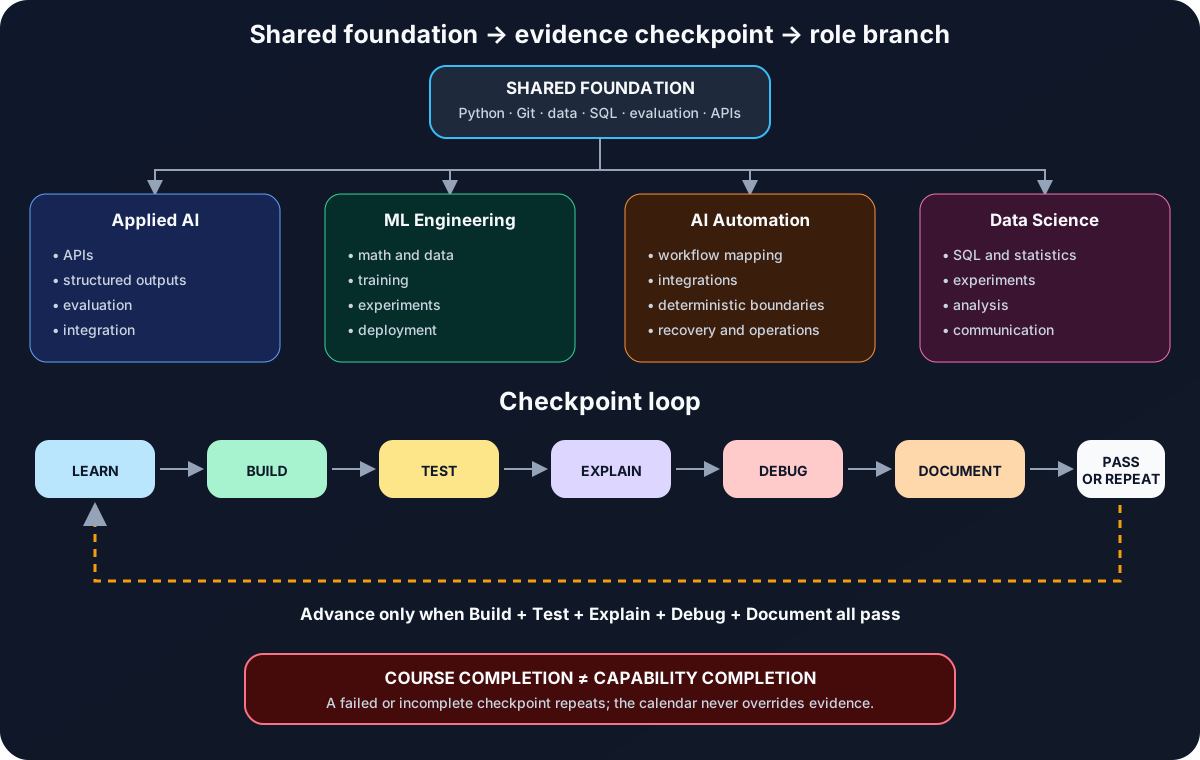
| Path | Later emphasis | Boundary |
|---|---|---|
| Applied AI | APIs, structured outputs, evaluation, integration | Reliable model-backed product behavior, not model research |
| ML Engineering | Math/data, training, experiments, deployment | Deeper model and production-system work |
| AI Automation | Workflow mapping, integrations, deterministic/model boundaries, recovery/operations | Permissions and irreversible actions stay outside model judgment |
| Data Science | SQL/statistics, experiments, analysis, communication | Defensible analysis, not every deployment concern |
Use checkpoints instead of course completion
Each checkpoint names a capability, inspectable artifact, self-test, failure condition, and transition condition. Build means implement without copying line-for-line. Test covers normal, edge, and failure behavior. Explain justifies choices and limits. Debug diagnoses a broken variant. Document provides setup, evidence, and limitations.
Pass only when all five dimensions pass. Any explicit failure makes the checkpoint repeat; an untested or incomplete dimension remains incomplete. Calendar progression never overrides capability progression. The twelve-week layout is sample, adjustable, checkpoint-driven, and repeatable: any checkpoint may take less or more than two weeks.
templates/ai-learning-weekly-scorecard.csvcheckpoint_id,weeks,capability,artifact,build,test,explain,debug,document,status,failure_code,next_action,evidence_reference
CP-01,1-2,programming_and_data,csv_validator,incomplete,incomplete,incomplete,incomplete,incomplete,incomplete,,attempt_without_tutorial,
CP-02,3-4,sql_statistics_evaluation,analysis_report,incomplete,incomplete,incomplete,incomplete,incomplete,incomplete,,complete_cp_01_first,
CP-03,5-6,baseline_ml_workflow,baseline_experiment,incomplete,incomplete,incomplete,incomplete,incomplete,incomplete,,complete_cp_02_first,
CP-04,7-8,api_boundaries,validated_api,incomplete,incomplete,incomplete,incomplete,incomplete,incomplete,,complete_cp_03_first,
CP-05,9-10,ai_application_evaluation,fixed_fixture_eval,incomplete,incomplete,incomplete,incomplete,incomplete,incomplete,,complete_cp_04_first,
CP-06,11-12,project_integration,reproducible_case_study,incomplete,incomplete,incomplete,incomplete,incomplete,incomplete,,complete_cp_05_first,| Dimension | Pass | Failure |
|---|---|---|
| Build | Works from an owned starting point | Depends on tutorial copying |
| Test | Normal, edge, and failure cases repeat | Only happy path observed |
| Explain | Choices, assumptions, limits stated | Terms repeated without artifact reasoning |
| Debug | Broken variant diagnosed from evidence | Random edits replace diagnosis |
| Document | Setup, command, result, limits inspectable | Screenshot or unrepeatable claim only |
Weeks 1–2 — programming and data handling
Use the official Python tutorial as a language reference—it expects basic programming familiarity—then use Python skills for AI engineers for deeper engineering capability. Practice Git snapshots, diffs, and history alongside the code.
Artifact: a command-line CSV validator that checks required columns, reports malformed rows, exits nonzero on invalid input, and writes a deterministic summary. Self-test it from a blank start, add empty-file and wrong-type cases, explain mutation and exceptions, repair a parsing bug, and document the exact command.
Failure: it works only while copying steps, silently accepts bad rows, or cannot be explained. Transition: code, tests, output, and limitations prove all five dimensions pass.
Weeks 3–4 — SQL, statistics, and evaluation
Use the PostgreSQL tutorial for tables, queries, joins, aggregates, and transactions. Artifact: a versioned dataset, SQL analysis, and report containing a baseline, two checks, and one limitation. Self-test a join, reproduce an aggregate, calculate a confusion-matrix metric, and explain why accuracy can mislead on imbalanced labels.
Failure: leakage crosses an evaluation boundary, a join duplicates rows unnoticed, or the conclusion exceeds the data. Transition: rerun from a clean database and pass all five dimensions.
Weeks 5–6 — baseline machine-learning workflow
Define a target, split without leakage, establish a simple baseline, choose a suitable metric, fit one model, inspect errors, and record versions. scikit-learn documents model selection, metrics, and cross-validation; Google’s Machine Learning Crash Course supplies structured concepts and exercises.
Artifact: a reproducible baseline experiment with split rationale, comparison, error slice, and limitations. Failure: no baseline, test data influences selection, or the metric cannot be explained. Transition: reproduce and pass all five dimensions. ML Engineering and Data Science learners deepen math and experiments; Applied AI and Automation learners need the evaluation discipline but not identical training depth here.
Weeks 7–8 — APIs and software boundaries
FastAPI's official request-body guide demonstrates typed models, JSON conversion, validation, and generated schema. Use the backend roadmap for deeper backend progression.
Artifact: a typed API that validates requests, returns a stable response, and distinguishes invalid input from internal failure. Test normal, missing-field, wrong-type, and simulated dependency-failure paths; explain status codes and repair a validation bug.
Failure: malformed input reaches core logic, errors leak secrets, or response shape changes without a test. Transition: all five dimensions pass with local reproduction instructions.
Weeks 9–10 — AI application and evaluation
Artifact: a model-backed or recorded-output feature with a strict structured result, fixed synthetic fixture, deterministic validator, explicit failure, and human-owned review path. The prompt evaluation guide owns deeper methodology.
Reject missing, extra, and wrong-type fields; rerun the same fixture; explain variable model behavior; repair a failure without relabeling it. Permissions, identity, irreversible actions, and hard business rules stay deterministic.
Failure: one polished response replaces evaluation, a fixture moves to hide regression, or model output authorizes side effects. Transition: all dimensions pass and one honest failure remains documented.
Weeks 11–12 — integrate and document one project
Integrate one bounded project. For ideas use the Python project catalogue; this guide owns the checkpoint sequence.
Artifact: a repository with architecture, setup, tests, fixed fixture, exact command and result, failure analysis, privacy/security boundaries, and limitations. Reproduce it cleanly, trace a request, break a dependency, and explain recovery.
Failure: undocumented local state, claims beyond evidence, or screenshots replacing reproducibility. Transition: all dimensions pass. Reaching week twelve without CP-06 passing means repeat it; attendance does not become capability.
Worked example — when a checkpoint must repeat
SYNTHETIC EDUCATIONAL EXAMPLE. These records are not Muhammad Farooq’s learning history, Farooq77 learner/student data, a real learner, a real course result, evidence anyone can learn AI in twelve weeks, a job-readiness benchmark, an employer benchmark, or a hiring outcome. Counts apply only to this six-record fixture.
Fictional learner Sam Rivera repeats CP-01 because the validator depends on tutorial reproduction: Build passes, Test/Explain/Debug fail, and Document is incomplete. CP-03 repeats because its baseline cannot be explained; CP-05 repeats because a failure path is unhandled; CP-06 remains incomplete because test/debug evidence is unfinished.
The analyzer derives and verifies status. It outputs no readiness, employability, job-readiness, hiring-probability, salary, or industry-standard score.
fixtures/synthetic-learning-checkpoints.json{
"notice": "SYNTHETIC EDUCATIONAL EXAMPLE — fixture data only",
"learner": "Sam Rivera — fictional learner",
"dimensions": ["build", "test", "explain", "debug", "document"],
"records": [
{"id":"CP-01","build":"pass","test":"fail","explain":"fail","debug":"fail","document":"incomplete","status":"repeat","failureCode":"tutorial_dependency"},
{"id":"CP-02","build":"pass","test":"pass","explain":"pass","debug":"pass","document":"pass","status":"passed","failureCode":null},
{"id":"CP-03","build":"pass","test":"pass","explain":"fail","debug":"incomplete","document":"pass","status":"repeat","failureCode":"baseline_not_explained"},
{"id":"CP-04","build":"pass","test":"pass","explain":"pass","debug":"pass","document":"pass","status":"passed","failureCode":null},
{"id":"CP-05","build":"pass","test":"pass","explain":"pass","debug":"fail","document":"pass","status":"repeat","failureCode":"failure_path_unhandled"},
{"id":"CP-06","build":"pass","test":"incomplete","explain":"pass","debug":"incomplete","document":"pass","status":"incomplete","failureCode":"integration_evidence_incomplete"}
]
}scripts/analyze-learning-checkpoints.mjsimport assert from 'node:assert/strict';
import fs from 'node:fs';
const fixture = JSON.parse(fs.readFileSync(new URL('../fixtures/synthetic-learning-checkpoints.json', import.meta.url), 'utf8'));
const dimensions = ['build', 'test', 'explain', 'debug', 'document'];
const allowed = new Set(['pass', 'fail', 'incomplete']);
assert.match(fixture.notice, /^SYNTHETIC EDUCATIONAL EXAMPLE/);
assert.deepEqual(fixture.dimensions, dimensions);
assert(Array.isArray(fixture.records) && fixture.records.length > 0);
const ids = new Set();
const derive = (record) => {
for (const dimension of dimensions) assert(allowed.has(record[dimension]), `${record.id}: invalid ${dimension}`);
if (dimensions.every((dimension) => record[dimension] === 'pass')) return 'passed';
if (dimensions.some((dimension) => record[dimension] === 'fail')) return 'repeat';
return 'incomplete';
};
for (const record of fixture.records) {
assert(!ids.has(record.id), `duplicate id: ${record.id}`);
ids.add(record.id);
assert.equal(record.status, derive(record), `${record.id}: status differs from rubric`);
}
const withStatus = (status) => fixture.records.filter((record) => record.status === status);
const tutorialFailures = fixture.records.filter((record) => record.failureCode === 'tutorial_dependency').length;
assert(tutorialFailures > 0, 'required tutorial-dependency failure is missing');
console.log(fixture.notice);
console.log(`records=${fixture.records.length}`);
for (const status of ['passed', 'repeat', 'incomplete']) console.log(`${status}=${withStatus(status).length}`);
console.log(`tutorial_dependency_failures=${tutorialFailures}`);
console.log(`repeat_ids=${withStatus('repeat').map((record) => record.id).join(',')}`);
console.log(`incomplete_ids=${withStatus('incomplete').map((record) => record.id).join(',')}`);
console.log('failed_dimensions');
for (const dimension of dimensions) console.log(`${dimension}=${fixture.records.filter((record) => record[dimension] === 'fail').length}`);
console.log('incomplete_dimensions');
for (const dimension of dimensions) console.log(`${dimension}=${fixture.records.filter((record) => record[dimension] === 'incomplete').length}`);
console.log('transition_rule=advance_only_when_all_dimensions_pass');Expected output
SYNTHETIC EDUCATIONAL EXAMPLE — fixture data only
records=6
passed=2
repeat=3
incomplete=1
tutorial_dependency_failures=1
repeat_ids=CP-01,CP-03,CP-05
incomplete_ids=CP-06
failed_dimensions
build=0
test=1
explain=2
debug=2
document=0
incomplete_dimensions
build=0
test=1
explain=0
debug=2
document=1
transition_rule=advance_only_when_all_dimensions_passChoose resources by purpose
Official references define current behavior; a structured course sequences unfamiliar concepts; practice exposes recall gaps; project evidence integrates the capability. A resource earns its place only when it serves the next checkpoint.
| Resource | Purpose | Stop when |
|---|---|---|
| Official reference | Exact behavior | Question is answered and tested |
| Structured course | Sequence a foundation | Checkpoint can be attempted independently |
| Practice | Fluency and debugging | Failure pattern stops recurring |
| Project evidence | Integration and trade-offs | Checkpoint passes or exposes next gap |
Know when to stop collecting courses
Stop when you start another introduction to avoid a blank editor, copy before attempting, change tools whenever debugging hurts, collect certificates without artifacts, or cannot name the checkpoint served. Return to the weakest dimension: shrink Build, add cases for Test, write plainly for Explain, reproduce a defect for Debug, or have someone follow Document.
Use credentials only when they solve a defined problem
A credential may provide structure or satisfy a named screen, but does not prove all five dimensions. Use the AI certification comparison only when a target role names one or its curriculum closes a specific gap.
Review your evidence before targeting roles
This is an evidence review, not a job-readiness score or guarantee. Check each claim has an artifact, normal/edge/failure tests, decisions, a debugging example, reproducible setup, truthful limits, and your contribution. Compare it with each role's responsibilities and eligibility.
Package truthful evidence with the AI engineer resume guide, use the remote AI job guide for funnel diagnosis, and the AI interview guide for preparation. Passing this plan guarantees none of eligibility, interviews, offers, or workplace performance.
FAQ
Can I learn AI without a computer science degree?
You can build substantial applied capability through self-directed foundations and evidence. Some research, regulated, employer-specific, and immigration contexts still require or prefer degrees, so never assume every AI role accepts non-degree candidates.
Does this plan make someone job-ready in twelve weeks?
No. It is a sample, adjustable, checkpoint-driven, repeatable calendar. Failed checkpoints repeat, and employment depends on role, eligibility, interviews, and market factors.
When should I take another course?
Name the failed dimension first. Use a course only if it closes that gap, then return to the artifact. Course completion alone is not capability completion.
Sources
Primary and authoritative sources reviewed for this article.
- The Python Tutorial
Official tutorial for Python concepts, modules, files, and exceptions; it expects basic programming familiarity and is not comprehensive.
- Git tutorial
Official introduction to importing projects, changes, commits, history, branches, and collaboration.
- PostgreSQL tutorial
Official relational and SQL tutorial covering tables, queries, joins, aggregates, and transactions.
- scikit-learn model selection and evaluation
Official guidance for model selection, metrics, scoring, cross-validation, and evaluation pitfalls.
- Google Machine Learning Crash Course
Official structured foundational machine-learning concepts and exercises.
- FastAPI request body tutorial
Official documentation for typed request models, JSON conversion, validation, and generated API schema.
Conclusion
Choose one target path today, copy the weekly scorecard, and attempt CP-01’s CSV validator without copying a tutorial line-for-line. Record Build, Test, Explain, Debug, and Document honestly; advance only if all five pass.