
Remote Backend Engineer Career Roadmap
A production-minded backend roadmap built around one evolving service: correct APIs, relational integrity, authorization, deployment, asynchronous work, caching, AI integration, and operational documentation.
A credible backend roadmap is not a calendar of frameworks. It is a progression in ownership: first make one service correct, then deploy and recover it, then introduce asynchronous work and caching only when requirements justify them, and finally contain uncertain dependencies such as AI. This roadmap evolves one educational job-application tracking service at every checkpoint. It is not the architecture of Farooq77 Jobs and does not describe private Farooq77 infrastructure.
The reference project: a job-application tracking service
Users own applications; status history, notes, and events make important changes inspectable.
The first version has users, applications, application_status_history, and notes. A user creates an application for a role, reads it, changes its status, and sees an appendable history of status transitions. Authentication establishes the caller's identity. Authorization decides whether that identity may access the requested application.
This small domain exposes decisions that simple CRUD demonstrations often hide: ownership must be enforced on every object lookup, application and history writes may need one transaction, duplicate background delivery must not repeat a side effect, and operational failures must remain visible. Add complexity checkpoint by checkpoint rather than starting with microservices, a queue cluster, or Kubernetes.
A useful portfolio repository includes its API contract, migrations, tests, deployment notes, observability fields, and failure drills. The evidence is not the number of technologies; it is whether another engineer can understand the invariants, operate the service, and evaluate a change.
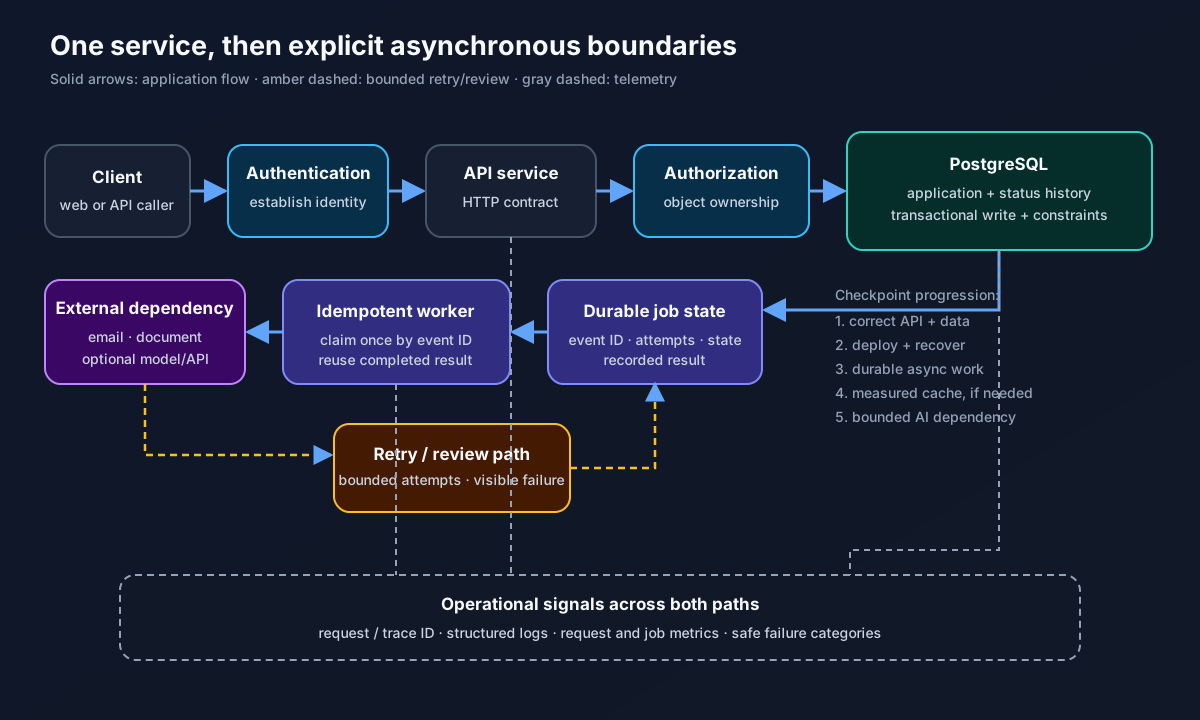
Checkpoint 1 — Make one service correct
Prove HTTP behavior, relational invariants, and object authorization before distributing the system.
Define a small contract: POST /applications creates an owned record, GET /applications/{id} returns an authorized representation, and PATCH /applications/{id}/status appends history while changing the current status. HTTP methods communicate request intent; application-specific status codes and error bodies should be documented consistently rather than improvised per route.
Authentication answers “who are you?” Authorization answers “may this identity perform this action on this resource?” A valid session is not permission to read an arbitrary application ID. One useful acceptance criterion is exact: User A cannot read or mutate User B's application. Test both read and status-change paths, including guessed valid identifiers.
The route excerpt returns the same not-found response when the record is missing or belongs to another user. That is one practical policy for avoiding resource disclosure; different products may require a different documented response policy. The repository query should include owner_id where practical, so authorization is part of data access rather than a forgotten presentation check.
app/routes/applications.pyfrom typing import Annotated
from uuid import UUID
from fastapi import APIRouter, Depends, HTTPException
router = APIRouter()
@router.get("/applications/{application_id}")
def get_application(
application_id: UUID,
current_user: Annotated[User, Depends(get_current_user)],
repository: Annotated[ApplicationRepository, Depends(get_repository)],
) -> ApplicationResponse:
application = repository.find_owned(
application_id=application_id, owner_id=current_user.id
)
if application is None:
raise HTTPException(status_code=404, detail="Application not found")
return ApplicationResponse.model_validate(application)migrations/001_applications.sqlCREATE TABLE users (
id uuid PRIMARY KEY,
email text NOT NULL UNIQUE,
created_at timestamptz NOT NULL DEFAULT now()
);
CREATE TABLE applications (
id uuid PRIMARY KEY,
owner_id uuid NOT NULL REFERENCES users(id),
company text NOT NULL,
role_title text NOT NULL,
status text NOT NULL CHECK (status IN ('draft', 'applied', 'interview', 'offer', 'closed')),
created_at timestamptz NOT NULL DEFAULT now(),
updated_at timestamptz NOT NULL DEFAULT now()
);
CREATE TABLE application_status_history (
id bigint GENERATED ALWAYS AS IDENTITY PRIMARY KEY,
application_id uuid NOT NULL REFERENCES applications(id),
changed_by uuid NOT NULL REFERENCES users(id),
from_status text,
to_status text NOT NULL,
changed_at timestamptz NOT NULL DEFAULT now(),
CHECK (from_status IS NULL OR from_status <> to_status)
);
CREATE INDEX applications_owner_created_idx
ON applications (owner_id, created_at DESC);
CREATE INDEX status_history_application_changed_idx
ON application_status_history (application_id, changed_at);- Store the application change and its status-history row in one transaction so callers do not observe half of the transition.
- Use foreign keys, uniqueness, non-null rules, and status constraints to protect invariants when a code path is wrong.
- Keep history appendable for audit questions; do not present this exact schema as the only valid design.
- Acceptance evidence: contract tests, migration-from-empty test, User-A/User-B authorization tests, and a documented error model.
Checkpoint 2 — Deploy and operate it
Deployment is complete only when configuration, migrations, signals, recovery, and ownership are understood.
Move environment-specific configuration outside source code and keep secrets in the deployment environment or a secret manager. Validate required configuration at startup without printing secret values. A liveness check answers whether the process is running; readiness should fail when the instance cannot safely serve traffic. Decide deliberately whether a temporary database outage should remove an instance from service.
Emit structured logs with a stable request ID, route, safe actor identifier, outcome, and failure category. Track a small set of useful metrics such as request count, error count, duration distribution, database-pool pressure, and background-job states. Trace context can connect API and worker activity; never use telemetry as permission to log application notes, tokens, or other sensitive content.
Treat migration ordering as part of deployment design. Prefer compatibility across the rollout window: expand the schema, deploy code that can use both forms where needed, migrate data, and remove old structures later. This pattern is contextual, not a universal rollback mechanism. Record how backups are restored and verify recovery in a safe environment rather than assuming a backup file is sufficient.
Tips
- Failure drill — migration failure: stop further rollout; inspect the migration and transaction state; do not blindly rerun a destructive step; restore application/schema compatibility where possible; verify integrity; then record impact, decisions, and follow-up work.
- A rollback may mean reverting application code, completing a forward-compatible database repair, or restoring data. Choose only after inspecting what committed.
- Operational evidence: deployment procedure, migration plan, readiness behavior, dashboard or query examples, restoration notes, and one rehearsed failure scenario.
Checkpoint 3 — Add asynchronous work safely
Durable state and idempotency matter more than which queue product carries the message.
After creating an application, suppose the service sends a confirmation notification. The API transaction records an outbox/job row with an event ID; a worker claims it, performs the external side effect, and records completion. Persist attempts, next-attempt time, and the last safe failure category so a restart does not erase work or hide an exhausted job.
Assume duplicate delivery. The handler below reuses a recorded result when a completed call is followed by another call for the same event ID in the same in-memory JobStore. The test proves only that sequential behavior: send() succeeds and its result is stored before the second call begins. It does not prove exactly-once external effects, crash recovery after remote success but before local recording, or safety when workers compete.
A database uniqueness constraint can prevent duplicate event records, and a transaction can make local writes atomic. Neither alone makes a remote send atomic with the local record. A real integration needs durable state and worker coordination, plus a downstream idempotency contract or reconciliation for ambiguous outcomes. Those mechanisms need their own crash and concurrency tests; they are not implemented by this dictionary example.
Classify failures: retry a dependency timeout only under a bounded policy that accounts for whether the effect may already have happened; move exhausted attempts to failed_review; reject invalid input without retry; treat duplicates with recorded completion as an ordinary no-op with the prior result available; and expose dependency outages through job state and operational signals. A dead-letter queue is one implementation option, not a mandatory architecture.
app/jobs.pyfrom dataclasses import dataclass, field
from typing import Callable
@dataclass
class JobStore:
results: dict[str, str] = field(default_factory=dict)
states: dict[str, str] = field(default_factory=dict)
def process_notification(
event_id: str,
store: JobStore,
send: Callable[[], str],
) -> str:
if event_id in store.results:
return store.results[event_id]
store.states[event_id] = "processing"
result = send()
store.results[event_id] = result
store.states[event_id] = "completed"
return resulttests/test_jobs.pyfrom app.jobs import JobStore, process_notification
def test_duplicate_delivery_reuses_recorded_result():
calls = 0
def send() -> str:
nonlocal calls
calls += 1
return "notification-42"
store = JobStore()
first = process_notification("application-created-7", store, send)
second = process_notification("application-created-7", store, send)
assert first == second == "notification-42"
assert calls == 1
assert store.states["application-created-7"] == "completed"| Condition | Worker decision | Durable evidence |
|---|---|---|
| Retryable failure | Record failure and schedule a bounded later attempt | attempt count, next attempt, safe error category |
| Exhausted retry | Stop automatic attempts and enter failed_review | final state and operator-visible reason |
| Invalid input | Reject without retry | invalid state and validation category |
| Duplicate event with recorded completion | Return the recorded result; skip the side effect | unique event ID and prior result |
| Dependency outage | Apply timeout and bounded retry policy | dependency signal plus affected job states |
Checkpoint 4 — Add caching only for a measured need
Do not add Redis or another cache merely because production systems sometimes contain one.
Consider a dashboard summary per user: counts grouped by application status. First inspect the query plan and request pattern. Add an index or improve the query when that addresses the measured issue. If repeated reads still impose a relevant cost, a cache may be justified—but it introduces stale data, expiry, invalidation, and outage behavior that must be owned.
Define the cache key by user and response version, choose an expiry tied to acceptable staleness, and invalidate or refresh after an application status transaction commits. Decide whether cache failure falls back to PostgreSQL or fails the request. Compare the same query and user-visible correctness before and after; do not invent benchmark numbers or call a cache an automatic scalability improvement.
| Question | Evidence | Decision consequence |
|---|---|---|
| Is the read actually a bottleneck? | Request pattern, query plan, database and service signals | If not, keep the direct query |
| Can the query/index be improved first? | Measured plan and representative data shape | Prefer the simpler ownership model when sufficient |
| How stale may the summary be? | Product requirement stated explicitly | Defines expiry and refresh behavior |
| What invalidates it? | Create/status-change transaction boundaries | Invalidate only after successful commit |
| What if cache is unavailable? | Documented fallback and load implications | Test degraded behavior before rollout |
Checkpoint 5 — Integrate an uncertain AI dependency
Add AI after the deterministic application state and failure paths already work.
A bounded final-stage use case is an optional summary or classification of an application note. Store the authorized request as background work if provider latency warrants it, cap input size, and send only the data the feature needs. Validate the response before storing it, retain provider timeout/failure categories, and route invalid or uncertain results to review.
The AI result is advisory data. It must not bypass object authorization, mutate status history without deterministic rules, or corrupt the application when the provider is unavailable. The core application remains usable while the AI job is pending, failed, or under review. Version the processing configuration needed to interpret a stored result.
For strict Python models, provider boundaries, unit-test mechanics, and model evaluation, continue with Python Skills Every AI Engineer Needs. This roadmap stays focused on service ownership and failure containment.
- Bound and authorize the input before creating the AI job.
- Use explicit provider timeouts and visible dependency-failure states.
- Validate output and preserve validation problems instead of silently repairing them.
- Keep deterministic application rules outside the model response.
- Provide a human-review or safe fallback path where the feature requires one.
Prove remote engineering behavior
Concrete written artifacts reduce ambiguity more convincingly than saying you communicate well.
These are useful formats, not claims that every team uses the same templates. Keep each document proportional to the decision or incident and link it to code, migrations, dashboards, or tests where those provide evidence.
Translate the strongest artifacts into outcome-and-evidence bullets using the AI engineer resume guide. For interview practice, the backend-relevant AI interview questions can help you explain trade-offs without turning this roadmap into an interview guide.
| Artifact | Useful fields |
|---|---|
| Design note | Problem; constraints; proposed change; alternatives; risks; rollout; rollback |
| Async status update | Completed; next; blocked; decision needed |
| Runbook | Symptom; first checks; dependency checks; safe recovery action; escalation condition |
| Incident summary | Impact; timeline; cause; contributing factors; recovery; prevention/action items |
Readiness matrix by responsibility
Advance when you can produce evidence and explain failure—not when you have merely installed a tool.
| Responsibility | Evidence you can produce | Failure you can explain | What not to add prematurely |
|---|---|---|---|
| API contract | Documented routes, errors, and contract tests | Invalid input or incompatible client behavior | Extra framework layers |
| Database integrity | Constraints, migration test, transaction boundary | Partial write or constraint violation | Multiple databases |
| Authorization | User-A/User-B read and mutation tests | Guessed object ID and missing ownership check | Complex role hierarchy without requirements |
| Deployment and migrations | Repeatable rollout, readiness, failure drill | Partially applied migration | Kubernetes as an entry requirement |
| Background work | Durable states and bounded retry policy | Restart, outage, or exhausted retry | Extra queue services without a slow task |
| Idempotency | Completed-result reuse test; documented recovery boundaries | Remote success before local recording; competing workers | Claims of universal exactly-once delivery |
| Observability | Request correlation, safe logs, core metrics | API-to-worker failure investigation | High-cardinality or sensitive fields |
| Caching | Measured read pattern and invalidation test | Stale result or cache outage | Redis before evidence |
| AI integration | Bounded job, validated result, review path | Timeout, invalid output, provider outage | AI control of authorization or core state |
| Operational documentation | Design note, status update, runbook, incident summary | Ambiguous ownership during recovery | Long documents without decisions |
What to learn next—and what to defer
Deepen the consequence you can own before widening the technology list.
Build the application tracker in order. At checkpoint one, demonstrate object authorization and transactional status history. At checkpoint two, deploy it and rehearse a migration failure. At checkpoint three, demonstrate completed-result reuse and document the remaining crash and concurrency risks. Only then investigate a measured cache need or add the optional AI job.
Defer microservice decomposition until boundaries or independent operational needs justify it. Defer Kubernetes until the target environment or deployment problem calls for its orchestration model. Defer a dedicated cache or queue provider until the simpler database-backed design cannot meet a stated requirement. These tools can be valuable; they are not universal entry requirements.
When comparing roles or locations, use the remote software engineering salary guide as separate market context. For presenting the complete evidence set, review the author's current focus on the About page.
Examples
- Next action: write the User-A/User-B authorization test before adding the first background worker.
- Operational next action: create a one-page migration-failure drill and identify which evidence confirms database integrity.
- Architecture next action: record one design note explaining why a durable PostgreSQL job table is sufficient—or why measured requirements justify something else.
FAQ
Which backend language should I learn?
Choose a language relevant to the roles you are targeting and use it deeply enough to build, test, deploy, and diagnose one service. The ownership progression in this roadmap applies beyond the illustrative FastAPI stack.
Do I need Kubernetes for a remote backend role?
Not universally. First understand deployment, process and network behavior, configuration, health checks, observability, and recovery. Learn Kubernetes when a target environment or concrete orchestration problem makes it relevant.
Should I start with microservices?
A dependable single service usually exposes enough API, database, authorization, migration, and operational decisions for early evidence. Split services only when understood boundaries or independent requirements justify the added coordination and failure modes.
How do I prove remote engineering readiness?
Show scoped delivery plus inspectable design notes, status updates, authorization and failure tests, deployment instructions, a recovery runbook, and an honest incident or failure-drill summary.
Sources
Primary and authoritative sources reviewed for this article.
- RFC 9110: HTTP Semantics
IETF standard defining HTTP resource, method, and request semantics discussed in the API-contract checkpoint.
- FastAPI: Get Current User
Official documentation for injecting an authenticated current-user dependency at an HTTP boundary.
- PostgreSQL: Constraints
Official documentation for primary keys, foreign keys, uniqueness, non-null, and check constraints.
- PostgreSQL: Transactions
Official explanation of grouping multiple database steps into an all-or-nothing operation.
- OWASP API1:2023 Broken Object Level Authorization
Primary API-security guidance supporting per-object authorization checks on endpoints that accept object identifiers.
- OpenTelemetry signals
Official overview of traces, metrics, logs, and the different operational questions they support.
- OpenTelemetry context propagation
Official explanation of correlating signals across service and worker boundaries.
- Amazon Builders' Library: Making retries safe with idempotent APIs
AWS engineering guidance on ambiguous remote outcomes, reconciliation, caller-provided request identifiers, and atomic recording of an idempotency token with the effects it protects.
Conclusion
Backend credibility grows with the consequences you can own. Make one service correct, prove its authorization and data invariants, deploy and recover it, then introduce asynchronous work, caching, and AI only behind explicit requirements and visible failure states. The next concrete step is not another tool: it is the missing acceptance test, migration drill, or runbook for your current checkpoint.