
How to Get a Remote AI Job in 2026
Run a measurable remote AI job search with eligibility gates, proof-of-work matching, a portable tracker, funnel diagnostics, and a practical 30/60/90-day plan.
A remote AI job search becomes manageable when you treat it as an operating system rather than a motivation contest. Each role passes through the same gates: discover it, verify eligibility, match evidence, apply, record the outcome, and change one controllable part of the process when the funnel stalls. This guide gives you the artifacts and a fixed synthetic example needed to run that loop. It does not promise a job or present the example metrics as employer benchmarks.
The remote AI job-search operating system
One record, explicit gates, and a next action
Start one tracker row when you discover a plausible role. Do not count a listing as an opportunity until you have checked the official application destination and hard eligibility constraints. If it passes, map the role's core work to evidence you can show. Then decide whether to strengthen evidence, submit, follow up, prepare for a stage, or close the row.
The diagram is deliberately a loop. An outcome is useful only when it changes a future action: tighter discovery filters, a clearer proof package, a stronger application, or focused interview practice. Keep observation separate from explanation. A rejection is an observation; its cause is usually unknown unless the employer tells you.
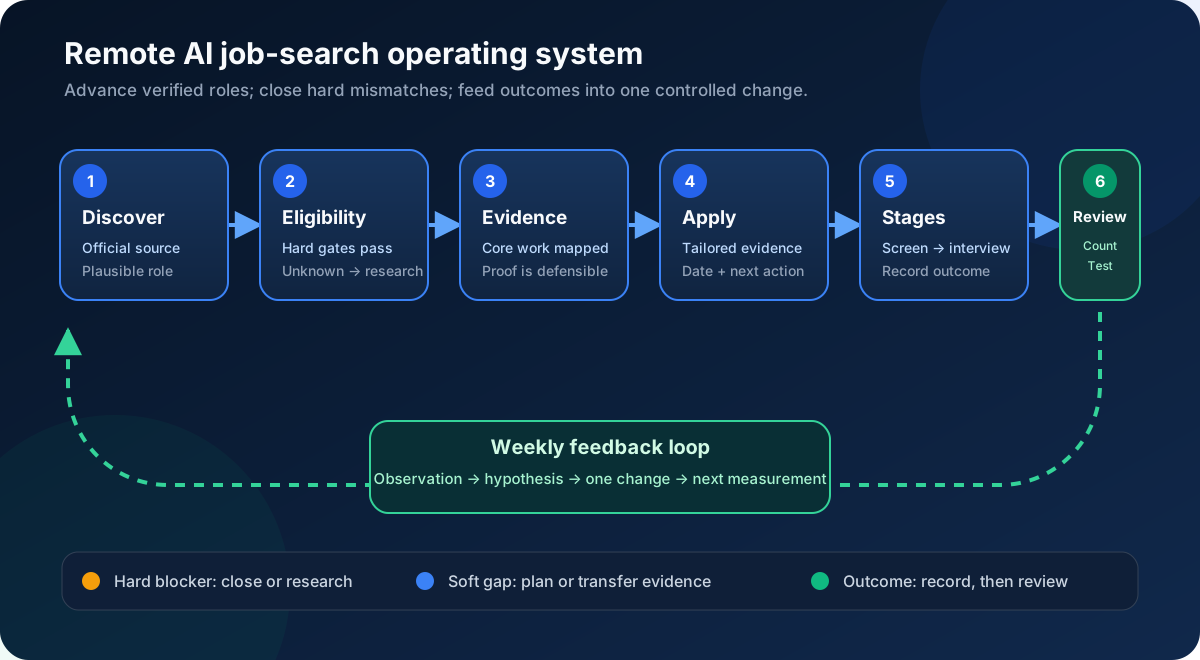
- Discovery asks whether the role is plausible and the listing is verifiable.
- Eligibility separates non-negotiable constraints from preferences and learnable gaps.
- Evidence matching connects the job's work to inspectable proof rather than keyword claims.
- Applications and stages always have an owner, date, status, and next action.
- Review converts counts into hypotheses, then tests one process change at a time.
Gate one — verify eligibility before tailoring
Hard constraints stop the application; soft fit shapes the plan
Remote describes a work arrangement, not universal hiring access. A listing can still restrict country, state, time zone, payroll entity, work authorization, security clearance, travel, or employment type. Treat explicit restrictions as facts. When the text is ambiguous, mark the row research rather than silently assuming eligibility.
Hard constraints include explicit location or authorization rules, required clearance, mandatory professional licensing, and a non-negotiable employment arrangement you cannot accept. Soft fit includes preferred tools, domain familiarity, an approximate experience range, or a secondary skill that can be learned. A stretch application can be rational when the gap is soft and the core work matches; it is not rational when a hard gate fails.
When a listing or offer includes pay, use the remote software engineering salary guide to interpret base pay, contract structure, geography, and total compensation without treating a headline range as a guarantee.
checklists/remote-ai-role-eligibility.md# Remote AI role eligibility check
Role: <company — title>
Official URL: <url>
Checked on: <YYYY-MM-DD>
Decision: eligible | ineligible | research
## Hard constraints — every applicable answer must pass
- [ ] The company can hire in my country/state. Evidence: <listing text or official policy>
- [ ] I satisfy the stated work-authorization or sponsorship rule. Evidence: <text>
- [ ] I can meet required time-zone overlap and travel. Evidence: <text>
- [ ] I accept the stated employment type: employee, contractor, or project work.
- [ ] I hold any explicitly mandatory clearance, license, degree, or certification.
- [ ] The role's seniority and core responsibility are plausible for my background.
## Soft fit — gaps may become a plan, not an automatic rejection
- [ ] I can demonstrate at least two core responsibilities.
- [ ] Missing tools are secondary or transferable from tools I have used.
- [ ] I understand the product/domain well enough to explain why my evidence transfers.
- [ ] Compensation and schedule are worth clarifying if not stated.
## Decision note
Hard blocker or unanswered question: <none or exact item>
Evidence to attach: <project, case study, writing, or work sample>
Next action and date: <action — YYYY-MM-DD>Tips
- Quote the relevant listing text so your decision remains auditable after the listing closes.
- Use research only for a real unanswered constraint, and assign a next action.
- Check the company's official careers page before spending time on tailoring.
Gate two — match proof of work to the role
Choose evidence before rewriting the resume
Extract the three responsibilities most central to the role. For each one, point to a project, production result, technical note, or work sample that a reviewer could inspect or that you could defend in detail. A strong match uses the same kind of decision: evaluating an LLM feature, operating an API, building a data pipeline, handling failure, or communicating an asynchronous technical decision.
Use the dedicated AI engineer resume guide for evidence-led bullets, the Python readiness guide for production boundaries, and the backend roadmap when the target work is service-heavy. This article coordinates those assets; it does not repeat their curricula.
| Match | Meaning | Action |
|---|---|---|
| Strong | Two or more core responsibilities map to inspectable, defensible work. | Tailor the top of the resume and submit. |
| Moderate | Core work transfers, but the domain, scale, or one central responsibility differs. | Write the transfer argument; apply if hard gates pass. |
| Weak | Evidence shows tools or coursework but not the role's core decisions. | Build or improve one proof artifact before applying. |
| None | No credible evidence for the central work. | Close or defer the role; do not invent claims. |
- Write one sentence per core responsibility: requirement → evidence → limitation.
- Prefer a complete small system with setup, evaluation, failure handling, and limitations over many screenshots.
- Prepare a two-minute explanation covering the problem, constraints, decisions, validation, failure modes, and next improvement.
- Remove private data, secrets, copied tutorial claims, and metrics you cannot reproduce.
Use one portable application tracker
A row is useful only when it preserves a decision and a next action
The tracker below works in a spreadsheet, a database import, or a plain-text repository. Keep controlled values for eligibility, evidence match, and stage so counts remain comparable. Add prose only in reason and notes fields. The first row is a clearly fictional example; replace it rather than treating it as a real lead.
For discovery channels, compare the dedicated remote AI job websites guide and remote AI companies guide. Record the source, but verify the role on the employer's official domain.
templates/remote-ai-application-tracker.csvid,company,role,source,official_role_url,date_found,eligibility,eligibility_reason,evidence_match,application_date,stage,furthest_stage,response_received,last_activity,next_action,next_action_due,rejection_or_block_reason,notes
example-001,Example Robotics,Applied AI Engineer,company_page,https://example.com/jobs/example-001,2026-08-27,research,Confirm hiring countries,moderate,,discovered,discovered,false,2026-08-27,Check official location policy,2026-08-28,,FICTIONAL PLACEHOLDER — replace this rowTips
- Use ISO dates (YYYY-MM-DD) so sorting and overdue checks are predictable.
- Keep one canonical row per role; update its stage instead of duplicating it.
- Close rows explicitly when the listing disappears, eligibility fails, you withdraw, or a decision arrives.
- Never put passwords, identity documents, bank details, or confidential interview material in the tracker.
A fixed synthetic funnel for practice
The records are educational fixtures, not provider or employer results
The following 12 records are entirely synthetic and use fictional company names. Their dates, outcomes, eligibility decisions, and blockers were authored to exercise the analyzer. They are not observations of any real candidate, company, job board, hiring market, or provider benchmark.
The fixture keeps the analysis reproducible: anyone running the analyzer against the unchanged JSON should obtain the same output. Its as_of date freezes stale-action calculations so the example will not drift over time.
fixtures/synthetic-application-funnel.json{
"fixture": "synthetic educational example — not real hiring data",
"as_of": "2026-08-27",
"records": [
{"id":"case-01","company":"Example Vision Labs","role":"Applied AI Engineer","eligibility":"ineligible","evidence_match":"strong","application_date":null,"stage":"screened_out","furthest_stage":"discovered","response_received":false,"next_action_due":null,"blocker":"geography"},
{"id":"case-02","company":"Sample Health AI","role":"ML Platform Engineer","eligibility":"ineligible","evidence_match":"moderate","application_date":null,"stage":"screened_out","furthest_stage":"discovered","response_received":false,"next_action_due":null,"blocker":"work_authorization"},
{"id":"case-03","company":"Demo Clinical Systems","role":"Clinical AI Specialist","eligibility":"ineligible","evidence_match":"weak","application_date":null,"stage":"screened_out","furthest_stage":"discovered","response_received":false,"next_action_due":null,"blocker":"mandatory_qualification"},
{"id":"case-04","company":"Example Robotics","role":"AI Product Engineer","eligibility":"eligible","evidence_match":"strong","application_date":null,"stage":"ready_to_apply","furthest_stage":"ready_to_apply","response_received":false,"next_action_due":"2026-08-28","blocker":null},
{"id":"case-05","company":"Sample Data Works","role":"LLM Evaluation Engineer","eligibility":"eligible","evidence_match":"weak","application_date":null,"stage":"ready_to_apply","furthest_stage":"ready_to_apply","response_received":false,"next_action_due":"2026-08-25","blocker":"evidence_gap"},
{"id":"case-06","company":"Demo Automation Co","role":"AI Automation Engineer","eligibility":"eligible","evidence_match":"strong","application_date":"2026-08-14","stage":"applied","furthest_stage":"applied","response_received":false,"next_action_due":"2026-08-24","blocker":"no_response"},
{"id":"case-07","company":"Example Search Tools","role":"Backend Engineer — AI","eligibility":"eligible","evidence_match":"moderate","application_date":"2026-08-20","stage":"applied","furthest_stage":"applied","response_received":false,"next_action_due":"2026-08-29","blocker":"no_response"},
{"id":"case-08","company":"Sample Agents Inc","role":"AI Solutions Engineer","eligibility":"eligible","evidence_match":"moderate","application_date":"2026-08-12","stage":"recruiter_reply","furthest_stage":"recruiter_reply","response_received":true,"next_action_due":"2026-08-30","blocker":null},
{"id":"case-09","company":"Demo Model Ops","role":"MLOps Engineer","eligibility":"eligible","evidence_match":"strong","application_date":"2026-08-08","stage":"interview","furthest_stage":"interview","response_received":true,"next_action_due":"2026-08-31","blocker":null},
{"id":"case-10","company":"Example Knowledge Systems","role":"RAG Engineer","eligibility":"eligible","evidence_match":"strong","application_date":"2026-08-05","stage":"assessment","furthest_stage":"assessment","response_received":true,"next_action_due":"2026-09-01","blocker":null},
{"id":"case-11","company":"Sample Reliability AI","role":"AI Backend Engineer","eligibility":"eligible","evidence_match":"strong","application_date":"2026-07-29","stage":"rejected","furthest_stage":"interview","response_received":true,"next_action_due":null,"blocker":"interview_stage_rejection"},
{"id":"case-12","company":"Demo Research Tools","role":"AI Research Engineer","eligibility":"eligible","evidence_match":"moderate","application_date":"2026-08-01","stage":"rejected","furthest_stage":"screening","response_received":true,"next_action_due":null,"blocker":"screening_mismatch"}
]
}Run the dependency-free funnel analyzer
Count observable states before proposing causes
Save the fixture and script at the displayed relative filenames, then run node scripts/analyze-job-search-funnel.mjs. The script uses only Node built-ins. It validates the fixture marker, uses the frozen as_of date, derives counts from fields rather than embedded totals, and sorts blocker labels for stable output.
Definitions matter. Applied means application_date is present. A recruiter response is the fixture's explicit response_received value. Interview or assessment activity uses furthest_stage, so a later rejection does not erase a stage already reached. A stale action is an active row whose next_action_due is earlier than as_of.
scripts/analyze-job-search-funnel.mjsimport { readFileSync } from "node:fs";
const fixtureUrl = process.argv[2]
? new URL(process.argv[2], `file://${process.cwd()}/`)
: new URL("../fixtures/synthetic-application-funnel.json", import.meta.url);
const data = JSON.parse(readFileSync(fixtureUrl, "utf8"));
if (data.fixture !== "synthetic educational example — not real hiring data") {
throw new Error("Refusing to analyze an unlabeled fixture.");
}
if (!Array.isArray(data.records) || data.records.length === 0) {
throw new Error("Fixture records must be a non-empty array.");
}
const activeStages = new Set(["ready_to_apply", "applied", "recruiter_reply", "interview", "assessment"]);
const activityStages = new Set(["interview", "assessment"]);
const decisionStages = new Set(["offer", "rejected", "withdrawn"]);
const asOf = Date.parse(`${data.as_of}T00:00:00Z`);
const count = (predicate) => data.records.filter(predicate).length;
const metrics = {
records: data.records.length,
discovered: data.records.length,
screened_out: count((row) => row.stage === "screened_out"),
eligible: count((row) => row.eligibility === "eligible"),
ready_to_apply: count((row) => row.stage === "ready_to_apply"),
applied: count((row) => row.application_date !== null),
recruiter_responses: count((row) => row.response_received === true),
interview_or_assessment: count((row) => activityStages.has(row.furthest_stage)),
decisions: count((row) => decisionStages.has(row.stage)),
stale_next_actions: count((row) => activeStages.has(row.stage) && row.next_action_due !== null && Date.parse(`${row.next_action_due}T00:00:00Z`) < asOf),
};
const blockers = new Map();
for (const row of data.records) {
if (row.blocker) blockers.set(row.blocker, (blockers.get(row.blocker) ?? 0) + 1);
}
const locationOrAuthorization = count((row) => row.blocker === "geography" || row.blocker === "work_authorization");
const lines = [
"SYNTHETIC EDUCATIONAL EXAMPLE — fixture metrics only",
...Object.entries(metrics).map(([key, value]) => `${key}=${value}`),
"blockers",
...[...blockers.entries()].sort(([left], [right]) => left.localeCompare(right)).map(([key, value]) => `${key}=${value}`),
`diagnosis screened_out=${metrics.screened_out}/${metrics.discovered}; location_or_authorization=${locationOrAuthorization}/${metrics.discovered}; stale=${metrics.stale_next_actions}`,
];
console.log(lines.join("\n"));Expected output
SYNTHETIC EDUCATIONAL EXAMPLE — fixture metrics only
records=12
discovered=12
screened_out=3
eligible=9
ready_to_apply=2
applied=7
recruiter_responses=5
interview_or_assessment=3
decisions=2
stale_next_actions=2
blockers
evidence_gap=1
geography=1
interview_stage_rejection=1
mandatory_qualification=1
no_response=2
screening_mismatch=1
work_authorization=1
diagnosis screened_out=3/12; location_or_authorization=2/12; stale=2
Tips
- Keep raw records; totals without rows cannot be audited or reclassified.
- Do not compare your rates with this authored fixture. Compare your own definitions consistently.
- Small samples are noisy. Use counts to choose what to inspect, not to declare universal conversion rates.
Worked diagnosis — change discovery first
The example supports a hypothesis, not a causal verdict
In the synthetic output, 3 of 12 discovered roles are screened out before application. Two of those failures are explicit geography or work-authorization blockers. This is the clearest early leak in the authored fixture because it consumes discovery and review effort before evidence or application quality can matter.
A reasonable hypothesis is that saved searches admit too many roles outside the fictional candidate's hiring geography. That is not proof of cause: twelve authored records cannot establish why a real search performs poorly, and the mandatory-qualification failure has a different explanation. The controlled change is to add eligible-country, payroll-region, and authorization terms to one saved search while leaving the resume and proof package unchanged.
For the next batch, observe the count and share of newly discovered roles that pass hard eligibility, plus every screen-out reason. If geography and authorization failures fall without collapsing the supply of plausible roles, keep the filter. If they do not, inspect source mix and query syntax. Separately, clear the two stale next actions; operational delay is visible but does not explain the earlier eligibility loss.
| Item | Worked example |
|---|---|
| Observed | 3/12 roles screened out; 2/12 blocked by geography or authorization; 2 active next actions stale. |
| Hypothesis | Discovery filters may be admitting avoidable location and authorization mismatches. |
| Change one thing | Tighten one saved search with explicit eligible-region and authorization terms; keep evidence and resume unchanged. |
| Observe next | Eligibility-pass count and blocker mix in the next batch, alongside total plausible roles found. |
| Do not claim | That the filter caused a hiring outcome, that a rejection proves a resume defect, or that fixture ratios are benchmarks. |
Use a stage-specific decision table
Diagnose the earliest repeated loss you can influence
Review at a fixed weekly time. Start with overdue actions, then inspect the earliest stage with a repeated loss. A pattern becomes a hypothesis only after definitions and tracking are consistent. Change one lever for the next batch so the result remains interpretable.
| Stage | Observable signal | Plausible hypotheses | Controlled next change | Observe next |
|---|---|---|---|---|
| Discovery | Few plausible roles or repeated irrelevant listings | Role family too broad; weak source mix; query misses adjacent titles | Revise one saved search or add one verified source | Plausible roles found and source contribution |
| Eligibility | Many hard-constraint screen-outs | Geography, authorization, travel, or contract filters are loose | Add one explicit hard-gate filter | Eligibility-pass count and blocker mix |
| Evidence | Eligible roles repeatedly receive weak evidence matches | Target is ahead of current proof; portfolio shows tools but not decisions | Build one missing proof artifact or narrow one role family | Strong/moderate evidence matches in new eligible roles |
| Application | Ready rows age without submission | Tailoring workflow is too large; completion rule is unclear | Use a time-boxed evidence map and submission checklist | Ready-to-apply age and completed submissions |
| Screening | Applications receive few verified human responses | Positioning, core evidence, seniority, or eligibility interpretation may be weak | Rewrite only the headline and first evidence bullets for one role family | Response counts from comparable applications |
| Interview | Screens progress but technical stages repeat the same weakness | Examples lack depth; trade-offs or debugging explanation are unclear | Practice that gap with the AI interview frameworks | Stage feedback and quality of recorded practice |
| Operations | Next actions become overdue or records lack decisions | Too many active roles; unclear review cadence or ownership | Cap active work and clear stale actions at a weekly review | Stale-action count and rows without a next action |
Run a weekly operating cadence
Separate sourcing, deep work, submission, and review
Batch similar work to reduce context switching. Use one session for discovery and eligibility, two for proof or technical preparation, one for tailored submissions, and one short review. Exact days matter less than protected focus and closing every session with tracker updates.
Volume is a capacity decision, not a virtue. Set a weekly application range only after estimating the time required for verification and evidence mapping. If quality falls, reduce work in progress rather than hiding unfinished rows.
- Discovery: verify sources, open official listings, and run the hard-gate checklist.
- Evidence: improve the proof item attached to the highest-priority eligible role.
- Application: tailor from a role-family resume, submit through the verified destination, and record the date.
- Preparation: rehearse one architecture, debugging, evaluation, and remote-collaboration story.
- Review: clear stale actions, count stages, inspect blockers, write one hypothesis, and choose one change.
Common Mistakes
- Counting saved listings as applications or applications as qualified opportunities.
- Changing search, resume, portfolio, and outreach together, then guessing which helped.
- Using silence or rejection as proof of a specific defect when no feedback was provided.
- Sourcing new roles while overdue follow-ups and interview preparation accumulate.
Protect trust and personal data
Verify before applying, interviewing, paying, or sharing
A familiar company name, logo, or job-board page is not sufficient verification. Open the employer's official domain independently, locate the role or careers contact, compare the recruiter address with that domain, and confirm that interview steps and documents are consistent with the official process. Store the official URL in the tracker.
The U.S. Federal Trade Commission warns that honest employers do not ask candidates to pay to obtain a job. It also warns against depositing an employer-supplied check and sending money onward. Do not send bank details, identity documents, tax identifiers, or other sensitive data merely because an unsolicited message claims urgency. Legitimate onboarding may eventually require private information, but verify the employer, offer, recipient, and secure channel first.
- Stop if someone asks for payment, gift cards, cryptocurrency, equipment reimbursement, or money forwarding as a condition of work.
- Treat personal-email recruiters, messaging-only interviews, instant offers, and pressure as signals to verify—not automatic proof either way.
- Search the company or recruiter's name with scam, review, or complaint, then verify through an independently found official channel.
- Report suspected fraud to the platform and relevant authority; U.S. users can use ReportFraud.ftc.gov.
A measurable 30/60/90-day plan
Deliverables and review loops, not employment promises
Choose targets that you control: completed eligibility checks, inspectable proof, verified applications, practice sessions, and review notes. Recruiter decisions and hiring timelines are outside your control. The plan builds a better search system; it does not guarantee interviews, offers, income, or a particular completion date.
| Period | Build | Operate | Review evidence |
|---|---|---|---|
| Days 1–30 | Select one primary and one adjacent role family; finish one proof package; create tracker, checklist, resume variant, and four verified searches. | Screen at least 20 plausible listings with the hard-gate checklist; record every blocker; submit only when evidence is moderate or strong. | One baseline funnel snapshot, blocker counts, proof gaps, stale actions, and one written hypothesis. |
| Days 31–60 | Improve the proof package from observed role gaps; prepare four technical stories and two asynchronous collaboration examples. | Continue a capacity-based weekly application range; run two recorded practices per week; keep every active row assigned a next action. | Compare consistent stage counts with the baseline; choose one discovery, evidence, application, or preparation change. |
| Days 61–90 | Publish a concise case study or technical note; remove weak materials; document repeatable tailoring and interview-prep checklists. | Maintain verified sourcing, applications, follow-ups, and practice without exceeding capacity. | Audit 90 days, label unknown causes honestly, keep effective controls, and define the next 30-day experiment. |
Tips
- A completed deliverable is inspectable: a file, URL, recorded practice, tracker row, or review note.
- If the market supplies fewer eligible roles than a target assumes, record that instead of padding counts with mismatches.
- If personal capacity changes, reduce volume while keeping eligibility, evidence, and trust gates intact.
FAQ
Should I apply when I miss some requirements?
Apply when hard constraints pass, missing items are secondary, and you can map the core work to credible evidence. Do not ignore explicit geography, authorization, clearance, licensing, or employment-type restrictions.
How many remote AI jobs should I apply to each week?
Use a capacity-based range after measuring verification, evidence matching, tailoring, and follow-up time. There is no universal number. A smaller set of eligible, evidenced applications produces cleaner diagnostic data than known mismatches.
Does no recruiter response mean my resume is bad?
No. Silence is an observed outcome, not a known cause. Possibilities include positioning, eligibility, competition, timing, an internal candidate, a paused role, or tracking error. Review comparable applications and test one change.
Can I use the synthetic funnel ratios as hiring benchmarks?
No. Every fixture record and outcome was authored for this educational example. Use the files to learn and validate the analyzer, then measure your own consistently defined records.
Where should I find remote AI roles?
Use official company career pages and compare channels in the job-websites guide. You can also review Farooq77 job listings, then independently verify the employer source.
Sources
Primary and authoritative sources reviewed for this article.
- LinkedIn Help: Find remote jobs
Official instructions reviewed for remote search filters, matching, and alerts.
- YC Work at a Startup: Remote jobs
Official remote startup job board; each listing still requires an eligibility check.
- FTC Consumer Advice: Job Scams
Authoritative guidance reviewed for payment, fake-check, identity-data, verification, and reporting warnings.
Conclusion
A durable remote AI search is a controlled loop: verify hard eligibility, attach defensible proof, record the next action, and diagnose the earliest repeated loss without pretending correlation is causation. The included tracker, checklist, synthetic fixture, and executable analyzer make that process inspectable. Keep the gates strict, the experiments small, and the claims honest.