
How to Build an AI Engineer Resume
Build a truthful AI engineer resume by extracting role requirements, mapping real evidence, writing defensible bullets, and running deterministic integrity checks.
An AI engineer resume is not a keyword inventory. It is a compact evidence interface connecting one target role's requirements to work you can truthfully explain and, where possible, let a reviewer inspect. The workflow in this guide starts with requirements and a master evidence record, not polished wording. It uses one fixed synthetic role and candidate throughout; none of the example data is Muhammad Farooq's resume, Farooq77 hiring data, or evidence of recruiter preference.
An AI engineer resume is an evidence interface
Connect role requirements to verifiable candidate evidence
A strong claim tells a reviewer what you built or did, which responsibility you owned, which implementation or constraint mattered, what result or behavior is actually known, and where the support lives. It also leaves unknown outcomes unknown. A technically specific behavior—such as validating a response schema or testing retry handling—is more credible than an invented improvement percentage.
Tailoring means selecting and prioritizing truthful evidence for a target role. It can change the summary emphasis, skill order, project selection, and bullet order. It cannot create a technology, responsibility, result, or eligibility fact that does not exist in the master record.
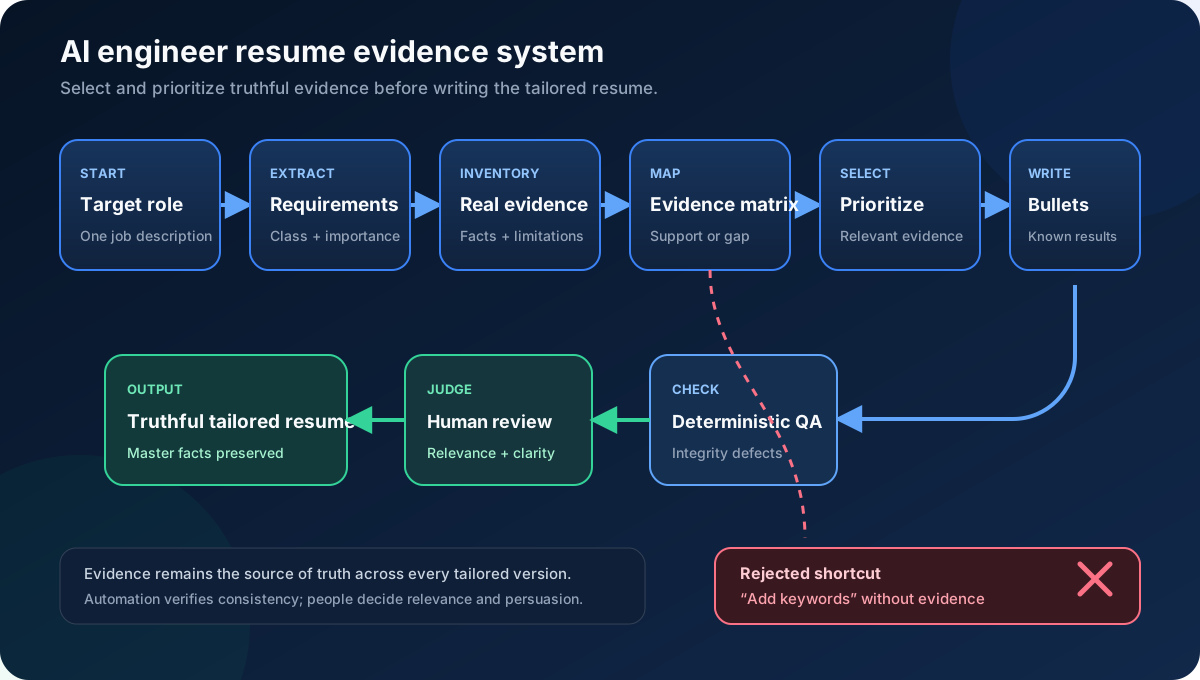
- Target one role family closely enough that relevance can be evaluated.
- Keep a master evidence inventory separate from any tailored resume.
- Map evidence before writing or reordering bullets.
- Run deterministic integrity checks, then perform human judgment the script cannot supply.
- Preserve every truthful original fact when creating a role-specific version.
Extract the requirements that actually matter
Classify one job description before assigning resume space
Read one target description and turn each meaningful statement into a requirement record. Classify it as a core responsibility, required technical skill, preferred technical skill, domain expectation, systems or operations expectation, collaboration expectation, or explicit eligibility constraint. Then assign importance based on the role's central work—not the number of times a word appears.
Hard location, authorization, clearance, travel, licensing, and employment constraints belong primarily to job-selection logic. The remote AI job-search guide owns that eligibility funnel. Resume wording must never conceal or pretend to solve an explicit constraint.
The fixed example below is a SYNTHETIC EDUCATIONAL EXAMPLE. It is not a real vacancy, Farooq77 opening, real employer requirement set, market-demand claim, or benchmark job description.
examples/synthetic-applied-ai-role.json{
"fixture": "SYNTHETIC EDUCATIONAL EXAMPLE — not a real vacancy or benchmark",
"role": "Applied AI Engineer",
"requirements": [
{"id":"R01","requirement":"Build and maintain Python API services","class":"core_responsibility","importance":"core"},
{"id":"R02","requirement":"Integrate LLM capabilities with product workflows","class":"required_technical_skill","importance":"core"},
{"id":"R03","requirement":"Create evaluation and automated test coverage","class":"required_technical_skill","importance":"core"},
{"id":"R04","requirement":"Implement retrieval or structured data integration","class":"required_technical_skill","importance":"core"},
{"id":"R05","requirement":"Deploy services and handle operational failures","class":"systems_operations_expectation","importance":"core"},
{"id":"R06","requirement":"Document decisions and collaborate asynchronously","class":"collaboration_communication_expectation","importance":"required"},
{"id":"R07","requirement":"Operate Kubernetes workloads","class":"preferred_technical_skill","importance":"preferred"},
{"id":"R08","requirement":"Work within the stated hiring region","class":"explicit_eligibility_constraint","importance":"hard_gate"}
]
}| Class | Question | Resume treatment |
|---|---|---|
| Core responsibility | What must this person repeatedly own? | Lead with direct evidence when available. |
| Required technical skill | Which technology or capability enables core work? | Include only supported usable familiarity. |
| Preferred technical skill | What would help but is not stated as mandatory? | Mention only with evidence; otherwise leave a visible gap. |
| Domain or operations | Which context, deployment, or failure responsibility matters? | Show transferable or direct evidence with its limitation. |
| Collaboration | What documentation or team behavior is expected? | Use a concrete artifact or accurately scoped contribution. |
| Eligibility constraint | Can the employer legally and operationally hire this candidate? | Verify outside the resume; never disguise a mismatch. |
Build a master evidence inventory
Record facts once so tailoring does not mutate them
An evidence record separates the underlying fact from its resume wording. Capture the project or work item, your responsibility, technical stack, problem, action, known result, evidence type, inspectable reference, confidence, and limitations. The tailored resume may select or shorten that record, but it should not strengthen the underlying fact.
The eight records below are fixed synthetic candidate data for Avery Chen, a fictional person. They are not Muhammad Farooq's projects, clients, work history, resume, production outcomes, or personal information. Example.com URLs are reserved placeholders used only to make URL validation deterministic.
templates/ai-engineer-evidence-inventory.csvevidence_id,project_or_work,responsibility,technical_stack,problem_or_context,action,known_result,evidence_type,evidence_reference,confidence,metric_support,notes
E01,Knowledge API,Owned API boundary,Python|FastAPI|LLM API,Support knowledge lookup,Implemented request validation and grounded response schema,Service returns citations for the fixed evaluation fixture,repository,https://example.com/evidence/e01,strong,unsupported,Synthetic record
E02,Retrieval fixture,Owned ingestion and retrieval,Python|PostgreSQL|pgvector,Grounded answer retrieval,Indexed documents and exposed ranked retrieval,24-document synthetic fixture is reproducible,evaluation_report,https://example.com/evidence/e02,strong,supported,Synthetic fixture count
E03,Evaluation harness,Owned deterministic checks,Python|Node.js|JSON Schema,Regression detection,Created fixed cases and schema assertions,12 deterministic cases execute locally,test_report,https://example.com/evidence/e03,strong,supported,Synthetic fixture count
E04,Provider adapter,Owned failure handling,Python|HTTP API|pytest,Transient provider failures,Added bounded retries and typed error mapping,4 retry-path tests pass,test_report,https://example.com/evidence/e04,strong,supported,Synthetic fixture count
E05,Container deployment,Owned service packaging,Docker|health checks|logging,Repeatable service startup,Packaged service and documented health behavior,Container exposes a documented health endpoint,architecture_note,https://example.com/evidence/e05,moderate,unsupported,No production scale claim
E06,Decision record,Coauthored interface decision,Markdown|JSON Schema|Git,Async collaboration,Documented schema trade-offs and review decision,Decision record preserves rationale and limitations,decision_record,https://example.com/evidence/e06,moderate,unsupported,Shared ownership stated
E07,Kubernetes tutorial,Completed introductory exercise,Kubernetes,Preferred orchestration exposure,Followed a tutorial deployment,No independent implementation evidence,learning_note,https://example.com/evidence/e07,weak,unsupported,Do not claim operational skill
E08,Workflow adapter,Owned integration mapping,Python|webhooks|queues,External workflow handoff,Mapped events and failure states,Local fixture demonstrates success and failure paths,repository,https://example.com/evidence/e08,moderate,unsupported,Synthetic record| Strength | Meaning | Typical action |
|---|---|---|
| Strong | Directly supports the requirement with inspectable implementation or validated evidence. | Lead or include. |
| Moderate | Adjacent or partial support with a limitation that can be stated honestly. | Include when relevant; describe transfer accurately. |
| Weak | Exposure or vague mention without evidence of usable responsibility. | Usually omit; do not upgrade into a skill claim. |
| None | No supporting record exists. | Gap—do not claim. Build evidence before similar targeting if needed. |
Tips
- Keep unknown business outcomes blank or explicitly unknown.
- Use shared or contributed ownership when sole ownership would be inaccurate.
- Update evidence records after work changes; do not rewrite history inside a tailored copy.
- Store confidential evidence privately and describe only what you are permitted to disclose.
Map requirements to evidence before writing
A visible gap is safer than a manufactured match
Join each role requirement to evidence IDs, assign the strongest defensible level, and choose a controlled resume action. This prevents a preferred keyword from receiving more space than a core responsibility and exposes unsupported claims before polished language hides them.
R07 is intentionally unsupported for resume purposes. E07 proves only tutorial exposure, not Kubernetes operations. The correct tailoring action is gap_do_not_claim. R08 is a hard eligibility gate and is checked before applying rather than converted into resume evidence.
templates/role-requirement-evidence-matrix.csvrequirement_id,requirement,importance,evidence_ids,evidence_strength,resume_action,gap_note
R01,Build and maintain Python API services,core,E01,strong,lead_with_evidence,
R02,Integrate LLM capabilities with product workflows,core,E01|E08,strong,include,
R03,Create evaluation and automated test coverage,core,E03|E04,strong,lead_with_evidence,
R04,Implement retrieval or structured data integration,core,E02,strong,include,
R05,Deploy services and handle operational failures,core,E04|E05,moderate,include,No production scale evidence
R06,Document decisions and collaborate asynchronously,required,E06,moderate,mention_briefly,Shared ownership
R07,Operate Kubernetes workloads,preferred,E07,weak,gap_do_not_claim,Tutorial exposure is not implementation evidence
R08,Work within the stated hiring region,hard_gate,,none,eligibility_check_not_resume,Verify before applying- Lead with evidence: direct support for central work deserves early placement.
- Include: relevant evidence belongs in the targeted version but need not lead.
- Mention briefly: useful context with partial or shared support.
- Leave out: truthful but irrelevant detail that crowds stronger evidence.
- Gap—do not claim: unsupported or shallow exposure remains absent from the resume.
- Build evidence: a future action, never permission to describe unfinished work as complete.
Turn evidence into strong technical bullets
Action + technical object + implementation or constraint + verified result or behavior
The model is a checklist, not a sentence template. Start with your action and technical object. Add the implementation choice or constraint that demonstrates judgment. End with a result or observable behavior only when the evidence supports it, then make the evidence destination easy to reach. Different work may need a different order or omit a component that adds no clarity.
Use a number only when you can explain what was measured, how, during which window, against which denominator or baseline when relevant, and whether it came from production, a test, a benchmark, or a synthetic fixture. Do not invent a percentage to make a bullet appear consequential.
| Evidence type | Defensible example | Qualification |
|---|---|---|
| Fixture or test coverage | 12 deterministic cases and 4 retry-path tests | Label as local synthetic test evidence. |
| Interface behavior | Validated requests and typed error responses | Link schema or tests. |
| Data scope | 24-document reproducible retrieval fixture | Do not imply production volume. |
| Deployment behavior | Container exposes a documented health endpoint | Do not imply scale or uptime. |
| Evaluation coverage | Fixed cases exercise success and failure paths | State the case source and limitations. |
Examples
- Bad — keyword pile: Python, FastAPI, LLMs, RAG, Kubernetes, Docker, AI expert.
- Better — specific action: Built a Python FastAPI service that connected an LLM to a retrieval workflow.
- Strong — same E01 and E02 evidence: Built a Python FastAPI knowledge service with validated requests, grounded responses, and ranked retrieval over a reproducible 24-document synthetic fixture; linked the implementation and evaluation note.
- Truthful non-metric outcome from E04 and E05: Added bounded provider retries, typed error mapping, container health behavior, and local failure-path tests; no production reliability improvement is claimed.
Common Mistakes
- Turning a team result into sole ownership.
- Calling a local fixture production data.
- Using measured-looking percentages without measurement records.
- Listing Kubernetes because it appears in the role when evidence shows only tutorial exposure.
- Hiding the evidence limitation behind broad phrases such as production-grade or expert.
Build the resume around the strongest evidence
Structure follows relevance and candidate strength
A practical order is name and contact with professional links, targeted summary, grouped technical skills, experience and/or selected projects, then relevant education or certifications. An experienced candidate may lead with work history; a career changer may lead with selected projects. No single order is mandatory for every candidate.
Choose two to four evidence items by relevance, depth of ownership, inspectability, technical specificity, recency when meaningful, and complementarity. Avoid four projects that prove the same shallow capability. If you still need evidence to select, use the dedicated project catalogue rather than expanding this resume workflow into a project-ideas list.
For project ideas, use Best Python Projects for an AI Resume. For deeper implementation readiness, use the Python skills guide or the AI automation roadmap.
Keep formatting conservative without inventing universal ATS rules: use clear headings, readable text, standard contact information, and truthful role-relevant terminology. Do not place critical facts only inside decorative graphics. Follow the employer's requested file format. This guide does not assign an ATS score, prescribe keyword density, promise that one layout always wins, recommend hidden keywords, or claim PDF or DOCX is universally superior.
- Summary: role identity plus the strongest supported responsibilities; no unsupported aspiration disguised as experience.
- Skills: group usable familiarity under Languages, AI/LLM, Backend/API, Data/Retrieval, Automation/Orchestration, Infrastructure/Deployment, and Testing/Evaluation only when supported.
- Experience and projects: prioritize mapped evidence and accurately distinguish owned, coauthored, and contributed work.
- Education and certifications: include when relevant to the role or needed to explain preparation.
- Links: point to the relevant README section, demo, architecture note, test report, safe endpoint, or case study—not an unexplained profile homepage.
Tips
- A listed technology creates an implicit claim that you can discuss and use it at the stated level.
- Use descriptive evidence-link labels and verify that every destination resolves before submission.
- For stable source-code evidence, link to a commit-specific file or relevant section when practical.
Worked example — tailor a synthetic AI engineer resume
Selection and prioritization use the same role and evidence records
For the synthetic Applied AI Engineer role, R01–R04 have strong direct support, R05–R06 have moderate support with stated limitations, R07 remains an unsupported preferred gap, and R08 stays in eligibility verification. The targeted version selects E01–E06, leads with API and evaluation evidence, omits Kubernetes from skills, and preserves E07 only in the private master inventory.
This is truthful tailoring: the summary emphasizes applied AI service work; skills surface Python, FastAPI, LLM integration, retrieval, testing, Docker, and documentation because the inventory supports them; bullets prioritize E01–E05; E06 accurately says coauthored; irrelevant or weak evidence is omitted. No evidence changes halfway through the example.
| Step | Decision |
|---|---|
| Extract | Eight requirements: six work expectations, one unsupported preferred skill, and one eligibility gate. |
| Inventory | Eight records with known results, evidence references, confidence, and limitations. |
| Map | Strong R01–R04; moderate R05–R06; weak gap R07; non-resume gate R08. |
| Select | Prioritize E01–E05; use E06 briefly; omit E07 from the tailored resume. |
| Write | Replace broad tool claims with owned actions and verified fixture behavior. |
| Validate | Fail the unsupported Kubernetes claim and integrity defects; pass the corrected representation. |
Run deterministic integrity checks
Automation catches consistency defects—not resume quality
The compact fixtures below are machine-readable resume representations, not visual resume templates. Both use Avery Chen, a fictional candidate, and the unchanged synthetic role, inventory, and matrix. The flawed version intentionally claims the R07 gap, includes an unsupported 40% number, references missing evidence E99, and leaves an invalid placeholder link.
The corrected version removes those defects without manufacturing Kubernetes evidence or a performance metric. Passing means only that defined integrity rules passed. It does not mean the resume is persuasive, optimized for an ATS, preferred by recruiters, or guaranteed to receive an interview.
examples/flawed-synthetic-ai-engineer-resume.json{
"fixture": "SYNTHETIC EDUCATIONAL EXAMPLE — not a real candidate or resume",
"candidate": "Avery Chen — fictional",
"sections": {
"summary": "Applied AI engineer building Python services and evaluation workflows.",
"skills": {"Languages":["Python"],"AI_LLM":["LLM integration"],"Infrastructure":["Docker","Kubernetes"]},
"experience_projects": [{
"name": "Synthetic knowledge service",
"link": "github.com/placeholder",
"bullets": [
{"id":"B01","text":"Built a Python FastAPI knowledge service with grounded responses.","requirement_ids":["R01","R02"],"evidence_ids":["E01"],"numeric_claims":[]},
{"id":"B02","text":"Operated production Kubernetes workloads.","requirement_ids":["R07"],"evidence_ids":["E07"],"numeric_claims":[]},
{"id":"B03","text":"Improved response quality by 40%.","requirement_ids":["R03"],"evidence_ids":["E03"],"numeric_claims":[{"value":"40%","evidence_id":null}]},
{"id":"B04","text":"Documented API decisions.","requirement_ids":["R06"],"evidence_ids":["E99"],"numeric_claims":[]}
]
}]
}
}examples/corrected-synthetic-ai-engineer-resume.json{
"fixture": "SYNTHETIC EDUCATIONAL EXAMPLE — not a real candidate or resume",
"candidate": "Avery Chen — fictional",
"sections": {
"summary": "Applied AI engineer building Python APIs with retrieval and deterministic evaluation evidence.",
"skills": {"Languages":["Python"],"AI_LLM":["LLM integration"],"Backend_API":["FastAPI"],"Data_Retrieval":["PostgreSQL","pgvector"],"Infrastructure":["Docker"],"Testing_Evaluation":["pytest","JSON Schema"]},
"experience_projects": [{
"name": "Synthetic knowledge service",
"link": "https://example.com/evidence/e01",
"bullets": [
{"id":"B01","text":"Built a Python FastAPI knowledge service with validated requests and grounded responses.","requirement_ids":["R01","R02"],"evidence_ids":["E01"],"numeric_claims":[]},
{"id":"B02","text":"Implemented ranked retrieval over a reproducible 24-document synthetic fixture.","requirement_ids":["R04"],"evidence_ids":["E02"],"numeric_claims":[{"value":"24","evidence_id":"E02"}]},
{"id":"B03","text":"Added 12 deterministic evaluation cases and 4 retry-path tests with typed provider errors.","requirement_ids":["R03","R05"],"evidence_ids":["E03","E04"],"numeric_claims":[{"value":"12","evidence_id":"E03"},{"value":"4","evidence_id":"E04"}]},
{"id":"B04","text":"Packaged the service with a documented health endpoint and coauthored the schema decision record.","requirement_ids":["R05","R06"],"evidence_ids":["E05","E06"],"numeric_claims":[]}
]
}]
}
}scripts/check-resume-evidence.mjsimport { readFileSync } from "node:fs";
const base = process.argv[2] ? new URL(process.argv[2], `file://${process.cwd()}/`) : new URL("../", import.meta.url);
const read = (name) => readFileSync(new URL(name, base), "utf8");
const parseCsv = (name) => {
const lines = read(name).trim().split(/\r?\n/);
const headers = lines.shift().split(",");
return lines.map((line, index) => {
const values = line.split(",");
if (values.length !== headers.length) throw new Error(`${name} row ${index + 2} has the wrong width`);
return Object.fromEntries(headers.map((header, column) => [header, values[column]]));
});
};
const role = JSON.parse(read("examples/synthetic-applied-ai-role.json"));
const evidence = parseCsv("templates/ai-engineer-evidence-inventory.csv");
const matrix = parseCsv("templates/role-requirement-evidence-matrix.csv");
const flawed = JSON.parse(read("examples/flawed-synthetic-ai-engineer-resume.json"));
const corrected = JSON.parse(read("examples/corrected-synthetic-ai-engineer-resume.json"));
const marker = "SYNTHETIC EDUCATIONAL EXAMPLE";
if (!role.fixture.startsWith(marker) || !flawed.fixture.startsWith(marker) || !corrected.fixture.startsWith(marker)) {
throw new Error("Every fixture must retain its synthetic label");
}
const requirements = new Map(role.requirements.map((item) => [item.id, item]));
const evidenceById = new Map(evidence.map((item) => [item.evidence_id, item]));
const matrixById = new Map(matrix.map((item) => [item.requirement_id, item]));
for (const row of matrix) {
if (!requirements.has(row.requirement_id)) throw new Error(`Matrix references unknown requirement ${row.requirement_id}`);
for (const id of row.evidence_ids.split("|").filter(Boolean)) {
if (!evidenceById.has(id)) throw new Error(`Matrix references unknown evidence ${id}`);
}
}
function checkResume(resume) {
const errors = [];
const sections = resume.sections ?? {};
for (const name of ["summary", "skills", "experience_projects"]) {
if (!sections[name] || (Array.isArray(sections[name]) && sections[name].length === 0)) errors.push(`missing required section ${name}`);
}
for (const entry of sections.experience_projects ?? []) {
if (!(entry.link ?? "").startsWith("https://") || /\s/.test(entry.link ?? "") || /placeholder|todo|<|>/i.test(entry.link ?? "")) {
errors.push(`link ${entry.link ?? "<missing>"} is not an acceptable absolute HTTPS URL`);
}
for (const bullet of entry.bullets ?? []) {
if (!bullet.text?.trim()) errors.push(`bullet ${bullet.id ?? "<missing>"} is empty`);
if (new Set(bullet.evidence_ids).size !== bullet.evidence_ids.length) errors.push(`bullet ${bullet.id} repeats an evidence ID`);
for (const id of bullet.evidence_ids) if (!evidenceById.has(id)) errors.push(`bullet ${bullet.id} references unknown evidence ${id}`);
for (const id of bullet.requirement_ids) {
if (!requirements.has(id)) errors.push(`bullet ${bullet.id} references unknown requirement ${id}`);
else if (matrixById.get(id)?.resume_action === "gap_do_not_claim") errors.push(`bullet ${bullet.id} claims gap requirement ${id}`);
}
const numbers = bullet.text.match(/\b\d+(?:\.\d+)?%?/g) ?? [];
for (const value of numbers) {
const claim = (bullet.numeric_claims ?? []).find((item) => item.value === value);
const support = claim?.evidence_id ? evidenceById.get(claim.evidence_id) : undefined;
if (!claim || !support || support.metric_support !== "supported") errors.push(`bullet ${bullet.id} numeric claim ${value} lacks supporting evidence`);
}
}
}
return errors.sort();
}
const flawedErrors = checkResume(flawed);
const correctedErrors = checkResume(corrected);
const lines = [
"SYNTHETIC EDUCATIONAL EXAMPLE — deterministic integrity checks only",
`flawed_resume=${flawedErrors.length ? "FAIL" : "PASS"}`,
`flawed_errors=${flawedErrors.length}`,
...flawedErrors.map((error) => `- ${error}`),
`corrected_resume=${correctedErrors.length ? "FAIL" : "PASS"}`,
`corrected_errors=${correctedErrors.length}`,
"human_review_required=true",
];
console.log(lines.join("\n"));
if (flawedErrors.length === 0 || correctedErrors.length !== 0) process.exitCode = 1;Expected output
SYNTHETIC EDUCATIONAL EXAMPLE — deterministic integrity checks only
flawed_resume=FAIL
flawed_errors=4
- bullet B02 claims gap requirement R07
- bullet B03 numeric claim 40% lacks supporting evidence
- bullet B04 references unknown evidence E99
- link github.com/placeholder is not an acceptable absolute HTTPS URL
corrected_resume=PASS
corrected_errors=0
human_review_required=true
Tips
- The script validates references, explicit gaps, required structure, links, duplicate IDs, empty bullets, and declared numeric support.
- It cannot judge relevance, clarity, visual hierarchy, credibility of private evidence, or whether a human will find the resume persuasive.
- Do not weaken a legitimate failing rule to make a fixture pass; correct the resume or underlying evidence consistently.
Perform the human review automation cannot replace
Integrity is necessary; relevance and persuasion still require judgment
Once integrity and human review are complete, prepare to defend the selected claims using the AI interview question frameworks. If a resume bullet relies on prompt or evaluation work, link to the actual artifact and use the prompt-engineering evaluation guide for that methodology rather than reproducing it here.
- Is the most relevant evidence easy to find in the first review pass?
- Does every strong claim have support you can produce or explain?
- Is ownership accurately described as owned, coauthored, or contributed?
- Are unknown outcomes left unknown instead of converted into implied success?
- Is the summary consistent with the evidence inventory and selected bullets?
- Is irrelevant material crowding out deeper and more recent evidence?
- Do links resolve and land near the work or explanation they are meant to prove?
- Is the document readable quickly with clear headings and ordinary selectable text?
- Does the application respect explicit eligibility facts outside the resume?
Tailor without inventing experience
Preserve a truthful master record and create selected views
Keep the master inventory and master resume as the factual source. Create a named copy for the role family or application, record the target description and date, then change selection, order, emphasis, and accurate terminology. When a claim changes because new work was completed, update the evidence record first.
Keyword matching remains subordinate to factual accuracy. A role term can replace an equivalent phrase when it accurately describes the same work; it cannot turn tutorial exposure into operational responsibility or team participation into sole ownership.
| Good tailoring | Bad tailoring |
|---|---|
| Reorder truthful evidence around core requirements. | Invent a technology because it appears in the description. |
| Select the two to four most relevant projects or roles. | Inflate participation into ownership. |
| Use role terminology when it accurately names completed work. | Copy requirements as if they were candidate achievements. |
| Surface supported technologies and remove irrelevant detail. | Fabricate metrics or relabel test data as production impact. |
| Adjust summary emphasis while retaining factual boundaries. | Hide an explicit eligibility conflict through wording. |
Tips
- Save the target description or requirement extraction beside the tailored version.
- Use version names that identify role family and date without storing sensitive employer data publicly.
- Before submission, compare every changed claim with the master evidence inventory.
FAQ
Does every AI engineer resume bullet need a metric?
No. Use a number only when its definition, measurement method, context, and evidence are defensible. A specific implementation, tested behavior, handled failure mode, deployment boundary, or reproducible artifact is useful evidence without an invented percentage.
Should I add every technology from the job description?
No. Include a technology only when your evidence supports usable familiarity at the implied level. The worked example deliberately leaves Kubernetes out because tutorial exposure does not support an operational skill claim.
Can a deterministic script calculate my ATS score?
This article does not claim that. Its script checks fixture integrity and consistency only. Applicant-tracking systems and employer workflows vary, and a deterministic pass cannot predict screening, recruiter preference, interviews, or offers.
Should projects appear before experience?
Use the order that surfaces the strongest relevant evidence. Experienced candidates may lead with work history; career changers or early-career candidates may lead with selected projects when those are more relevant and inspectable.
What should a project link open?
Prefer a destination near the claimed evidence: a relevant README section, commit-specific file, demo, architecture note, evaluation report, safe endpoint, or concise case study. Verify the link and explain what the reviewer should inspect.
Sources
Primary and authoritative sources reviewed for this article.
- MIT Career Advising: Resumes, cover letters, portfolios, and CVs
Official career-center guidance reviewed for fact-based resumes, role tailoring, and pre-submission review.
- CareerOneStop Resume Guide: Work experience
U.S. Department of Labor-sponsored guidance reviewed for relevant responsibilities, accomplishments, specifics, and outcomes.
- GitHub Docs: Getting permanent links to files
Official documentation reviewed for stable commit-specific evidence links.
Conclusion
Today, choose one real target description and create the first five rows of your evidence matrix: requirement, importance, evidence ID, strength, and resume action. Mark unsupported items gap—do not claim. That small artifact gives every later summary, skill, and bullet a truthful foundation.