How Google’s PageBreak Uses AI Agents to Find Real Security Vulnerabilities
Google’s PageBreak project combines an AI security agent with deterministic validators to reduce false positives. Here is what developers can learn about safe, evidence-based vulnerability discovery.
AI-assisted security scanners are good at proposing suspicious code paths, but a plausible hypothesis is not the same as a verified vulnerability. Google’s PageBreak project takes a more disciplined approach: an agent explores first-party applications, then specialized deterministic validators test whether a candidate issue is real before it becomes a high-priority report. The engineering lesson is useful far beyond Google: let AI search broadly, but let bounded evidence decide what gets escalated.
What Google says PageBreak does
An agentic security workflow designed to close the loop.
Google describes PageBreak as an internal AI agent used by its Product Security team to test first-party web applications. The project began as a pilot in November 2025 and became a fuller project in January 2026. Google says most of its usage is based on Gemini models, while the system is flexible enough to work with different models.
The problem PageBreak targets is not only discovering possible vulnerabilities. It is separating exploitable defects from noisy, unverified output. Google says PageBreak has uncovered more than 500 XSS vulnerabilities across first-party applications, while its validation loop is intended to keep unverified candidates away from product teams.
The result is better described as an agent-plus-verifier system than as a model that independently proves every security claim. The model helps navigate code and application behavior; specialized tooling supplies the evidence.
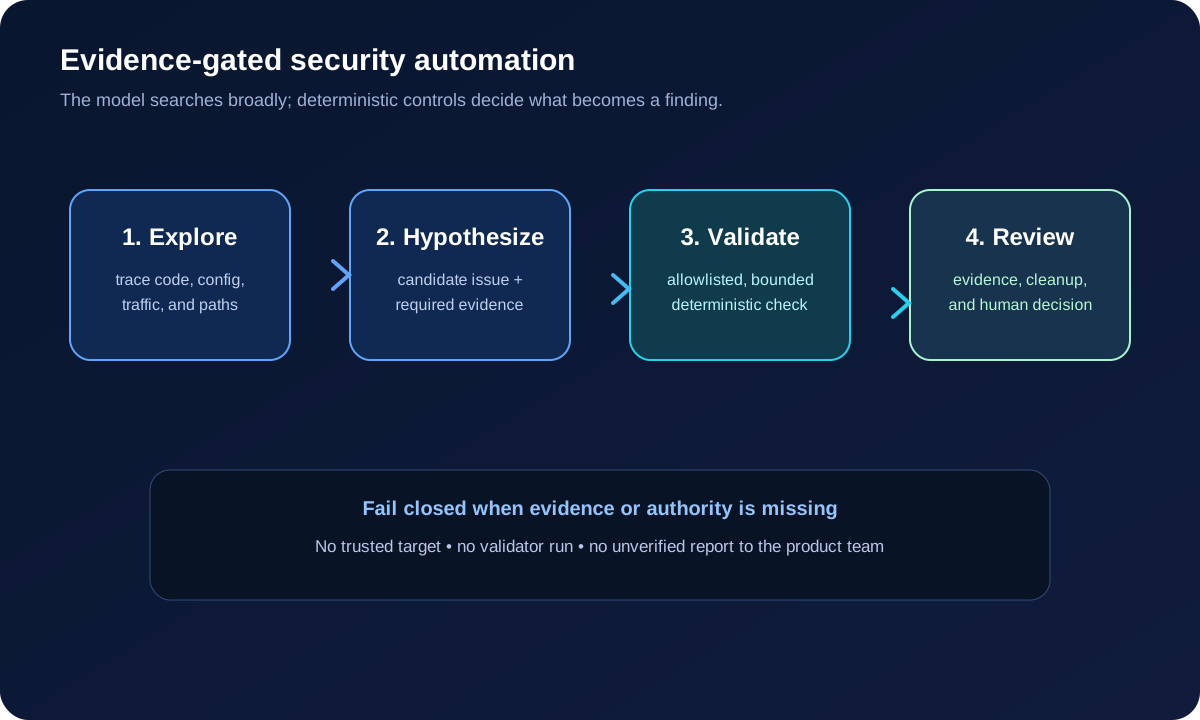
| Stage | Purpose |
|---|---|
| Explore | Use an agent to trace code, configuration, traffic, and reachable application paths. |
| Hypothesize | Describe a possible vulnerability and the conditions that would make it exploitable. |
| Validate | Run a narrowly scoped, vulnerability-specific check against an authorized environment. |
| Escalate | Send high-confidence findings to product teams with evidence and context. |
| Learn | Use uncertain candidates and missing capabilities to improve future validators and scans. |
Why deterministic validation matters
A language model can identify a suspicious data flow or construct a convincing explanation for why a bug might exist. That explanation may still be wrong because a sanitizer runs later, a permission check changes the path, a feature flag is disabled, or the supposed input never reaches the sink in a real deployment.
A deterministic validator turns the claim into a testable condition. It should define the target, the allowed input, the expected signal, and the cleanup behavior before it runs. The validator should produce a compact evidence record rather than asking another model to judge whether the first model sounded confident.
Google describes validators for classes such as XSS, SQL injection, path traversal, remote code execution, and SSRF. The safe general principle is more important than any individual check: only test systems you own or are explicitly authorized to assess, and keep validation isolated, rate-limited, observable, and reversible where possible.
- Treat model output as a hypothesis, not a finding.
- Make the validator’s success condition explicit and machine-checkable.
- Bind every test to an authorized target, identity, scope, and time window.
- Record evidence without retaining unnecessary secrets or sensitive payloads.
- Stop and escalate when the test cannot establish a safe boundary.
The right division of labor between an agent and a validator
Agents are useful when the search space is large and the path to a bug is not obvious. They can follow references, compare configuration, inspect request flows, and propose a sequence of checks. Their flexibility is also their weakness: they may pursue an attractive but incorrect path, repeat unsafe actions, or infer authority from incomplete context.
Validators should be narrower. A validator should not improvise a new target or expand scope because the agent says that doing so is necessary. It should accept structured input, enforce policy again, perform the minimum safe action, and return a typed result such as confirmed, not confirmed, blocked by policy, or inconclusive.
This pattern resembles a reliable automation workflow: an untrusted proposal enters a deterministic boundary, the boundary checks identity and resource scope, and only then can a bounded effect occur. The model remains valuable without becoming the final authority.
| Agent can help with | Validator must enforce |
|---|---|
| Finding a suspicious data flow | The authorized application and exact test scope |
| Suggesting a likely input path | Input limits, rate limits, and safe test conditions |
| Explaining why a check may work | The objective success signal and evidence format |
| Prioritizing candidate findings | Whether the result is confirmed, inconclusive, or rejected |
| Identifying missing context | Fail-closed behavior when required evidence is unavailable |
Secure-by-design reduces the agent’s attack surface
Google also compared PageBreak with applications built on its high-assurance web frameworks. It reported that, as of September 4, 2026, the scanner found only two XSS vulnerabilities across hundreds of applications using those frameworks, and those were limited to internal applications or debug endpoints with hardening gaps.
That comparison points to an important product lesson: automated detection is not a substitute for preventing entire classes of mistakes. Framework defaults, safe output encoding, typed interfaces, authorization boundaries, and constrained configuration can reduce the number of paths an agent needs to investigate.
The best security automation therefore has two feedback loops. One finds and verifies defects in existing applications. The other feeds recurring defect patterns back into framework design, templates, code review, and platform guardrails so the same class of bug becomes harder to introduce.
Common Mistakes
- Assuming an AI scanner makes insecure framework defaults acceptable.
- Sending every model-generated candidate to developers without confidence or evidence gating.
- Giving a security agent broad production credentials instead of a controlled assessment identity.
- Measuring success by the number of reports rather than verified findings and prevented regressions.
- Treating a validator as safe without testing its scope, cleanup, and failure behavior.
A safe implementation pattern for engineering teams
A smaller team can apply the same architecture without recreating Google’s internal infrastructure. Start with a fixed test fixture or staging application, a narrow set of vulnerability checks, and a policy service that approves every target and action. Keep the agent’s credentials separate from the validator’s credentials, and keep both separate from production identities.
Store candidate findings as structured records: target, route or component, suspected class, evidence requirements, authorization context, validator version, result, and cleanup status. Never let a model-supplied target, tenant, user, or approval field replace trusted caller context.
Run the validator in an isolated worker with denied-by-default network access. Require an explicit allowlist, cap attempts and request rates, redact secrets from logs, and mark uncertain outcomes as inconclusive rather than forcing a yes-or-no answer.
- Use synthetic or staging targets for development and evaluation.
- Require explicit authorization before every scan and validator run.
- Separate discovery, validation, remediation, and deployment permissions.
- Make validators idempotent and clean up their test state.
- Keep evidence reproducible without storing raw secrets.
- Route confirmed findings to human review before disclosure or production changes.
What PageBreak does not prove
Google’s report is a description of an internal system and its results, not an independent benchmark of every AI security scanner. The reported 500-plus vulnerabilities and near-zero false-positive claim are Google’s own measurements in its own applications and infrastructure.
The project also does not prove that deterministic validators can cover every vulnerability type. Google acknowledges that validators have gaps and uses non-deterministic candidates to guide future validator development. That is a useful admission: high-confidence automation and broader exploratory search serve different purposes.
A responsible article should therefore present PageBreak as an architecture lesson, not as evidence that AI has solved application security. The durable pattern is evidence-gated automation with explicit authority boundaries.
FAQ
Is PageBreak a general-purpose security scanner developers can download?
No. Google describes PageBreak as an internal Product Security project. The transferable lesson is its workflow: agent-assisted exploration followed by deterministic, authorized validation.
Why not let the AI decide whether a vulnerability is real?
A model can produce a persuasive but incorrect explanation. A deterministic validator checks a defined condition against an authorized environment and returns evidence that can be reviewed and reproduced.
Can small engineering teams use the same pattern?
Yes, at smaller scope: use staging fixtures, narrow validators, explicit allowlists, isolated workers, structured evidence, and human review before disclosure or production changes.
Sources
Primary and authoritative sources reviewed for this article.
- Google Security Blog: Agentic Hacks, Real Proofs: Inside Google’s PageBreak Project
Primary source for PageBreak’s timeline, agent-plus-validator design, reported findings, deterministic validation approach, and comparison with high-assurance frameworks.
Conclusion
PageBreak’s most useful lesson is not that an AI agent can find bugs. It is that reliable security automation needs a second boundary that can prove or reject the agent’s claim. Let the model explore and prioritize, but keep authorization, validation, evidence, and real-world effects under deterministic controls.