
Production Web Scraping Pipelines in Python
Build a production-oriented Python web scraping pipeline with validation, retries, deduplication, pagination, checkpointing, change detection, observability, and output quality gates.
A script that extracts one page once is not yet a reliable data pipeline. Production-oriented scraping must distinguish transport success from page validity, reject malformed records, normalize comparable values, control retries and pagination, preserve restart state, detect changes, and block bad output before publication. This guide builds those boundaries around a small executable Python fixture. Every page and result is synthetic and local: it is implementation evidence, not a benchmark of a real website, browser, service, client, or production workload.
A scraper that works once is not a pipeline
Reliable extraction is a chain of explicit contracts, not a lucky selector.
A successful HTTP response says that bytes arrived. It does not say that the expected page loaded, required records exist, fields are valid, pagination is complete, or an output is safe to publish. A dependable design treats each of those as a separate decision with its own evidence.
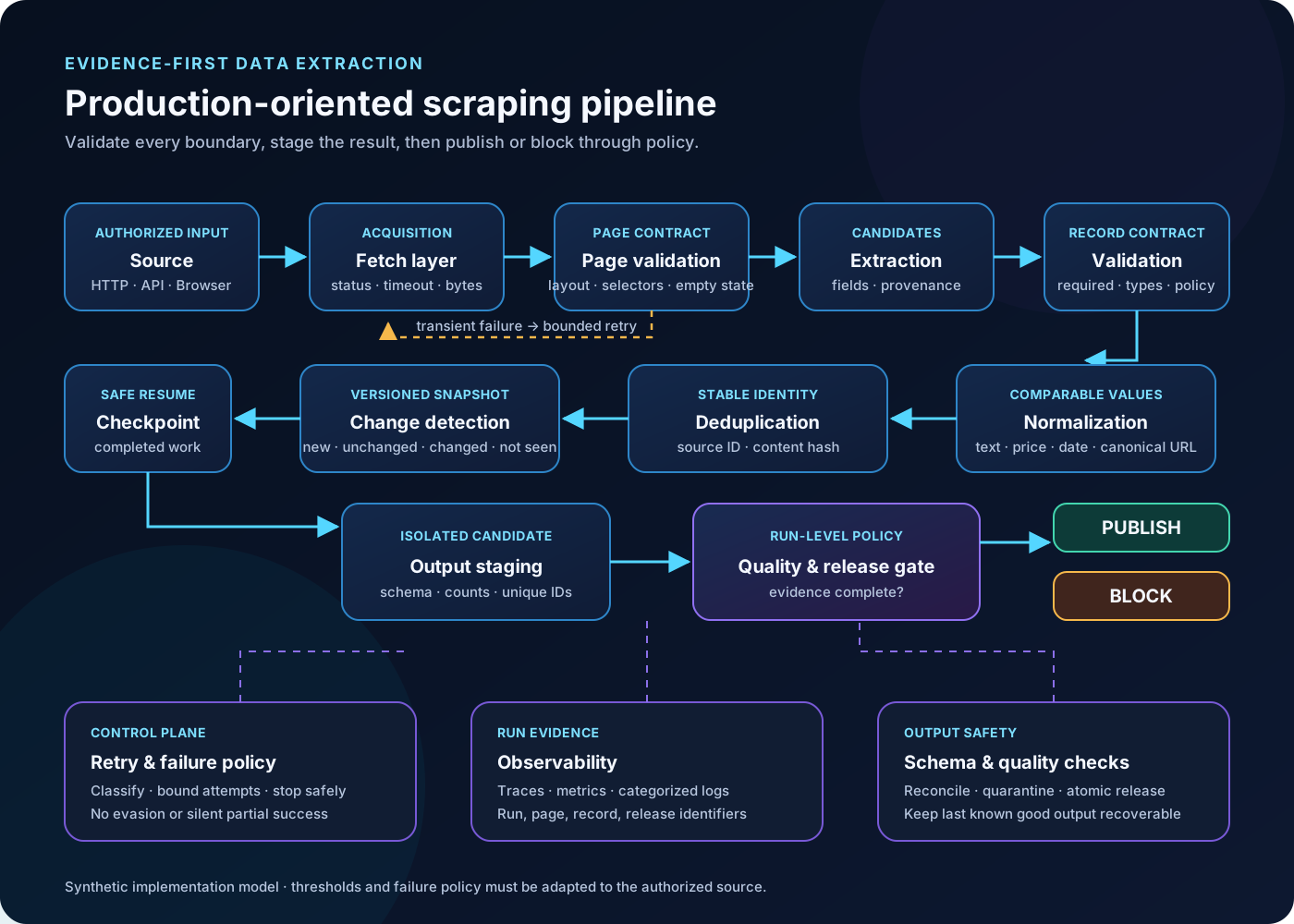
The useful system boundary runs from authorized source access through fetching, page validation, extraction, record validation, normalization, deduplication, change detection, checkpointing, staging, and a final release gate. Failures remain categorized so a timeout is not confused with selector drift or a bad record.
This article is production-oriented rather than production-proven. Its fixture runs entirely from local HTML strings, uses no network, and intentionally blocks publication when the third page changes layout.
Tips
- Define what makes a page and a record valid before writing selectors.
- Preserve raw failure categories even if a dashboard later groups them.
- Stage output first; publish only after the run-level quality gate passes.
Define the extraction contract first
Source, page, record, identity, and release rules should be named before execution.
An extraction contract identifies allowed sources and paths, expected page structure, required record fields, accepted types and categories, canonical URL rules, stable identity, pagination limits, retryable failures, and publication conditions. Without that contract, code cannot distinguish an empty but legitimate page from a broken selector.
The worked fixture accepts only HTTPS URLs on catalog.example, three controlled categories, ISO dates, and USD prices. A record requires source ID, title, price, URL, category, location, and date. These are teaching rules for a fictional catalog—not universal scraping requirements.
A run also needs an evidence contract: dataset and run IDs, counts derived from processing, categorized failures, the last successful checkpoint, staged-record count, and the final publish decision.
| Boundary | Accepted evidence | Failure response |
|---|---|---|
| Fetch | Known fixture page, successful response within two attempts | Retry a transient failure; stop after exhaustion |
| Page | Expected catalog-v1 wrapper and at least one record selector | Classify selector drift and block |
| Record | All required fields plus controlled formats | Reject record with a reason |
| Identity | Stable source_id and deterministic content hash | Dedupe exact repeats; flag conflicts |
| Release | No critical run failure and complete staged evidence | PUBLISH or BLOCKED |
Choose the narrowest fetch boundary
Use direct HTTP or an official API when it supplies the required representation; add a browser only when rendering truly requires it.
A direct HTTP client is usually the smallest operational boundary for stable server-rendered pages: fewer moving parts, easier timeouts, and simpler replay. When an authorized official API provides the needed fields, it can offer a clearer contract than HTML. The choice remains source-specific.
Browser automation is appropriate when the required public representation is produced only after supported client-side interaction or rendering. It also adds browser binaries, navigation state, JavaScript timing, resource cost, and more failure modes. The Playwright vs Selenium comparison examines those browser-control trade-offs; neither tool turns every page into a browser-required workload.
Keep acquisition behind a fetch interface so page validation and downstream record logic do not depend on whether bytes came from an HTTP client, permitted API, stored response, or browser. The executable fixture supplies stored local HTML and proves none of those network clients.
| Mode | Use when | Additional boundary |
|---|---|---|
| HTTP | Required representation is present in the response | Timeouts, status policy, encoding, redirects |
| Official API | Authorized structured access covers the requirement | Credentials, quotas, schema/version policy |
| Browser | Supported rendering or interaction is necessary | Navigation state, runtime dependencies, browser failures |
| Stored fixture | Deterministic local tests and regression reproduction | Fixture realism and maintenance |
Run the synthetic pipeline locally
Two embedded artifacts reproduce the complete educational run with Python 3.12 standard library only.
The JSON fixture contains three fictional catalog pages and a previous snapshot. Page one times out once and then succeeds. Two records are invalid, one record repeats across pages, one previous record is not observed, and page three uses an unexpected layout.
The runner parses stored HTML, validates and normalizes records, computes hashes, deduplicates by stable identity, compares the current stage with previous records, records the checkpoint, and applies a run-level gate. It performs no request and has no external side effect.
The expected output is serialized explicitly as UTF-8 bytes with LF separators and no final newline. Its counts are derived by the runner; they are not an accuracy, speed, coverage, or scale measurement.
examples/scraping_fixture.json{
"dataset": "synthetic-catalog-scrape-v1",
"run_id": "run-synthetic-001",
"policy": {
"allowed_host": "catalog.example",
"allowed_categories": [
"home",
"office",
"outdoor"
],
"max_attempts": 2,
"max_pages": 5
},
"pages": {
"/catalog?page=1": {
"outcomes": [
{
"type": "timeout",
"message": "synthetic transient timeout"
},
{
"type": "response",
"status": 200,
"body": "<!doctype html><html><body><main data-layout=\"catalog-v1\"><article data-record data-source-id=\"sku-100\" data-price=\"$12.00\" data-url=\"https://catalog.example/items/sku-100?utm_source=fixture\" data-category=\"home\" data-location=\"Lahore\" data-date=\"2026-09-01\"><h2>Desk Lamp</h2></article><article data-record data-source-id=\"sku-200\" data-price=\"USD 25\" data-url=\"https://catalog.example/items/sku-200\" data-category=\"office\" data-location=\"Karachi\" data-date=\"2026-09-01\"><h2>Monitor Stand</h2></article><article data-record data-source-id=\"sku-300\" data-price=\"$8.50\" data-url=\"https://catalog.example/items/sku-300\" data-category=\"home\" data-location=\"Islamabad\" data-date=\"2026-09-02\"><h2>Cable Tray</h2></article><article data-record data-source-id=\"sku-400\" data-price=\"$44\" data-url=\"https://catalog.example/items/sku-400\" data-category=\"outdoor\" data-location=\"Lahore\" data-date=\"2026-09-02\"><h2> </h2></article><a rel=\"next\" href=\"/catalog?page=2\">Next</a></main></body></html>"
}
]
},
"/catalog?page=2": {
"outcomes": [
{
"type": "response",
"status": 200,
"body": "<!doctype html><html><body><main data-layout=\"catalog-v1\"><article data-record data-source-id=\"sku-300\" data-price=\"USD 8.50\" data-url=\"https://catalog.example/items/sku-300\" data-category=\"home\" data-location=\"Islamabad\" data-date=\"2026-09-02\"><h2>Cable Tray</h2></article><article data-record data-source-id=\"sku-500\" data-price=\"$19.99\" data-url=\"https://catalog.example/items/sku-500?ref=public&utm_campaign=test\" data-category=\"outdoor\" data-location=\"Peshawar\" data-date=\"2026-09-02\"><h2>Weather Cover</h2></article><article data-record data-source-id=\"sku-600\" data-price=\"$9\" data-url=\"javascript:alert(1)\" data-category=\"office\" data-location=\"Karachi\" data-date=\"2026-09-02\"><h2>Label Roll</h2></article><a rel=\"next\" href=\"/catalog?page=3\">Next</a></main></body></html>"
}
]
},
"/catalog?page=3": {
"outcomes": [
{
"type": "response",
"status": 200,
"body": "<!doctype html><html><body><main data-layout=\"catalog-v2\"><div class=\"product-card\"><span>Layout changed</span></div></main></body></html>"
}
]
}
},
"previous_records": [
{
"source_id": "sku-100",
"title": "Desk Lamp",
"price": "USD 12.00",
"canonical_url": "https://catalog.example/items/sku-100",
"category": "home",
"location": "Lahore",
"date": "2026-09-01"
},
{
"source_id": "sku-200",
"title": "Monitor Stand",
"price": "USD 23.00",
"canonical_url": "https://catalog.example/items/sku-200",
"category": "office",
"location": "Karachi",
"date": "2026-09-01"
},
{
"source_id": "sku-700",
"title": "Storage Bin",
"price": "USD 14.00",
"canonical_url": "https://catalog.example/items/sku-700",
"category": "home",
"location": "Quetta",
"date": "2026-08-31"
}
]
}examples/run_scraping_pipeline.pyimport hashlib
import json
import re
import sys
import unicodedata
from datetime import date
from html.parser import HTMLParser
from pathlib import Path
from urllib.parse import parse_qsl, urlencode, urljoin, urlsplit, urlunsplit
class CatalogParser(HTMLParser):
def __init__(self):
super().__init__()
self.layout = None
self.records = []
self.next_url = None
self._record = None
self._in_title = False
self._title_parts = []
def handle_starttag(self, tag, attrs):
values = dict(attrs)
if tag == "main":
self.layout = values.get("data-layout")
if tag == "article" and "data-record" in values:
self._record = {
"source_id": values.get("data-source-id"),
"price": values.get("data-price"),
"url": values.get("data-url"),
"category": values.get("data-category"),
"location": values.get("data-location"),
"date": values.get("data-date"),
}
elif tag == "h2" and self._record is not None:
self._in_title = True
self._title_parts = []
elif tag == "a" and values.get("rel") == "next":
self.next_url = values.get("href")
def handle_data(self, data):
if self._in_title:
self._title_parts.append(data)
def handle_endtag(self, tag):
if tag == "h2" and self._in_title:
self._record["title"] = "".join(self._title_parts)
self._in_title = False
elif tag == "article" and self._record is not None:
self.records.append(self._record)
self._record = None
def clean_text(value):
return " ".join(unicodedata.normalize("NFKC", value or "").split())
def canonicalize_url(value, allowed_host):
parts = urlsplit(value or "")
if parts.scheme != "https" or (parts.hostname or "").lower() != allowed_host:
raise ValueError("url_policy")
query = [
(key, item)
for key, item in parse_qsl(parts.query, keep_blank_values=True)
if not key.lower().startswith("utm_")
]
host = (parts.hostname or "").lower()
if parts.port:
host = f"{host}:{parts.port}"
return urlunsplit(("https", host, parts.path or "/", urlencode(sorted(query)), ""))
def normalize_price(value):
match = re.fullmatch(r"\s*(?:USD\s*|\$)(\d+(?:\.\d{1,2})?)\s*", value or "")
if not match:
raise ValueError("price_format")
return f"USD {float(match.group(1)):.2f}"
def normalize_record(raw, policy, source_page):
required = ("source_id", "title", "price", "url", "category", "location", "date")
if any(not clean_text(raw.get(field)) for field in required):
raise ValueError("missing_required_field")
category = clean_text(raw["category"]).lower()
if category not in policy["allowed_categories"]:
raise ValueError("category_policy")
normalized_date = clean_text(raw["date"])
date.fromisoformat(normalized_date)
record = {
"source_id": clean_text(raw["source_id"]),
"title": clean_text(raw["title"]),
"price": normalize_price(raw["price"]),
"canonical_url": canonicalize_url(raw["url"], policy["allowed_host"]),
"category": category,
"location": clean_text(raw["location"]),
"date": normalized_date,
"source_page": source_page,
}
content = {key: record[key] for key in (
"source_id", "title", "price", "canonical_url", "category", "location", "date"
)}
record["content_hash"] = hashlib.sha256(
json.dumps(content, sort_keys=True, separators=(",", ":")).encode("utf-8")
).hexdigest()
return record
def previous_hash(record):
content = {key: record[key] for key in (
"source_id", "title", "price", "canonical_url", "category", "location", "date"
)}
return hashlib.sha256(
json.dumps(content, sort_keys=True, separators=(",", ":")).encode("utf-8")
).hexdigest()
def fetch(page, page_spec, attempt):
outcome = page_spec["outcomes"][min(attempt - 1, len(page_spec["outcomes"]) - 1)]
if outcome["type"] == "timeout":
raise TimeoutError(outcome["message"])
return outcome["status"], outcome["body"]
def run(fixture):
policy = fixture["policy"]
stats = {
"pages_attempted": 0,
"pages_fetched": 0,
"pages_valid": 0,
"records_seen": 0,
"records_valid": 0,
"records_rejected": 0,
"duplicates": 0,
"new_records": 0,
"unchanged_records": 0,
"changed_records": 0,
"not_seen_records": 0,
"fetch_failures": 0,
"selector_failures": 0,
"retries": 0,
"checkpoint_page": 0,
"staged_records": 0,
}
failures = []
staged = {}
seen_pages = set()
page = "/catalog?page=1"
while page and len(seen_pages) < policy["max_pages"]:
if page in seen_pages:
failures.append({"category": "pagination_loop", "page": page})
break
seen_pages.add(page)
stats["pages_attempted"] += 1
page_spec = fixture["pages"].get(page)
if page_spec is None:
failures.append({"category": "missing_fixture_page", "page": page})
break
body = None
for attempt in range(1, policy["max_attempts"] + 1):
try:
status, candidate_body = fetch(page, page_spec, attempt)
if status >= 500:
raise ConnectionError(f"retryable_http_{status}")
if status >= 400:
failures.append({"category": "permanent_http", "page": page, "status": status})
break
body = candidate_body
stats["pages_fetched"] += 1
break
except (TimeoutError, ConnectionError) as exc:
stats["fetch_failures"] += 1
if attempt < policy["max_attempts"]:
stats["retries"] += 1
continue
failures.append({"category": "fetch_exhausted", "page": page, "detail": str(exc)})
if body is None:
break
parser = CatalogParser()
parser.feed(body)
if parser.layout != "catalog-v1" or not parser.records:
stats["selector_failures"] += 1
failures.append({
"category": "selector_drift",
"page": page,
"observed_layout": parser.layout,
})
break
stats["pages_valid"] += 1
for raw in parser.records:
stats["records_seen"] += 1
try:
record = normalize_record(raw, policy, page)
except (TypeError, ValueError) as exc:
stats["records_rejected"] += 1
failures.append({
"category": "record_validation",
"page": page,
"source_id": raw.get("source_id"),
"detail": str(exc),
})
continue
stats["records_valid"] += 1
identity = record["source_id"]
if identity in staged:
stats["duplicates"] += 1
if staged[identity]["content_hash"] != record["content_hash"]:
failures.append({"category": "identity_conflict", "source_id": identity})
continue
staged[identity] = record
stats["checkpoint_page"] = len(seen_pages)
page = urljoin("https://catalog.example" + page, parser.next_url) if parser.next_url else None
if page:
parts = urlsplit(page)
page = urlunsplit(("", "", parts.path, parts.query, ""))
previous = {item["source_id"]: item for item in fixture["previous_records"]}
for identity, record in staged.items():
if identity not in previous:
stats["new_records"] += 1
elif record["content_hash"] == previous_hash(previous[identity]):
stats["unchanged_records"] += 1
else:
stats["changed_records"] += 1
stats["not_seen_records"] = len(set(previous) - set(staged))
stats["staged_records"] = len(staged)
critical_categories = {
"pagination_loop", "missing_fixture_page", "fetch_exhausted",
"selector_drift", "identity_conflict"
}
publish_decision = "BLOCKED" if any(
failure["category"] in critical_categories for failure in failures
) else "PUBLISH"
lines = [
"SYNTHETIC EDUCATIONAL FIXTURE — local HTML only; no real-site benchmark",
f"dataset={fixture['dataset']}",
f"run_id={fixture['run_id']}",
]
lines.extend(f"{key}={value}" for key, value in stats.items())
lines.append(f"publish_decision={publish_decision}")
sys.stdout.buffer.write("\n".join(lines).encode("utf-8"))
if __name__ == "__main__":
fixture_path = Path(__file__).with_name("scraping_fixture.json")
run(json.loads(fixture_path.read_text(encoding="utf-8")))Expected output
SYNTHETIC EDUCATIONAL FIXTURE — local HTML only; no real-site benchmark
dataset=synthetic-catalog-scrape-v1
run_id=run-synthetic-001
pages_attempted=3
pages_fetched=3
pages_valid=2
records_seen=7
records_valid=5
records_rejected=2
duplicates=1
new_records=2
unchanged_records=1
changed_records=1
not_seen_records=1
fetch_failures=1
selector_failures=1
retries=1
checkpoint_page=2
staged_records=4
publish_decision=BLOCKED
Validate the page before extracting records
HTTP 200 with the wrong structure is a failed page, not an empty result.
Page validation should check structural markers that are expected for the target representation: layout/version attributes, a result container, pagination controls, and at least one record when the contract says records must exist. Store the observed marker and URL with the failure.
Zero extracted records is ambiguous. It may mean a legitimate empty result, a login or consent page, a rate-limit response rendered as HTML, a template change, or a broken selector. Only source-specific evidence can disambiguate those cases.
In the fixture, page three returns HTML successfully but exposes catalog-v2 and no expected article record. The runner classifies selector_drift and blocks output. It does not convert the page into a successful empty set.
Common Mistakes
- Counting every 200 response as a valid page.
- Treating zero records as automatically successful.
- Continuing pagination after a critical page-shape failure.
- Publishing partial data without exposing the missing-page evidence.
Separate extraction from record validation
Selectors collect candidates; validators decide whether candidates belong in the dataset.
Extraction maps page elements into candidate fields. Validation then enforces required values, types, enums, date parsing, price syntax, and URL policy. Keeping these steps separate makes it possible to change selectors without weakening the output contract.
Reject invalid records with a stable category and enough context to diagnose the source page. Do not silently fill required business fields with plausible defaults. A missing title and a disallowed URL are different defects even if both records are withheld.
The fixture sees seven candidates, accepts five before deduplication, and rejects two. Those counts describe authored cases only; they do not estimate real-site data quality.
Normalize only what the contract can defend
Comparable values require deterministic and reviewable transformations.
Normalization removes representational differences without inventing meaning. The runner applies Unicode NFKC normalization, collapses whitespace, lowercases a controlled category, converts accepted price syntax to two-decimal USD, validates an ISO date, and canonicalizes an allowed HTTPS URL.
URL parsing is not URL validation. Python's documentation explicitly warns that urlsplit and urlparse do not validate inputs, so the runner separately checks scheme and hostname. It also removes only utm_ tracking parameters, sorts remaining query pairs, and drops fragments.
Currency conversion, inferred locations, translated categories, and guessed dates would require additional evidence. They are outside this example.
Examples
- Input: " Monitor Stand " → title: "Monitor Stand"
- Input: "$8.50" or "USD 8.50" → price: "USD 8.50"
- Input: "https://catalog.example/items/sku-500?ref=public&utm_campaign=test" → canonical URL retains ref=public and removes the authored tracking parameter
Deduplicate with stable identity and content
Identity answers which entity; content hashes answer whether its normalized representation changed.
A stable source ID is preferable when the source contract provides one. Canonical URLs can be a secondary key, but URL normalization must be deliberate. Titles alone are usually poor identifiers because formatting and wording change.
The runner hashes a sorted, compact UTF-8 JSON representation of normalized content with SHA-256. The source page and hash itself are excluded. An exact repeat of sku-300 increments duplicates and does not create a second staged record.
Hashing is a comparison mechanism, not proof that two real-world entities are identical. A same-ID, different-hash collision within one run is categorized as an identity conflict and blocks this example.
Detect changes without inventing deletions
Compare current staged identities with a named previous snapshot.
For every staged unique record, absence from the previous snapshot means new, equal normalized hashes mean unchanged, and unequal hashes mean changed. Store the fields or hashes used so a later review can reproduce the classification.
A previous identity missing from the current stage is only not_seen. It must not become deleted until the source contract, crawl completeness, retention policy, and repeated observations justify that stronger state.
The fixture derives two new, one unchanged, one changed, and one not-seen record. Because the run later detects selector drift, even those valid classifications remain staged rather than published.
| State | Fixture count | Meaning |
|---|---|---|
| New | 2 | Current stable identity absent from previous records |
| Unchanged | 1 | Stable identity and normalized content hash match |
| Changed | 1 | Stable identity matches and normalized content hash differs |
| Not seen | 1 | Previous identity absent from this incomplete run; not a deletion |
Bound pagination and detect loops
Every traversal needs a stop condition independent of page markup.
Follow only next links that remain inside the allowed source boundary. Track visited page identities, cap total pages, and reject a repeated next target as a loop. Cursor-based APIs need equivalent cursor-history and maximum-request controls.
Pagination completeness is part of the release claim. If a critical page fails, a pipeline should not imply that its staged subset represents the whole collection. The fixture stops at the first selector-drift page.
The synthetic maximum of five pages is a test-policy value, not a recommended production threshold. Real limits should reflect authorization, rate policy, expected collection size, and operating budget.
Retry transient failures without hiding permanent ones
A retry policy needs categories, bounds, and observability.
Timeouts, connection failures, and selected server errors can be transient. Invalid URLs, authentication failures, forbidden access, missing required fields, and selector drift usually require a different action. Retrying every exception wastes capacity and can obscure a deterministic defect.
HTTP defines Retry-After for communicating when a later request might be appropriate in applicable responses. A real client should respect source policy and server guidance, use bounded exponential backoff with jitter where appropriate, and cap attempts and elapsed time.
The local runner retries one authored timeout immediately because it performs no network and should remain deterministic. Its two-attempt limit and zero wait are fixture behavior, not operational advice.
| Category | Example | Pipeline action |
|---|---|---|
| Transient transport | Timeout or selected 5xx | Bounded retry, then fail |
| Permanent HTTP/policy | Disallowed or unauthorized request | Stop; do not evade |
| Page contract | Unexpected layout or missing result container | Block and investigate |
| Record contract | Missing field or invalid format | Reject record and count |
| Identity | Same stable ID with conflicting content in one run | Quarantine/block |
| Output | Schema/count/referential mismatch | Do not publish |
Checkpoint only completed work
Restart state should identify a safe resumption boundary.
A checkpoint can record the last validated page or cursor, seen identities, retry state, staged artifact reference, configuration version, and run ID. Commit it only after the page and staged writes satisfy their invariants; otherwise a restart may skip incomplete work.
Durable checkpoints need atomic persistence, idempotent writes, version compatibility, locking or leases, and recovery tests. A database, object store, or transactional queue may be appropriate depending on the workload.
The fixture keeps state in process memory and reports checkpoint_page=2. That demonstrates checkpoint placement but does not prove crash recovery, multi-worker coordination, or durable resume.
Treat selector drift as an observable contract failure
Layout changes should create evidence before they corrupt output.
Monitor page-validity ratios, required-selector presence, record-count ranges, field-null rates, rejection reasons, and normalized-value distributions. Compare them with source-specific baselines, but do not hard-code universal anomaly thresholds.
Preserve a privacy-reviewed sample or response fingerprint when policy permits, plus the selector/configuration version. Tests using stored pages should include expected layouts and deliberate drift cases.
A fallback selector can be useful only when it has its own validation evidence. Broadening selectors until something matches can turn navigation, ads, or unrelated content into plausible records.
Instrument the run, not just the request
Traces, metrics, and logs answer different operational questions.
Use a run ID and page ID across fetch, validation, extraction, staging, and publication. Metrics can report attempts, valid pages, rejected records, retries, duplicates, and lag. Logs record categorized events. Traces connect the steps and external boundaries for one run.
OpenTelemetry distinguishes traces, metrics, and logs as separate signals. A production implementation can correlate them without dumping full page contents or personal data into telemetry.
Record configuration and code versions with the run. Redact secrets, minimize stored source content, control access and retention, and avoid collecting data merely because instrumentation makes it possible.
- Run: run_id, dataset/source contract version, start/end state, release decision.
- Page: URL identity, attempt, status category, page-validity outcome, checkpoint.
- Record: validation category, stable identity or privacy-safe reference, change state.
- Release: staged artifact reference, quality rules evaluated, blocking reasons.
Protect output integrity before publication
A well-formed file can still represent an incomplete or inconsistent run.
Write into an isolated stage, validate the output schema, assert unique identities, reconcile counts, and verify referential rules before swapping a published artifact. The release step should be atomic where consumers cannot tolerate mixed versions.
Quarantine rejected records and failure evidence separately from publishable records. Preserve the prior published version until the candidate run passes. A failed release gate should be visible and actionable, not converted to a warning after output has escaped.
The fixture stages four unique valid records. It emits BLOCKED because selector drift is critical, so it deliberately provides no published data artifact.
Tips
- Reconcile seen = valid + rejected before deduplication.
- Reconcile staged = valid - handled duplicates for this simple identity policy.
- Require every release decision to name its blocking evidence.
- Keep the last known good publication recoverable.
Use an explicit quality and release gate
Thresholds are policy inputs; they should not be reverse-engineered from a preferred result.
A release policy can require successful traversal, required page validity, zero unresolved identity conflicts, valid output schema, reconciled counts, and source-specific rejection or anomaly limits. High-consequence datasets may require human review.
The example blocks on selector drift, exhausted fetches, missing fixture pages, pagination loops, or identity conflicts. It permits categorized record rejection and handled exact duplicates. These choices make the demonstration inspectable; they are not universal thresholds.
Define and version quality rules before inspecting a candidate run. If policy changes, preserve which version decided each release.
From a fragile baseline to a hardened pipeline
The important upgrade is preserving evidence between stages.
A fragile baseline often fetches, selects, and writes in one loop. Status handling, selector assumptions, normalization, duplicate behavior, and partial-output semantics remain implicit. When results change, there is little evidence about which boundary failed.
A hardened design isolates acquisition, validates pages and records, normalizes deterministically, deduplicates by stated identity, compares against a versioned snapshot, checkpoints completed work, stages output, and releases through policy.
Frameworks can supply pieces of this architecture. Scrapy item pipelines explicitly support cleaning, validation, duplicate handling, and storage, while its engine and scheduler coordinate requests. Using a framework does not remove the need to define source-specific correctness.
| Concern | Fragile baseline | Hardened boundary |
|---|---|---|
| Success | Request returned | Transport + page + record + run contracts |
| Errors | Catch all and continue | Categorized, bounded, observable actions |
| Duplicates | Append every match | Stable identity and content comparison |
| Progress | Loop index | Validated checkpoint with run state |
| Output | Write immediately | Stage, reconcile, gate, then publish |
| Change | Overwrite snapshot | New/unchanged/changed/not-seen evidence |
Respect access, privacy, and operational boundaries
Reliability includes deciding what the pipeline should not collect or attempt.
Use authorized sources and methods, review applicable terms and policies, identify the operator where required, minimize request rate and collected fields, and protect personal or sensitive data. Prefer official access paths when they meet the need.
RFC 9309 standardizes the Robots Exclusion Protocol for crawler instructions and explicitly notes that those rules are not access authorization. A robots permission is not permission to bypass authentication, technical controls, contractual limits, or law; a robots disallow is not an invitation to evade it.
This guide provides no CAPTCHA bypass, fingerprint spoofing, account-limit evasion, proxy rotation, credential harvesting, or anti-abuse workaround. If access is blocked or unclear, stop and obtain authorization or use a supported source. This is engineering guidance, not legal advice.
What the executable fixture proves—and does not prove
The strongest conclusion is the narrowest one supported by the artifacts.
Extracting the two artifacts and running the script proves that the authored local pages produce the recorded validation, retry, deduplication, change, checkpoint, and release counts under the tested Python environment. Raw-byte comparison also verifies its deterministic output contract.
It does not contact or measure a real website. It does not establish scraping legality, browser behavior, selector durability, production throughput, accuracy, completeness, cost, rate safety, data freshness, crash recovery, or business impact.
| Evidence | Demonstrates | Does not prove |
|---|---|---|
| Local HTML fixture | Repeatable authored page and failure cases | Real-site structure or permission |
| Parser and validators | Implemented contract for selected fields | Universal extraction accuracy |
| Transient timeout case | One bounded retry path | Network resilience or rate compliance |
| Hash and snapshot comparison | Deterministic fixture change states | Real-world entity resolution |
| In-memory checkpoint | Placement after validated pages | Durable recovery |
| BLOCKED result | Selector drift prevents fixture publication | A universal release policy |
| Raw-byte output match | Reproducible summary serialization | Speed, scale, SLA, or business outcome |
Production hardening checklist
Move from educational mechanics to an owned operating system.
A real deployment needs source owners, documented authorization, contract fixtures, integration tests, durable idempotent state, secure configuration, secrets management, dependency patching, resource limits, and rollback. Exercise restart, duplicate delivery, partial writes, source drift, and publication failure.
Add privacy review, retention and deletion controls, schema migration strategy, alert ownership, incident runbooks, and a sampling process for rejected and changed records. Benchmark only with representative authorized workloads and publish only measurements actually observed.
For Python foundations, continue with the skills guide. For service boundaries and operations, use the backend roadmap. For release-quality mechanics that inspired the explicit gate, compare the LLM evaluation pipeline while keeping the domains distinct.
- Strengthen Python foundations: validation, typing, testing, packaging, and failure handling.
- Design service operations: APIs, databases, observability, deployment, and security.
- Choose automation boundaries: start with workflows and add complexity only when justified.
- Compare release-gate design: preserve versioned evidence and explicit blocking policy.
Tips
- Test stored success, empty, malformed, blocked, and drifted pages.
- Make writes idempotent and checkpoint updates atomic.
- Version selectors, schemas, policies, and normalized output.
- Measure with authorized representative workloads before making performance claims.
- Keep source access and publication permissions reviewable.
FAQ
Is an HTTP 200 response enough to count a scrape as successful?
No. It proves only that a response was received. Validate the expected page structure, required record fields, pagination completeness, staged output, and run-level quality rules before treating the extraction as successful.
When should a Python scraper use browser automation?
Use it when the authorized required representation genuinely depends on supported client-side rendering or interaction. Direct HTTP or an official API is a smaller boundary when it supplies the needed data. Browser automation adds runtime, state, timing, and failure complexity.
Should a missing previous record be marked deleted?
Not from one observation alone. Classify it as not seen unless the source contract, complete traversal, retention rules, and repeated evidence justify a deletion state.
What should happen when selectors return zero records?
Treat zero as ambiguous. Check expected layout markers, empty-state markers, access responses, status policy, and historical expectations. Do not automatically publish an empty dataset.
Does the executable example benchmark real scraping performance?
No. It reads synthetic HTML from a local JSON fixture, performs no network request, and reports deterministic authored counts. It proves selected pipeline logic only, not accuracy, speed, scale, legality, production reliability, or business results.
Sources
Primary and authoritative sources reviewed for this article.
- Python 3.12 documentation — html.parser
Reviewed for the standard-library HTMLParser callback model and its explicit non-validating parser boundary.
- Python 3.12 documentation — urllib.parse
Reviewed for URL splitting, joining, and the warning that parsing functions do not validate inputs.
- Python 3.12 documentation — hashlib
Reviewed for deterministic SHA-256 hashing used in the local content-comparison example.
- RFC 9110 — HTTP Semantics
Reviewed for HTTP status semantics and Retry-After; application retry policy remains source-specific.
- RFC 9309 — Robots Exclusion Protocol
Reviewed for standardized crawler rules and the explicit boundary that robots rules are not access authorization.
- Scrapy documentation — Architecture overview
Reviewed for the engine, scheduler, downloader, spider, and item-pipeline component boundaries.
- Scrapy documentation — Item Pipeline
Reviewed for post-extraction cleaning, validation, duplicate handling, and storage responsibilities.
- OpenTelemetry documentation — Signals
Reviewed for the distinction between traces, metrics, and logs used in the observability section.
- Playwright documentation — Pages
Reviewed for browser-page automation boundaries when client-side rendering or interaction is genuinely required.
- Selenium documentation — WebDriver
Reviewed for standards-based browser automation and its interaction/navigation scope.
Conclusion
A reliable scraper is a controlled data-release system: acquire through an authorized boundary, validate pages before records, normalize and deduplicate deterministically, preserve change and checkpoint evidence, observe failures, stage output, and publish only through explicit policy. The local fixture makes that chain executable while keeping its claims narrow. Next, strengthen the surrounding Python engineering foundations or apply the same evidence-first release thinking to LLM evaluation pipelines.