OpenAI Agents API Explained: Harness, Sessions, Sandboxes, and Production Boundaries
OpenAI’s Agents API gives applications access to a managed agent harness with durable sessions, orchestration, recovery, tools, and sandbox environments. Here is the production architecture developers should understand before shipping.
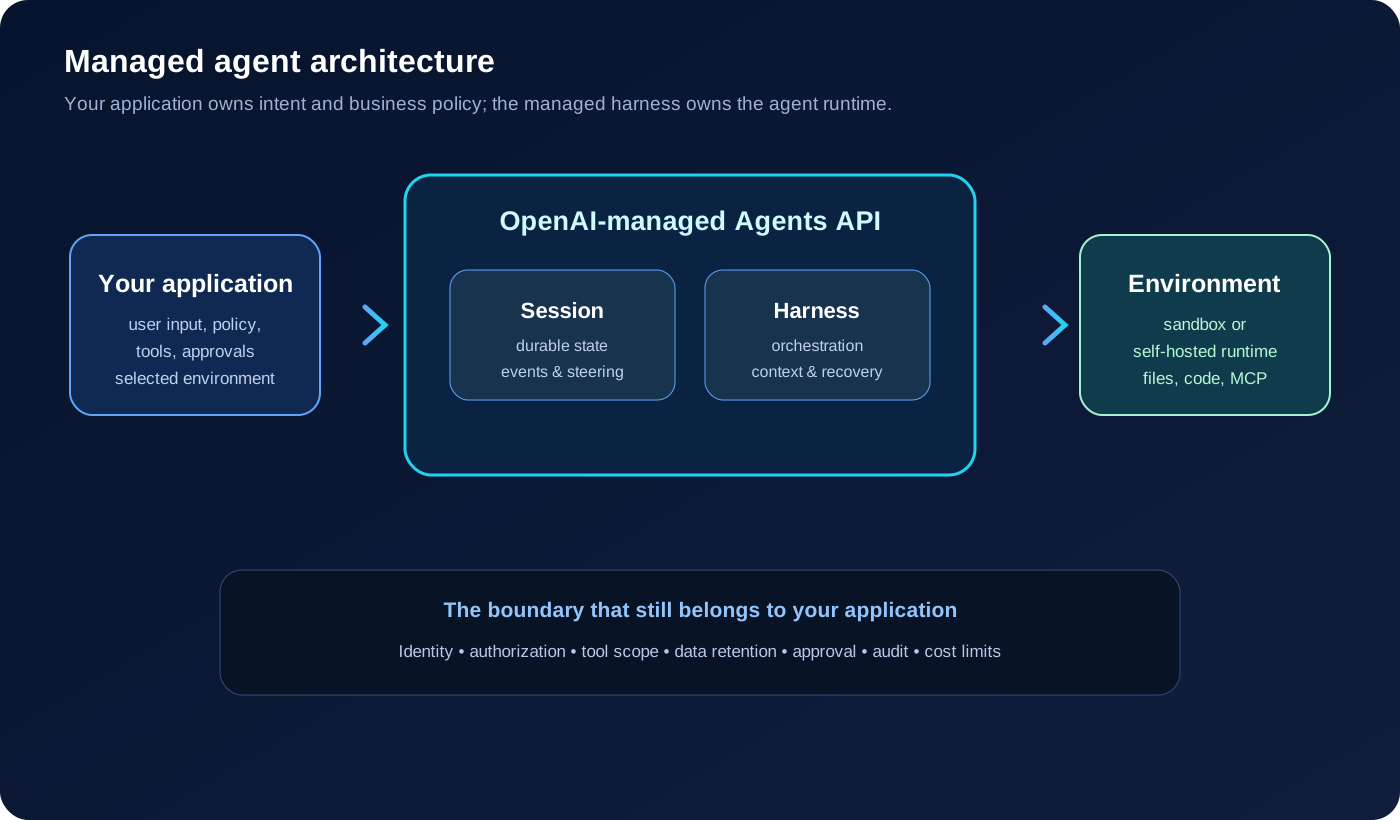
Most AI-agent demos stop at the model loop: receive a task, call a tool, return an answer. OpenAI’s Agents API moves the discussion up a level by exposing a managed Codex harness through an API. The platform can manage sessions, orchestration, context compaction, and recovery, while your application still owns the task, tools, execution environment, authorization, and business consequences. That boundary—not the model call—is the part developers need to design carefully.
What the Agents API is—and what it is not
A managed runtime for agent work, not a replacement for application ownership.
OpenAI’s official documentation describes the Agents API as access to an OpenAI-managed Codex harness. The service manages the agent runtime, while your application configures the agent and chooses the execution environment. This is different from writing your own loop around a model API, and it is also different from the existing Python production-agent architecture where your application owns orchestration, state, and tool execution directly.
The API is built around four concepts: an agent, an environment, a session, and events or items. An agent describes the model, instructions, tools, and MCP servers. An environment is where the agent can access files or run commands. A session is a durable instance that can continue work. Events and items are the input and output stream around that work.
That vocabulary matters because a session is not just a chat transcript and a sandbox is not just a container. Each resource has a different lifecycle, authority boundary, retention implication, and operational owner. Treating them as one undifferentiated memory layer makes recovery and access review harder.
The API does not remove the need for application policy. Your system still decides which users may create sessions, which tools are available, which data may enter a workspace, which actions require approval, and what happens when an agent produces an uncertain or partial result.
| Concept | What it represents | Design question |
|---|---|---|
| Agent | Model, instructions, tools, and MCP servers | Which capabilities are truly needed for this task? |
| Environment | Sandbox or self-hosted place where work runs | What files, network paths, packages, and secrets are reachable? |
| Session | Durable instance that can continue work | Who owns it, how long does it live, and how is it stopped? |
| Events and items | Inputs sent and outputs produced | Which events are authoritative, auditable, and safe to replay? |
The session lifecycle changes how you build agents
Long-running work needs operational states, not one giant request timeout.
The documented managed-session flow is straightforward: create a session, give it a task, follow progress through streamed output or webhooks, and continue or steer the same session. That creates a useful operational model for research, coding, document review, incident investigation, and other work that may outlive a single HTTP request.
A durable session also introduces responsibilities. Store the external session ID alongside your own request, user, tenant, policy version, and business operation ID. Decide which events are safe to show to the user, which belong only in protected telemetry, and how an operator can pause, cancel, or expire the work.
This is the same reason a reliable workflow should distinguish proposal, approval, execution, and recovery rather than hiding everything inside a model call. The site’s human-in-the-loop automation patterns article provides a useful state-and-approval lens for those boundaries.
- Give every session a caller, tenant, purpose, budget, expiry, and owner.
- Persist your own durable operation record; do not make the provider session your only business state.
- Handle duplicate events, reconnects, timeouts, cancellation, and unknown outcomes explicitly.
- Make resumption conditional on current authorization and current resource state.
- Provide a kill switch that revokes tools or environment access, not only a UI stop button.
Sandboxes are execution boundaries, not security theater
OpenAI’s documentation describes sandboxes as environments where agents can work with files, commands, packages, ports, snapshots, and controlled external connections. That makes them useful for agents that need to inspect repositories, create artifacts, run code, or continue from a checkpoint.
The word sandbox should not become a shortcut for ‘safe by default.’ Review the workspace directory, mounted files, package sources, outbound network policy, credentials, exposed ports, environment variables, metadata endpoints, and snapshot contents. A sandbox with production secrets and broad network egress is still a path to production authority.
Use the same least-privilege thinking described in the site’s LLM-to-API gateway guide: register narrow capabilities, validate arguments, authorize the target, and audit the effect outside the model.
| Boundary | Questions before production |
|---|---|
| Files | Which paths are mounted, writable, persisted, or included in artifacts? |
| Network | Is egress denied by default, and are destinations and methods allowlisted? |
| Credentials | Are tokens short-lived, scoped, injected only when needed, and absent from snapshots? |
| Packages | Are dependencies pinned, reviewed, cached safely, and reproducible? |
| Ports and MCP | Which services can be reached, and how are server identity and tool scope verified? |
| Recovery | What happens to files, sessions, and external side effects after expiry or restart? |
Tools, MCP, and approvals still need application policy
The Agents API can connect an agent to tools and MCP servers, but capability exposure is not the same as authorization. A tool should be registered for a purpose, constrained to a resource scope, and evaluated against the authenticated caller and current workflow state. The model’s request is a proposal; application code decides whether the request is allowed.
Keep read and write capabilities separate. A read-only data analyst may query a bounded dataset, while a remediation agent may propose a change that requires a human approval record bound to the exact resource, operation, arguments, policy version, and expiry. Never let a model-generated tenant, user, approval, or destination replace trusted context.
MCP connections deserve the same review as any other integration. Record which server was used, which tools were exposed, what data crossed the boundary, and whether the server can cause external effects. Remove unused tools instead of relying on instructions to prevent their use.
For model output validation and failure injection, connect this design to the site’s LLM application testing guide, which keeps semantic evaluation separate from deterministic executor assertions.
Common Mistakes
- Treating a tool description as an access-control decision.
- Giving every session the same broad MCP server list.
- Persisting secrets or sensitive source data in resumable workspace artifacts.
- Retrying an uncertain external write without reconciliation.
- Assuming a managed runtime means the application no longer needs audit, retention, or incident controls.
A production readiness checklist
Adopt the managed runtime only after its authority chain is explicit.
The Agents API can reduce the amount of infrastructure a team must build for long-running agent work, but it does not make a vague workflow production-ready. Start with a low-risk, reversible task and make its state, tools, data, and completion criteria inspectable.
Run the same task through failure paths: malformed input, unavailable environment, tool denial, expired approval, duplicate event, lost connection, partial artifact, provider timeout, session expiry, and ambiguous external effect. The system should return a named outcome and an owned recovery path rather than a generic success or failure string.
OpenAI’s documentation notes that the Agents API has its own data residency and retention considerations, including current US-only data residency and no Zero Data Retention support. Those platform constraints should be part of the architecture and procurement review, not discovered after sensitive data is connected.
- Define session ownership, expiry, cancellation, and deletion behavior.
- Use separate identities for users, agent sessions, tools, sandboxes, and external providers.
- Set budgets for time, tool calls, tokens, storage, network, and cost.
- Redact secrets and sensitive content from events, logs, traces, and artifacts.
- Keep a durable operation ledger outside the provider session.
- Require approval for irreversible, cross-tenant, credential-using, or production-changing actions.
- Test resume, retry, replay, and recovery before increasing authority or traffic.
What the Agents API does not prove
A managed harness can provide useful runtime capabilities, but a successful session does not prove that an agent is reliable, secure, compliant, cost-effective, or suitable for a high-impact workflow. Those claims require application-specific tests and operational evidence.
Likewise, a sandbox does not prove that secrets, tenant boundaries, network routes, MCP servers, or external side effects are correctly isolated. Verify the controls you depend on and document what the platform manages versus what your team must configure.
The durable takeaway is architectural: use the provider-managed harness for orchestration and long-running execution where it fits, while preserving application ownership of identity, policy, data handling, approvals, effects, and recovery.
FAQ
Is the Agents API the same as the Agents SDK?
No. The Agents API provides access to an OpenAI-managed harness through an API. The Agents SDK is an application-side framework for building agent workflows. Choose based on who should run and manage the harness, execution environment, and lifecycle.
Does a session replace my application database?
No. Keep your own durable record for the user, tenant, business operation, authorization, policy version, approvals, and external effects. The provider session is one runtime resource, not the complete business ledger.
Can an Agents API sandbox access production systems?
Only if your application and environment explicitly provide that authority. Production access should be exceptional, narrowly scoped, short-lived, monitored, and protected by deterministic policy and approval controls.
What is the best first use case?
Start with a bounded, reversible workflow such as document analysis, repository investigation, or read-only data analysis. Add write authority only after state, approvals, audit, and recovery paths are tested.
Sources
Primary and authoritative sources reviewed for this article.
- OpenAI Developers: Agents API overview
Official OpenAI documentation for the managed harness, agents, environments, sessions, events, sandboxes, tools, lifecycle, pricing model, and data controls.
- OpenAI Developers: Agents API quickstart
Official setup reference for creating an Agents API session and configuring the runtime.
Conclusion
The Agents API is most useful when the hard part of your product is not one model response but a durable stream of work across tools, files, environments, and time. Let the managed harness handle runtime complexity where appropriate, but keep the authority chain visible: the application decides who may act, what the agent may reach, which effects require approval, and how every uncertain outcome is recovered.