
Human-in-the-Loop AI Automation Patterns
Design human-in-the-loop AI automation with explicit proposal, policy, approval, authorization, idempotency, resume, execution, and audit boundaries.
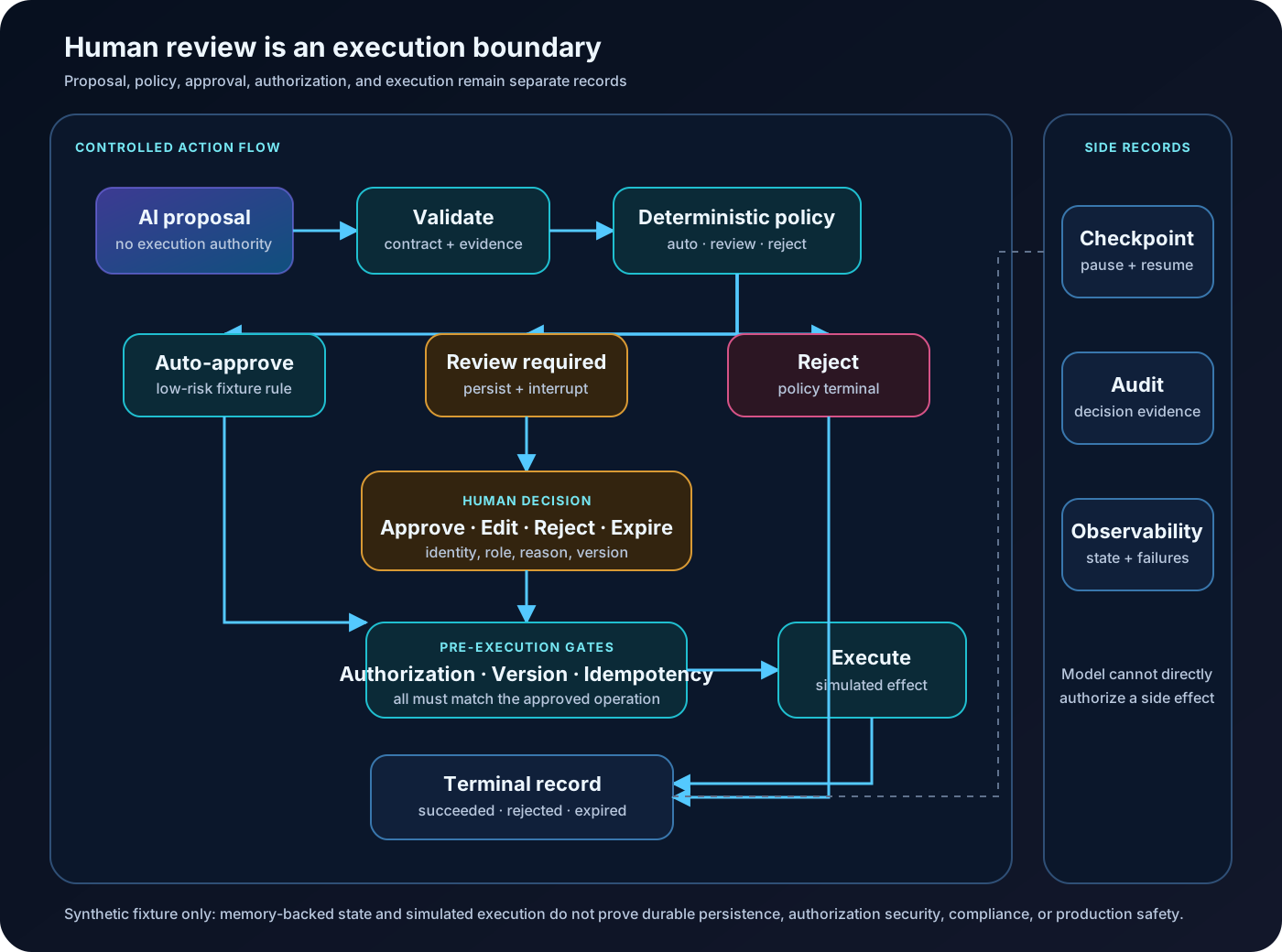
Human review is useful only when it forms a real execution boundary. An AI system may propose an action, but deterministic policy must decide whether it can proceed automatically, requires review, or must be rejected. A reviewer decision then needs its own contract, identity and authorization checks, state-version match, expiry, idempotency, and audit record before any side effect. This guide implements those boundaries in a synthetic Python fixture; it does not claim that adding a human guarantees safety.
Human review is an execution boundary
A review screen alone does not separate proposal from authority.
A reliable HITL flow records the model proposal, evaluates deterministic policy, persists review state, accepts an authenticated human decision, validates that decision against current state, and only then grants a narrow execution capability. Each step can fail independently.
Use review selectively. Sending every action to a person creates queues and fatigue without proving better decisions. Low-risk read-only actions may fit authored auto-approval rules, while prohibited actions should be rejected without asking a reviewer to override policy.
Build one synthetic operations fixture
Ten authored cases make the approval boundary reproducible without touching an external system.
The fictional workflow proposes read_vendor_profile, update_vendor_status, issue_vendor_credit, or a prohibited export. Policy selects AUTO_APPROVE, REVIEW_REQUIRED, or REJECT. Review cases can approve, reject, edit, expire, conflict on version, or fail reviewer authorization.
All times, identities, vendors, payloads, and decisions are synthetic. The simulator uses Python 3.12 standard library, JSON fixture data, and memory-only ledgers. It performs no provider, network, database, payment, email, or vendor-system call.
examples/hitl_approval_fixture.json{
"dataset": "synthetic-hitl-approval-v1",
"policy_version": "policy-1",
"now": "2026-09-05T12:00:00+00:00",
"cases": [
{"id": "case-01", "proposal": {"proposal_id": "prop-001", "run_id": "run-001", "operation_id": "op-001", "action_type": "read_vendor_profile", "subject_id": "vendor-alpha", "payload": {"fields": ["status"]}, "risk_class": "low", "evidence_ids": ["evidence-001"], "state_version": 1, "created_at": "2026-09-05T10:00:00+00:00"}, "current_state_version": 1, "expected": "auto_approved"},
{"id": "case-02", "proposal": {"proposal_id": "prop-002", "run_id": "run-002", "operation_id": "op-002", "action_type": "update_vendor_status", "subject_id": "vendor-beta", "payload": {"status": "reviewed"}, "risk_class": "medium", "evidence_ids": ["evidence-002"], "state_version": 2, "created_at": "2026-09-05T10:05:00+00:00"}, "current_state_version": 2, "expected": "review_required"},
{"id": "case-03", "proposal": {"proposal_id": "prop-003", "run_id": "run-003", "operation_id": "op-003", "action_type": "export_sensitive_records", "subject_id": "vendor-gamma", "payload": {"scope": "all"}, "risk_class": "prohibited", "evidence_ids": ["evidence-003"], "state_version": 1, "created_at": "2026-09-05T10:10:00+00:00"}, "current_state_version": 1, "expected": "policy_reject"},
{"id": "case-04", "proposal": {"proposal_id": "prop-004", "run_id": "run-004", "operation_id": "op-004", "action_type": "update_vendor_status", "subject_id": "vendor-delta", "payload": {"status": "approved"}, "risk_class": "medium", "evidence_ids": ["evidence-004"], "state_version": 3, "created_at": "2026-09-05T10:15:00+00:00"}, "current_state_version": 3, "review": {"review_id": "review-004", "proposal_id": "prop-004", "operation_id": "op-004", "reviewer_id": "reviewer-ops", "reviewer_role": "ops_reviewer", "decision": "approve", "reviewed_version": 3, "approved_payload": {"status": "approved"}, "reason_code": "evidence_checked", "timestamp": "2026-09-05T10:20:00+00:00", "expires_at": "2026-09-05T13:00:00+00:00"}, "expected": "approved"},
{"id": "case-05", "proposal": {"proposal_id": "prop-005", "run_id": "run-005", "operation_id": "op-005", "action_type": "update_vendor_status", "subject_id": "vendor-epsilon", "payload": {"status": "approved"}, "risk_class": "medium", "evidence_ids": ["evidence-005"], "state_version": 2, "created_at": "2026-09-05T10:25:00+00:00"}, "current_state_version": 2, "review": {"review_id": "review-005", "proposal_id": "prop-005", "operation_id": "op-005", "reviewer_id": "reviewer-ops", "reviewer_role": "ops_reviewer", "decision": "reject", "reviewed_version": 2, "approved_payload": null, "reason_code": "insufficient_evidence", "timestamp": "2026-09-05T10:30:00+00:00", "expires_at": "2026-09-05T13:00:00+00:00"}, "expected": "human_reject"},
{"id": "case-06", "proposal": {"proposal_id": "prop-006", "run_id": "run-006", "operation_id": "op-006", "action_type": "issue_vendor_credit", "subject_id": "vendor-zeta", "payload": {"amount": 1200, "currency": "USD"}, "risk_class": "high", "evidence_ids": ["evidence-006"], "state_version": 4, "created_at": "2026-09-05T10:35:00+00:00"}, "current_state_version": 4, "review": {"review_id": "review-006", "proposal_id": "prop-006", "operation_id": "op-006", "reviewer_id": "reviewer-finance", "reviewer_role": "finance_approver", "decision": "approve_with_edit", "reviewed_version": 4, "approved_payload": {"amount": 1000, "currency": "USD"}, "reason_code": "bounded_credit", "timestamp": "2026-09-05T10:40:00+00:00", "expires_at": "2026-09-05T13:00:00+00:00"}, "expected": "edited_approval"},
{"id": "case-07", "proposal": {"proposal_id": "prop-007", "run_id": "run-007", "operation_id": "op-007", "action_type": "update_vendor_status", "subject_id": "vendor-eta", "payload": {"status": "approved"}, "risk_class": "medium", "evidence_ids": ["evidence-007"], "state_version": 3, "created_at": "2026-09-05T10:45:00+00:00"}, "current_state_version": 4, "review": {"review_id": "review-007", "proposal_id": "prop-007", "operation_id": "op-007", "reviewer_id": "reviewer-ops", "reviewer_role": "ops_reviewer", "decision": "approve", "reviewed_version": 3, "approved_payload": {"status": "approved"}, "reason_code": "old_state", "timestamp": "2026-09-05T10:50:00+00:00", "expires_at": "2026-09-05T13:00:00+00:00"}, "expected": "stale_approval"},
{"id": "case-08", "proposal": {"proposal_id": "prop-008", "run_id": "run-008", "operation_id": "op-008", "action_type": "update_vendor_status", "subject_id": "vendor-theta", "payload": {"status": "reviewed"}, "risk_class": "medium", "evidence_ids": ["evidence-008"], "state_version": 1, "created_at": "2026-09-05T09:00:00+00:00"}, "current_state_version": 1, "review": {"review_id": "review-008", "proposal_id": "prop-008", "operation_id": "op-008", "reviewer_id": "reviewer-ops", "reviewer_role": "ops_reviewer", "decision": "approve", "reviewed_version": 1, "approved_payload": {"status": "reviewed"}, "reason_code": "late_review", "timestamp": "2026-09-05T12:00:00+00:00", "expires_at": "2026-09-05T11:00:00+00:00"}, "expected": "approval_expired"},
{"id": "case-09", "proposal": {"proposal_id": "prop-009", "run_id": "run-009", "operation_id": "op-009", "action_type": "issue_vendor_credit", "subject_id": "vendor-iota", "payload": {"amount": 200, "currency": "USD"}, "risk_class": "high", "evidence_ids": ["evidence-009"], "state_version": 2, "created_at": "2026-09-05T11:00:00+00:00"}, "current_state_version": 2, "review": {"review_id": "review-009", "proposal_id": "prop-009", "operation_id": "op-009", "reviewer_id": "reviewer-view", "reviewer_role": "viewer", "decision": "approve", "reviewed_version": 2, "approved_payload": {"amount": 200, "currency": "USD"}, "reason_code": "not_authorized", "timestamp": "2026-09-05T11:05:00+00:00", "expires_at": "2026-09-05T13:00:00+00:00"}, "expected": "unauthorized_reviewer"},
{"id": "case-10", "proposal": {"proposal_id": "prop-010", "run_id": "run-010", "operation_id": "op-004", "action_type": "update_vendor_status", "subject_id": "vendor-delta", "payload": {"status": "approved"}, "risk_class": "medium", "evidence_ids": ["evidence-004"], "state_version": 3, "created_at": "2026-09-05T10:15:00+00:00"}, "current_state_version": 3, "review": {"review_id": "review-010", "proposal_id": "prop-010", "operation_id": "op-004", "reviewer_id": "reviewer-ops", "reviewer_role": "ops_reviewer", "decision": "approve", "reviewed_version": 3, "approved_payload": {"status": "approved"}, "reason_code": "replay", "timestamp": "2026-09-05T11:10:00+00:00", "expires_at": "2026-09-05T13:00:00+00:00"}, "expected": "idempotent_replay"}
]
}examples/run_hitl_approval_simulation.pyimport hashlib
import json
import sys
from collections import Counter
from datetime import datetime
from enum import StrEnum
from pathlib import Path
class PolicyResult(StrEnum):
AUTO_APPROVE = "auto_approve"
REVIEW_REQUIRED = "review_required"
REJECT = "reject"
PROPOSAL_KEYS = {"proposal_id", "run_id", "operation_id", "action_type", "subject_id", "payload", "risk_class", "evidence_ids", "state_version", "created_at"}
REVIEW_KEYS = {"review_id", "proposal_id", "operation_id", "reviewer_id", "reviewer_role", "decision", "reviewed_version", "approved_payload", "reason_code", "timestamp", "expires_at"}
ACTIONS = {"read_vendor_profile", "update_vendor_status", "issue_vendor_credit", "export_sensitive_records"}
RISKS = {"low", "medium", "high", "prohibited"}
DECISIONS = {"approve", "reject", "approve_with_edit", "escalate", "expire"}
ROLE_ACTIONS = {"ops_reviewer": {"update_vendor_status"}, "finance_approver": {"issue_vendor_credit"}, "viewer": set()}
def parse_time(value):
return datetime.fromisoformat(value)
def validate_proposal(proposal):
if not isinstance(proposal, dict) or set(proposal) != PROPOSAL_KEYS:
raise ValueError("invalid_proposal")
for key in ("proposal_id", "run_id", "operation_id", "subject_id", "created_at"):
if not isinstance(proposal[key], str) or not proposal[key]:
raise ValueError("invalid_proposal")
if proposal["action_type"] not in ACTIONS or proposal["risk_class"] not in RISKS:
raise ValueError("invalid_proposal")
if not isinstance(proposal["payload"], dict) or not isinstance(proposal["state_version"], int) or proposal["state_version"] < 1:
raise ValueError("invalid_proposal")
if not isinstance(proposal["evidence_ids"], list) or not proposal["evidence_ids"] or not all(isinstance(value, str) and value for value in proposal["evidence_ids"]):
raise ValueError("invalid_proposal")
parse_time(proposal["created_at"])
def policy(proposal):
if proposal["risk_class"] == "prohibited" or proposal["action_type"] == "export_sensitive_records":
return PolicyResult.REJECT
if proposal["risk_class"] == "low" and proposal["action_type"] == "read_vendor_profile":
return PolicyResult.AUTO_APPROVE
return PolicyResult.REVIEW_REQUIRED
def validate_review(review):
if not isinstance(review, dict) or set(review) != REVIEW_KEYS:
raise ValueError("invalid_review")
for key in ("review_id", "proposal_id", "operation_id", "reviewer_id", "reviewer_role", "reason_code", "timestamp", "expires_at"):
if not isinstance(review[key], str) or not review[key]:
raise ValueError("invalid_review")
if review["decision"] not in DECISIONS or not isinstance(review["reviewed_version"], int):
raise ValueError("invalid_review")
if review["approved_payload"] is not None and not isinstance(review["approved_payload"], dict):
raise ValueError("invalid_review")
parse_time(review["timestamp"]); parse_time(review["expires_at"])
def payload_hash(payload):
encoded = json.dumps(payload, sort_keys=True, separators=(",", ":"), ensure_ascii=False).encode("utf-8")
return hashlib.sha256(encoded).hexdigest()
def execute(proposal, approved_payload, authorized, ledger, counters):
if not authorized:
counters["unauthorized_side_effects"] += 1
raise AssertionError("execution lacked authorization")
operation_id = proposal["operation_id"]
digest = payload_hash(approved_payload)
if operation_id in ledger:
assert ledger[operation_id] == digest
counters["idempotent_replays"] += 1
return "idempotent_replay"
ledger[operation_id] = digest
counters["executed"] += 1
return "executed"
def run(fixture):
counters = Counter(cases=len(fixture["cases"]))
ledger = {}
checkpoints = {}
outcomes = []
now = parse_time(fixture["now"])
for case in fixture["cases"]:
proposal = case["proposal"]
validate_proposal(proposal)
result = policy(proposal)
checkpoints[proposal["run_id"]] = {"state": "proposed", "state_version": proposal["state_version"]}
if result == PolicyResult.REJECT:
counters["rejected"] += 1
outcome = "policy_reject"
checkpoints[proposal["run_id"]]["state"] = "rejected"
elif result == PolicyResult.AUTO_APPROVE:
counters["auto_approved"] += 1
execute(proposal, proposal["payload"], True, ledger, counters)
outcome = "auto_approved"
checkpoints[proposal["run_id"]]["state"] = "succeeded"
else:
counters["review_required"] += 1
checkpoints[proposal["run_id"]]["state"] = "review_required"
review = case.get("review")
if review is None:
outcome = "review_required"
else:
validate_review(review)
if review["proposal_id"] != proposal["proposal_id"] or review["operation_id"] != proposal["operation_id"] or review["reviewed_version"] != proposal["state_version"] or case["current_state_version"] != proposal["state_version"]:
counters["stale_approvals"] += 1
outcome = "stale_approval"
elif parse_time(review["expires_at"]) <= now:
counters["expired_approvals"] += 1
outcome = "approval_expired"
checkpoints[proposal["run_id"]]["state"] = "expired"
elif proposal["action_type"] not in ROLE_ACTIONS.get(review["reviewer_role"], set()):
counters["unauthorized_reviews"] += 1
outcome = "unauthorized_reviewer"
elif review["decision"] == "reject":
counters["rejected"] += 1
outcome = "human_reject"
checkpoints[proposal["run_id"]]["state"] = "rejected"
elif review["decision"] in {"approve", "approve_with_edit"}:
approved_payload = review["approved_payload"]
if not isinstance(approved_payload, dict) or not approved_payload:
raise ValueError("invalid_edit")
counters["approved"] += 1
if review["decision"] == "approve_with_edit":
assert approved_payload != proposal["payload"]
counters["edited_approvals"] += 1
execution = execute(proposal, approved_payload, True, ledger, counters)
outcome = "idempotent_replay" if execution == "idempotent_replay" else ("edited_approval" if review["decision"] == "approve_with_edit" else "approved")
checkpoints[proposal["run_id"]]["state"] = "succeeded"
else:
outcome = review["decision"]
outcomes.append(outcome)
assert outcome == case["expected"], (case["id"], outcome, case["expected"])
assert len(outcomes) == counters["cases"]
assert counters["auto_approved"] == 1
assert counters["review_required"] == 8
assert counters["approved"] == 3
assert counters["edited_approvals"] == 1
assert counters["rejected"] == 2
assert counters["stale_approvals"] == 1
assert counters["expired_approvals"] == 1
assert counters["unauthorized_reviews"] == 1
assert counters["idempotent_replays"] == 1
assert counters["executed"] == 3
assert counters["unauthorized_side_effects"] == 0
return counters
def main():
fixture = json.loads(Path(__file__).with_name("hitl_approval_fixture.json").read_text(encoding="utf-8"))
counters = run(fixture)
names = ["cases", "auto_approved", "review_required", "approved", "edited_approvals", "rejected", "stale_approvals", "expired_approvals", "unauthorized_reviews", "idempotent_replays", "executed", "unauthorized_side_effects"]
lines = ["SYNTHETIC EDUCATIONAL FIXTURE — human approval simulation only", *[f"{name}={counters[name]}" for name in names]]
sys.stdout.buffer.write("\n".join(lines).encode("utf-8"))
if __name__ == "__main__":
main()Expected output
SYNTHETIC EDUCATIONAL FIXTURE — human approval simulation only
cases=10
auto_approved=1
review_required=8
approved=3
edited_approvals=1
rejected=2
stale_approvals=1
expired_approvals=1
unauthorized_reviews=1
idempotent_replays=1
executed=3
unauthorized_side_effects=0
Tips
- SYNTHETIC EDUCATIONAL FIXTURE only.
- No real customer, company, reviewer, vendor, payment, external service, or side effect.
- Policy rules illustrate fixture behavior; they are not universal compliance or industry rules.
Define a strict action proposal contract
Runtime validation must protect the boundary; type hints alone do not inspect JSON.
ActionProposal contains proposal_id, run_id, operation_id, action_type, subject_id, payload, risk_class, evidence_ids, state_version, and created_at. The fixture requires exact keys, non-empty identifiers, controlled enums, a dictionary payload, positive integer version, non-empty evidence IDs, and parseable timestamps.
The proposal carries evidence references rather than hidden reasoning. Treat every model-produced field as untrusted, including risk labels; deterministic policy should recompute or verify what matters for authorization.
Route with deterministic fixture policy
AUTO_APPROVE, REVIEW_REQUIRED, and REJECT are policy outcomes—not model confidence bands.
The fixture auto-approves only the low-risk read_vendor_profile action, routes status changes and credits to review, and rejects export_sensitive_records. These authored rules illustrate separation, not a universal risk standard.
Do not send low-confidence output to review unless the confidence is calibrated for the relevant distribution and decision. Risk class, action type, reversibility, authorization, evidence sufficiency, and policy prohibitions are usually clearer routing inputs.
Give human decisions their own contract
A click becomes trustworthy only after identity, permission, state, content, and time checks.
The review record includes review_id, proposal_id, operation_id, reviewer_id, reviewer_role, decision, reviewed_version, approved_payload, reason_code, timestamp, and expires_at. Decisions are limited to approve, reject, approve_with_edit, escalate, and expire.
Store a stable reviewer identity but avoid copying unnecessary personal details into logs. A UI is merely a client of the authorization and workflow system; it is not itself proof that the reviewer had permission.
Use the approved payload after an edit
Preserve both the model proposal and the human-approved action.
Case 06 proposes a synthetic credit amount of 1200 and the finance reviewer approves an edited amount of 1000. Execution hashes and records approved_payload, never the original proposal payload.
The audit trail should retain both versions, their hashes, the edit reason, reviewer authority, and policy version. Validate edited fields against the same action schema and policy; editing must not become a route around restrictions.
Reject stale approvals after state changes
Approval for version 3 must not silently apply to version 4.
Case 07 binds its review to proposal, operation, and state version 3 while current state is version 4. The simulator returns stale_approval and executes nothing. The safe next step is a fresh proposal or review against current evidence.
Production checks may also bind policy version, payload hash, risk class, authorization scope, and expiry. A materially changed operation requires renewed consent rather than reusing a historical yes.
Make rejection terminal and expiry explicit
Neither outcome is a transient execution failure.
A policy or human rejection records a terminal rejected state. It must not execute, retry into approval, or be revived by a stale worker. A new attempt should create a new attributable proposal under current policy.
Case 08 compares a fixture-specific expires_at to a fixed authored clock and records approval_expired. Expiry may trigger escalation or a new review request, but never silent execution; the fixture claims no universal review SLA.
Place idempotency directly before execution
A valid approval may be delivered more than once.
The execution ledger maps operation_id to the approved payload hash. Case 10 replays the already approved operation from case 04; the matching hash returns idempotent_replay and does not increment executed.
This is controlled in-memory behavior, not exactly-once execution. It does not prove an atomic distributed side effect, transactional ledger, crash recovery, provider idempotency, or multi-worker concurrency safety.
Persist review queues and checkpoints
Pending work needs durable state, ownership, priority, and expiry semantics.
A review item should expose risk class, creation time, expiry, assignment, status, and enough sanitized evidence for a decision. FIFO is not always correct: urgency, risk, specialized permissions, and aging may affect prioritization and escalation.
Safe resume loads a persisted checkpoint, validates the external decision, checks current proposal and state versions, re-evaluates authorization and expiry, then attempts idempotent execution. The fixture stores checkpoints only in memory and proves no restart durability.
Map pause and resume to orchestration frameworks carefully
Framework primitives help, but they do not define your authorization policy.
LangGraph documents interrupts that pause execution, persist graph state through a checkpointer, and resume with external input. Its documentation also demonstrates approve, edit, and reject patterns around tool calls.
LangGraph is optional. A custom workflow can implement the same conceptual boundary, while long-running distributed flows may benefit from a durable engine. In every case, application code still owns decision validation, authorization, freshness, idempotency, and audit.
Keep a failure taxonomy by boundary
The code should identify whether proposal, policy, review, authorization, state, execution, or audit failed.
Useful categories include invalid_proposal, policy_reject, review_required, approval_expired, stale_approval, unauthorized_reviewer, invalid_edit, idempotency_replay, execution_error, state_conflict, and audit_error.
Do not retry policy rejection, stale approval, unauthorized review, or invalid edits as transient infrastructure errors. An audit write failure may need to block execution when the audit record is part of the safety contract.
Design audit and observability as different records
Operations telemetry explains the path; audit evidence explains authority.
An audit record can include run_id, proposal_id, operation_id, state version, policy result, review ID, reviewer role, decision and reason, approved-payload hash, execution result, timestamp, and failure code. Avoid raw secrets, unnecessary personal data, full sensitive payloads, and hidden chain-of-thought.
Logs capture categorized events, metrics aggregate counts and distributions, and traces connect operations. OpenTelemetry treats them as distinct signals. Protect the audit store with stronger integrity, retention, and access rules appropriate to the decision risk.
Choose auto-approval and review by risk—not arbitrary confidence
Action properties matter more than an uncalibrated score.
Auto-approval is more defensible when policy already authorizes a low-impact, reversible or read-only action and evidence is sufficient. Review is more appropriate for financial, externally visible, compliance-sensitive, ambiguous, irreversible, or elevated-privilege actions. Explicitly prohibited actions should be rejected.
These are decision principles, not universal rules. Define risk with domain owners, test actual failure modes, and version the policy. Offline evaluation asks whether a system version behaves acceptably; runtime review asks whether this specific action may execute.
Human review does not guarantee safety
Reviewers can miss context, rush, disagree, and become fatigued.
A human checkpoint can reduce some risks and introduce others. Target review where judgment adds value, supply decision-relevant evidence, limit queue load, make escalation easy, and measure overrides, delays, disagreement, reversals, and post-execution defects without inventing an accuracy number.
NIST AI RMF frames risk management as ongoing governance, mapping, measurement, and management rather than a single control. HITL should be risk-based, auditable, and tested—not a label used as a compliance or safety guarantee.
Improve reviewer quality without fabricating certainty
Consistency requires guidance, calibration, sampling, and escalation.
Provide decision definitions, examples, prohibited actions, evidence requirements, and clear escalation paths. Use double review or specialist review selectively for high-impact cases; sample completed reviews for quality and investigate disagreement patterns.
Measure real reviewer outcomes only after defining denominators and ground truth. Review speed or agreement alone does not prove correctness, and pressure to clear a queue can degrade judgment.
What the fixture demonstrates—and does not prove
Executable evidence supports a narrow architecture claim.
The two embedded artifacts validate proposals and decisions, route deterministic policy, preserve edited payloads, check state versions, expiry and reviewer roles, record simulated executions by idempotency key, and assert that no unauthorized effect occurs.
Raw-byte output proves only the authored Python simulation in the tested environment. It does not prove production safety, reviewer correctness, compliance, authorization security, durable persistence, concurrency safety, business outcome, performance, or SLA.
| Evidence | What it demonstrates | What it does not prove |
|---|---|---|
| Fixture proposals | Strict fields, enums, evidence references, and state versions | Real model quality or complete hostile-input validation |
| Deterministic policy | Authored auto, review, and reject branches | Universal risk or compliance policy |
| Human decision records | Approve, reject, edit, role, reason, time, and expiry data | Reviewer correctness or identity security |
| Stale-version check | Changed state blocks an old approval | Distributed transaction or concurrency safety |
| Idempotency ledger | Matching replay avoids a duplicate simulated execution | Exactly-once external side effects |
| Simulator output | Ten asserted deterministic cases and zero unauthorized simulated effects | Production reliability, scale, latency, or SLA |
| Architecture SVG | Separation of proposal, review, gates, execution, and audit | A deployed durable system |
Production hardening checklist
Convert approval semantics into durable, testable guarantees.
Add transactional proposal and decision storage, optimistic concurrency, authenticated reviewer sessions, least-privilege authorization, policy and schema versions, signed or tamper-evident audit records, expiry workers, escalation, queue ownership, idempotent provider adapters, uncertain-effect reconciliation, and privacy controls.
Test state changes during review, duplicate decisions, concurrent reviewers, expired sessions, revoked roles, malformed edits, audit failure, process crashes around effects, policy upgrades, and replay. Make operational claims only from measured authorized production evidence.
- Engineer bounded agent proposals: separate tool intent from effect execution.
- Choose workflow or agent architecture: match control to task variability.
- Evaluate system versions offline: keep release evidence distinct from runtime approval.
- Accept approval decisions through a backend: keep HTTP concerns separate from approval semantics.
Tips
- Never let model output grant its own execution permission.
- Bind approval to proposal, operation, payload, state, policy, reviewer, and time.
- Execute the approved payload—not the original suggestion.
- Make rejection and expiry explicit states.
- Treat human review as one fallible control inside a larger system.
FAQ
What is human-in-the-loop AI automation?
It is an automation design that pauses selected actions for an external human decision, validates that decision, and resumes only through explicit state, authorization, version, expiry, idempotency, and audit boundaries.
Should every low-confidence AI output go to a human?
No. A score is useful for routing only when calibrated for the specific distribution and decision. Deterministic action risk, reversibility, evidence, authorization, and policy conditions are often more defensible review triggers.
Can a reviewer edit an AI-proposed action?
Yes, if the edit is validated as a new approved payload, checked against policy and authorization, bound to the operation and current state, and preserved separately from the original proposal in the audit trail.
How should stale or expired approvals behave?
They must not execute. A changed state, payload, operation, policy, permission, or elapsed expiry should create a controlled conflict, escalation, or new review request.
Does idempotency guarantee exactly-once execution?
No. An operation key and ledger can reduce duplicate effects, but exactly-once behavior across crashes and external services also requires atomicity and provider-specific guarantees that this fixture does not demonstrate.
Does human review make an AI system safe?
No. Reviewers can miss context, disagree, rush, or experience fatigue. Human review should be targeted, authorized, supported by evidence, auditable, measured, and combined with deterministic policy and technical controls.
Sources
Primary and authoritative sources reviewed for this article.
- OpenAI API documentation — Safety best practices
Reviewed for documented human-review guidance in high-stakes and code-generation contexts and for safety testing boundaries.
- LangGraph documentation — Interrupts
Reviewed for pause, checkpoint, resume, approve/reject, edited state, and idempotent pre-interrupt side-effect patterns.
- LangGraph documentation — Persistence
Reviewed for checkpointed state, thread identity, history, replay, human-in-the-loop, and recovery concepts.
- NIST — AI Risk Management Framework
Reviewed for the voluntary Govern, Map, Measure, and Manage approach to ongoing AI risk management.
- OWASP Cheat Sheet Series — Authorization
Reviewed for least privilege, deny-by-default, per-request authorization, and authorization testing guidance.
- OpenTelemetry documentation — Signals
Reviewed for the distinction among traces, metrics, and logs in operational observability.
Conclusion
A sound HITL architecture makes authority inspectable: the model proposes, deterministic policy routes, an authorized reviewer decides against current evidence, and guarded execution uses only the fresh approved payload. The synthetic simulator proves those mechanics locally without claiming safety or production guarantees. Continue with the broader reliable AI workflow guide or connect approval semantics to a separated FastAPI backend architecture.