
FastAPI Architecture for Production AI Applications
Design a production-oriented FastAPI backend for AI applications with typed contracts, async job processing, provider adapters, retries, idempotency, observability, health checks, and failure boundaries.
FastAPI supplies strong HTTP, validation, dependency, and OpenAPI primitives, but the framework alone does not make an AI application production-ready. The backend still needs explicit boundaries for request contracts, authorization, idempotency, provider behavior, long-running work, state transitions, persistence, retries, health, observability, and normalized failures. This guide designs those boundaries around a synthetic document-analysis API and executes a standard-library simulation. It makes no real provider call and reports no production benchmark.
FastAPI is the HTTP layer—not the whole AI system
Keep transport concerns thin and move durable behavior behind explicit application boundaries.
A route should translate an authenticated HTTP request into an application command, then translate an application result into a documented response. It should not own provider SDK parsing, retry loops, state transitions, database details, or queue recovery. Otherwise every endpoint becomes a different orchestration system.
The architecture in this guide separates routes, request validation, authorization, idempotency, job records, a queue/worker lane, a provider adapter, output validation, persistence, and observability. Each boundary can fail independently and should expose a stable failure category.
Production-oriented means the design addresses production concerns. The synthetic fixture cannot prove throughput, reliability, security completeness, crash recovery, multi-worker consistency, cloud scale, or an SLA.
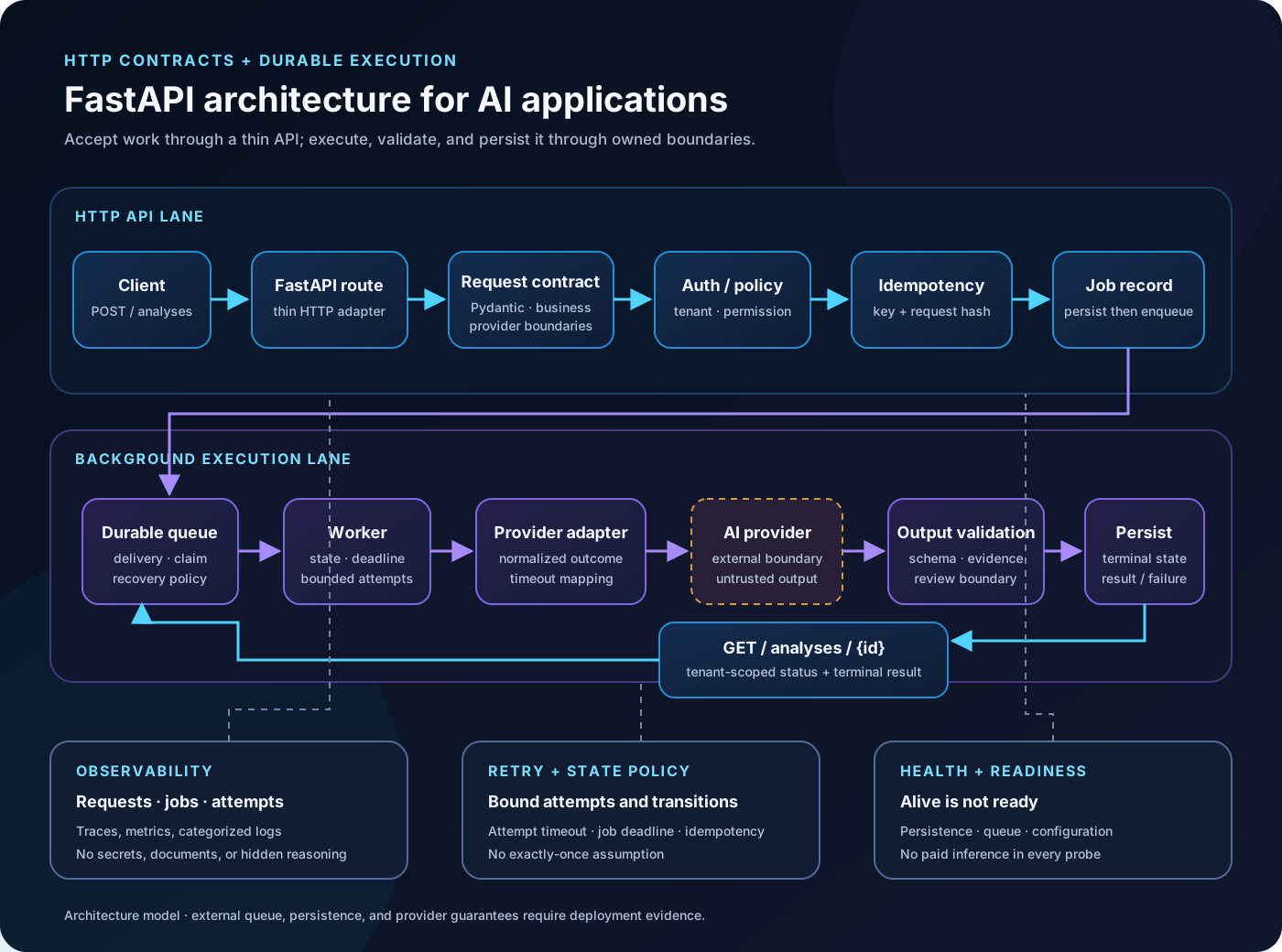
Define API contracts before route logic
Transport validation, business validation, and provider validation answer different questions.
CreateAnalysisRequest defines what a caller may send. AnalysisAcceptedResponse defines the 202 acknowledgement. AnalysisResultResponse defines the polling representation. ErrorEnvelope defines failures without leaking internal exceptions. Version these public contracts independently from provider SDK objects.
FastAPI request bodies use Pydantic models, while response models can validate and filter returned data. Configure extra-field and coercion behavior deliberately. Transport validation checks shape and types; business validation checks supported analysis types and tenant rules; provider validation checks untrusted external output.
Provider-specific objects must stop at the adapter. A client should not break because a provider renames a field, changes an error class, or adds metadata.
illustrative/fastapi_routes.pyfrom typing import Annotated, Literal
from fastapi import Depends, FastAPI, Header, status
from pydantic import BaseModel, ConfigDict, Field
class CreateAnalysisRequest(BaseModel):
model_config = ConfigDict(extra="forbid", strict=True)
document_id: str = Field(min_length=1)
analysis_type: Literal["summary", "classification", "risk_review"]
metadata: dict[str, str] = {}
class AnalysisAccepted(BaseModel):
analysis_id: str
status: Literal["accepted", "queued"]
status_url: str
class AnalysisResult(BaseModel):
analysis_id: str
status: Literal["queued", "running", "succeeded", "failed", "review_required"]
result: dict | None = None
failure_code: str | None = None
@app.post(
"/v1/analyses",
response_model=AnalysisAccepted,
status_code=status.HTTP_202_ACCEPTED,
)
async def create_analysis(
body: CreateAnalysisRequest,
idempotency_key: Annotated[str, Header(alias="Idempotency-Key")],
service: Annotated[AnalysisService, Depends(get_analysis_service)],
principal: Annotated[Principal, Depends(require_principal)],
) -> AnalysisAccepted:
return await service.accept(body, idempotency_key, principal)
@app.get("/v1/analyses/{analysis_id}", response_model=AnalysisResult)
async def get_analysis(
analysis_id: str,
service: Annotated[AnalysisService, Depends(get_analysis_service)],
principal: Annotated[Principal, Depends(require_principal)],
) -> AnalysisResult:
return await service.get_for_tenant(analysis_id, principal.tenant_id)| Boundary | Question | Example failure |
|---|---|---|
| Transport | Is the HTTP input structurally acceptable? | Missing document_id or wrong metadata type |
| Business/policy | May this tenant request this supported operation? | risk_review not permitted |
| Provider output | Does external output satisfy the domain result contract? | Missing evidence_ids |
The synthetic document-analysis workflow
A deterministic local simulator makes the backend control plane inspectable.
The fictional API accepts a document ID, analysis type, idempotency key, metadata, and tenant-scoped principal. A new valid request creates an analysis record, moves it to queued, and returns the identity conceptually. An in-memory worker later claims the job, calls a fake provider, validates the result, and stores a terminal state.
Nine POST attempts cover four accepted jobs, an exact replay, a conflicting reuse of a key, invalid input, an unsupported operation, and a policy block. The queued jobs cover success, a single timeout followed by success, invalid provider output routed to review, and another success.
Everything is synthetic. The runner uses Python 3.12 standard library, fixture data, and memory only. It starts no FastAPI server, performs no network call, and writes no database.
examples/fastapi_ai_backend_fixture.json{
"dataset": "synthetic-fastapi-ai-backend-v1",
"supported_analysis_types": [
"summary",
"classification",
"risk_review"
],
"max_provider_attempts": 2,
"requests": [
{
"request_id": "req-001",
"idempotency_key": "idem-001",
"document_id": "doc-alpha",
"analysis_type": "summary",
"metadata": {
"source": "fixture"
},
"principal": {
"tenant_id": "tenant-a",
"allowed_analysis_types": [
"summary",
"classification"
]
}
},
{
"request_id": "req-002",
"idempotency_key": "idem-001",
"document_id": "doc-alpha",
"analysis_type": "summary",
"metadata": {
"source": "fixture"
},
"principal": {
"tenant_id": "tenant-a",
"allowed_analysis_types": [
"summary",
"classification"
]
}
},
{
"request_id": "req-003",
"idempotency_key": "idem-001",
"document_id": "doc-alpha",
"analysis_type": "classification",
"metadata": {
"source": "fixture"
},
"principal": {
"tenant_id": "tenant-a",
"allowed_analysis_types": [
"summary",
"classification"
]
}
},
{
"request_id": "req-004",
"idempotency_key": "idem-002",
"document_id": "doc-timeout-once",
"analysis_type": "classification",
"metadata": {
"source": "fixture"
},
"principal": {
"tenant_id": "tenant-a",
"allowed_analysis_types": [
"summary",
"classification"
]
}
},
{
"request_id": "req-005",
"idempotency_key": "idem-003",
"document_id": "doc-invalid-output",
"analysis_type": "summary",
"metadata": {
"source": "fixture"
},
"principal": {
"tenant_id": "tenant-a",
"allowed_analysis_types": [
"summary",
"classification"
]
}
},
{
"request_id": "req-006",
"idempotency_key": "idem-004",
"document_id": "doc-policy",
"analysis_type": "risk_review",
"metadata": {
"source": "fixture"
},
"principal": {
"tenant_id": "tenant-a",
"allowed_analysis_types": [
"summary"
]
}
},
{
"request_id": "req-007",
"idempotency_key": "idem-005",
"document_id": "doc-gamma",
"analysis_type": "summary",
"metadata": {
"source": "fixture",
"language": "en"
},
"principal": {
"tenant_id": "tenant-b",
"allowed_analysis_types": [
"summary"
]
}
},
{
"request_id": "req-008",
"idempotency_key": "idem-006",
"document_id": "",
"analysis_type": "summary",
"metadata": {
"source": "fixture"
},
"principal": {
"tenant_id": "tenant-a",
"allowed_analysis_types": [
"summary"
]
}
},
{
"request_id": "req-009",
"idempotency_key": "idem-007",
"document_id": "doc-delta",
"analysis_type": "translation",
"metadata": {
"source": "fixture"
},
"principal": {
"tenant_id": "tenant-a",
"allowed_analysis_types": [
"translation"
]
}
}
],
"provider_outcomes": {
"doc-alpha": [
{
"type": "success",
"result": {
"analysis_type": "summary",
"summary": "Synthetic alpha summary.",
"labels": [
"fixture"
],
"evidence_ids": [
"segment-alpha-1"
]
}
}
],
"doc-timeout-once": [
{
"type": "timeout"
},
{
"type": "success",
"result": {
"analysis_type": "classification",
"summary": "Synthetic classification result.",
"labels": [
"operations"
],
"evidence_ids": [
"segment-timeout-1"
]
}
}
],
"doc-invalid-output": [
{
"type": "success",
"result": {
"analysis_type": "summary",
"summary": "Missing required evidence list.",
"labels": [
"fixture"
]
}
}
],
"doc-gamma": [
{
"type": "success",
"result": {
"analysis_type": "summary",
"summary": "Synthetic gamma summary.",
"labels": [
"fixture"
],
"evidence_ids": [
"segment-gamma-1"
]
}
}
]
},
"readiness_probes": [
{
"persistence": true,
"queue": true,
"provider_configuration": true
},
{
"persistence": true,
"queue": false,
"provider_configuration": true
}
],
"status_reads": [
"analysis-001",
"analysis-002",
"analysis-003",
"analysis-004"
]
}examples/run_fastapi_ai_backend_simulation.pyimport hashlib
import json
import sys
from collections import Counter, deque
from pathlib import Path
TERMINAL_STATES = {"succeeded", "failed", "review_required"}
TRANSITIONS = {
"accepted": {"queued"},
"queued": {"running"},
"running": {"succeeded", "failed", "review_required"},
}
class ProviderTimeout(Exception):
pass
class FakeProvider:
def __init__(self, outcomes):
self.outcomes = outcomes
self.calls = Counter()
def analyze(self, document_id, analysis_type):
index = self.calls[document_id]
self.calls[document_id] += 1
outcomes = self.outcomes[document_id]
outcome = outcomes[min(index, len(outcomes) - 1)]
if outcome["type"] == "timeout":
raise ProviderTimeout("synthetic provider timeout")
return outcome["result"]
def canonical_request_hash(request):
payload = {
"tenant_id": request["principal"]["tenant_id"],
"document_id": request["document_id"],
"analysis_type": request["analysis_type"],
"metadata": request["metadata"],
}
encoded = json.dumps(
payload, sort_keys=True, separators=(",", ":"), ensure_ascii=False
).encode("utf-8")
return hashlib.sha256(encoded).hexdigest()
def validate_request(request, supported_types):
required = {
"request_id",
"idempotency_key",
"document_id",
"analysis_type",
"metadata",
"principal",
}
if set(request) != required:
return "invalid_request"
for field in ("request_id", "idempotency_key", "document_id", "analysis_type"):
if not isinstance(request[field], str) or not request[field].strip():
return "invalid_request"
if not isinstance(request["metadata"], dict):
return "invalid_request"
principal = request["principal"]
if (
not isinstance(principal, dict)
or set(principal) != {"tenant_id", "allowed_analysis_types"}
or not isinstance(principal["tenant_id"], str)
or not principal["tenant_id"]
or not isinstance(principal["allowed_analysis_types"], list)
or not all(isinstance(value, str) for value in principal["allowed_analysis_types"])
):
return "invalid_request"
if request["analysis_type"] not in supported_types:
return "unsupported_operation"
if request["analysis_type"] not in principal["allowed_analysis_types"]:
return "policy_block"
return None
def validate_provider_result(result, expected_type):
if not isinstance(result, dict):
return False
if set(result) != {"analysis_type", "summary", "labels", "evidence_ids"}:
return False
if result["analysis_type"] != expected_type:
return False
if not isinstance(result["summary"], str) or not result["summary"].strip():
return False
if not isinstance(result["labels"], list) or not all(
isinstance(value, str) and value for value in result["labels"]
):
return False
if not isinstance(result["evidence_ids"], list) or not all(
isinstance(value, str) and value for value in result["evidence_ids"]
):
return False
return bool(result["evidence_ids"])
def transition(operation, target):
allowed = TRANSITIONS.get(operation["status"], set())
if target not in allowed:
raise ValueError(f"state_conflict:{operation['status']}->{target}")
operation["status"] = target
def run(fixture):
counters = Counter()
operations = {}
idempotency = {}
queue = deque()
provider = FakeProvider(fixture["provider_outcomes"])
for request in fixture["requests"]:
counters["requests"] += 1
error = validate_request(request, fixture["supported_analysis_types"])
if error:
counters[error + "s"] += 1
continue
request_hash = canonical_request_hash(request)
key = (request["principal"]["tenant_id"], request["idempotency_key"])
if key in idempotency:
existing_id, existing_hash = idempotency[key]
if existing_hash == request_hash:
counters["idempotent_replays"] += 1
continue
counters["idempotency_conflicts"] += 1
continue
analysis_id = f"analysis-{len(operations) + 1:03d}"
operation = {
"analysis_id": analysis_id,
"idempotency_key": request["idempotency_key"],
"request_hash": request_hash,
"tenant_id": request["principal"]["tenant_id"],
"document_id": request["document_id"],
"analysis_type": request["analysis_type"],
"status": "accepted",
"attempt_count": 0,
"result": None,
"failure_code": None,
}
operations[analysis_id] = operation
idempotency[key] = (analysis_id, request_hash)
counters["accepted"] += 1
transition(operation, "queued")
queue.append(analysis_id)
while queue:
analysis_id = queue.popleft()
operation = operations[analysis_id]
transition(operation, "running")
counters["jobs_processed"] += 1
for attempt in range(1, fixture["max_provider_attempts"] + 1):
operation["attempt_count"] = attempt
try:
result = provider.analyze(
operation["document_id"], operation["analysis_type"]
)
except ProviderTimeout:
if attempt < fixture["max_provider_attempts"]:
counters["provider_retries"] += 1
continue
operation["failure_code"] = "provider_timeout"
transition(operation, "failed")
break
if not validate_provider_result(result, operation["analysis_type"]):
operation["failure_code"] = "provider_invalid_output"
transition(operation, "review_required")
break
operation["result"] = result
transition(operation, "succeeded")
break
counters[operation["status"]] += 1
for probe in fixture["readiness_probes"]:
counters["readiness_checks"] += 1
if not all(probe.values()):
counters["readiness_failures"] += 1
for analysis_id in fixture["status_reads"]:
counters["status_reads"] += 1
operation = operations.get(analysis_id)
if operation and operation["status"] in TERMINAL_STATES:
counters["terminal_status_reads"] += 1
lines = [
"SYNTHETIC EDUCATIONAL FIXTURE — backend architecture only; no real provider",
f"dataset={fixture['dataset']}",
f"requests={counters['requests']}",
f"accepted={counters['accepted']}",
f"idempotent_replays={counters['idempotent_replays']}",
f"idempotency_conflicts={counters['idempotency_conflicts']}",
f"invalid_requests={counters['invalid_requests']}",
f"unsupported_operations={counters['unsupported_operations']}",
f"policy_blocks={counters['policy_blocks']}",
f"jobs_processed={counters['jobs_processed']}",
f"provider_retries={counters['provider_retries']}",
f"succeeded={counters['succeeded']}",
f"failed={counters['failed']}",
f"review_required={counters['review_required']}",
f"readiness_checks={counters['readiness_checks']}",
f"readiness_failures={counters['readiness_failures']}",
f"status_reads={counters['status_reads']}",
f"terminal_status_reads={counters['terminal_status_reads']}",
]
sys.stdout.buffer.write("\n".join(lines).encode("utf-8"))
if __name__ == "__main__":
fixture_path = Path(__file__).with_name("fastapi_ai_backend_fixture.json")
run(json.loads(fixture_path.read_text(encoding="utf-8")))Expected output
SYNTHETIC EDUCATIONAL FIXTURE — backend architecture only; no real provider
dataset=synthetic-fastapi-ai-backend-v1
requests=9
accepted=4
idempotent_replays=1
idempotency_conflicts=1
invalid_requests=1
unsupported_operations=1
policy_blocks=1
jobs_processed=4
provider_retries=1
succeeded=3
failed=0
review_required=1
readiness_checks=2
readiness_failures=1
status_reads=4
terminal_status_reads=4
Choose synchronous or job-based execution deliberately
Python async, streaming, and durable background processing are different mechanisms.
A synchronous HTTP completion can fit short, bounded work with predictable dependencies and a response deadline the client can tolerate. The route still needs cancellation, timeout, provider normalization, and output validation.
A job model is safer when work is long-running, involves multiple provider/tool steps, needs retries, processes large documents, must survive client disconnects, or requires worker isolation. POST accepts work and returns 202 plus an analysis ID; GET exposes progress and the terminal result.
Writing async def allows cooperative concurrency for awaitable I/O. It does not create durable background work, make CPU-heavy code non-blocking, or preserve a task after process failure. Streaming can improve interactive delivery but is not a job queue and does not supply recovery.
| Choice | Fits | Does not provide |
|---|---|---|
| Synchronous response | Short bounded request work | Durable retry or disconnect recovery |
| async def | Cooperative waiting on async I/O | CPU parallelism or persistence |
| Streaming | Incremental interactive output | Durable job state |
| Queue + worker | Long/retriable/recoverable jobs | Correctness without persistence and idempotency |
Persist before enqueueing and define the queue boundary
The acknowledgement should refer to state that the system can retrieve.
The production-oriented flow is validate, authorize, resolve idempotency, create the job record, enqueue its identity, and return 202 with analysis_id and status_url. A database transaction plus outbox or another atomic handoff pattern is often needed so the record and queue message cannot diverge.
The worker claims by analysis ID, validates the current state, records an attempt, calls the provider adapter, validates output, and commits a terminal state. The client polls a tenant-scoped GET endpoint rather than holding the original POST open indefinitely.
The fixture uses a deque and dictionaries. This demonstrates sequencing only; it does not prove atomic enqueueing, durable delivery, crash recovery, leases, or multi-worker behavior.
FastAPI documents BackgroundTasks for functions that run after a response is returned. It can be appropriate for small same-process follow-up work. The documentation itself points to larger queue tools when heavy computation should run in other processes or servers.
BackgroundTasks does not automatically persist a job, provide distributed claiming, survive process termination, enforce retry policy, or coordinate multiple workers. Long-running AI work usually needs an external queue/worker boundary plus persistent operation state.
The PSA Card Scanner and Batch Processor case study is a narrower public-code example of a FastAPI /process boundary, background processing, PostgreSQL-backed process/result state, and frontend status polling. It does not demonstrate the durable external queue and multi-worker guarantees described here.
Do not choose a queue product before defining delivery, ordering, retry, idempotency, timeout, cancellation, and recovery requirements.
Hide provider SDKs behind an adapter
The domain should consume normalized outcomes, not vendor response objects.
An AIProvider interface can expose analyze(document, analysis_type, deadline) and return a provider-neutral candidate result. The adapter owns SDK configuration, request translation, timeout mapping, rate-limit mapping, response parsing, and safe diagnostic context.
Normalize success, timeout, rate-limited, transient error, permanent error, and invalid output into application categories. Do not return raw exceptions, headers, request bodies, secrets, or provider-specific stack traces to API clients.
The fake provider reads authored outcomes from the fixture. It proves adapter-shaped control flow, not any real provider's reliability or structured-output behavior.
When model output can propose external API actions, the safe LLM-to-API workflow guide carries this boundary through validation, authorization, idempotent execution, and reconciliation.
Treat AI output as untrusted input
Structured transport does not establish task correctness.
Validate exact required fields, types, enums, evidence references, lengths, and format rules before committing a result. Provider JSON or structured-output modes can reduce syntax failures but do not prove that the answer is factually correct, grounded, safe, or appropriate.
The simulator requires exactly analysis_type, summary, labels, and evidence_ids; it checks types, the requested analysis type, non-empty summary and evidence. A missing evidence list routes the operation to review_required with provider_invalid_output.
Use review_required for ambiguous provider output, policy-sensitive analysis, conflicting evidence, exhausted retries that require adjudication, or an invalid final result where automatic failure would discard useful evidence. Define which cases are eligible and who may resolve them.
A review record should contain safe input references, normalized candidate output, validation failures, attempts, policy version, and the requested decision. It should not request hidden chain-of-thought or expose unrelated tenant data. The fixture routes one invalid result to review without assigning a confidence score or performing human judgment.
Use the existing evaluation pipeline guide for dataset design, graders, slice analysis, regressions, and release gates. This Article owns the HTTP and execution architecture around that quality system.
- Evaluate result quality separately: request/schema validity is necessary but not sufficient.
Apply layered timeouts and bounded retries
One global timeout cannot express every deadline in the system.
A client timeout bounds how long the caller waits. A request handler deadline protects the HTTP tier. A provider-attempt timeout bounds one external call. A worker timeout bounds one execution attempt, while an overall job deadline limits the entire operation across retries.
Retry only failures likely to be transient: selected timeouts, eligible server errors, or rate limits when server guidance and policy permit. Invalid input, unsupported operations, policy blocks, state conflicts, and invalid provider schemas should not loop.
Use capped exponential backoff with jitter conceptually and honor applicable Retry-After guidance. The fixture does not sleep: it retries one authored timeout once so execution stays deterministic. No latency result is measured.
| Failure | Default | Reason |
|---|---|---|
| Provider timeout | Bounded retry | May be transient |
| Eligible 5xx | Bounded retry | May recover; preserve deadline |
| Rate limited | Policy/server-guided retry | Respect Retry-After and limits |
| Invalid request | No retry | Caller must correct input |
| Invalid provider schema | No blind retry | Contract defect or review case |
| Policy block | No retry | Authorization decision |
Make idempotency a stored business rule
Client retries must not silently create duplicate operations.
Scope an idempotency key to the authenticated tenant or project. Store it with a canonical request hash and the created analysis ID. A repeated key with the same hash can return the existing operation; the same key with a different hash should return a conflict.
The request hash should cover the semantic command, not volatile transport fields. Protect the key and hash with a uniqueness constraint, and resolve races transactionally. Retention and reuse policy must be documented.
Idempotency does not guarantee exactly-once execution. Workers and downstream effects still need idempotent writes, claim/lease logic, and reconciliation because messages or attempts can be repeated.
Validate every operation-state transition
A named state machine prevents impossible updates from becoming ordinary records.
The fixture uses accepted, queued, running, succeeded, failed, and review_required. Succeeded, failed, and review_required are terminal for this teaching model. Production cancellation can be added only with explicit rules for who can request it and what happens if work is already running.
Allow transitions rather than merely listing statuses: accepted to queued, queued to running, and running to a terminal outcome. Use conditional updates or versions so two workers cannot both overwrite state without detection.
Store attempt count and failure code separately from status. A failed operation with provider_timeout needs different handling from a review_required operation with invalid output.
Persist evidence for recovery and polling
In-memory objects are useful tests, not operational storage.
A durable analysis record commonly contains analysis_id, tenant/project identity, idempotency key, request hash, status, analysis type, provider configuration reference, attempt count, timestamps, result reference, and failure code. Sensitive source documents should have separate access and retention rules.
Commit state transitions atomically, use optimistic concurrency or guarded updates, and make result writes idempotent. Decide how queued records are reconciled if message delivery fails and how running records are recovered after an expired lease.
The simulator stores everything in dictionaries and a deque. It proves none of durability, restart recovery, transaction isolation, multi-worker consistency, backups, or disaster recovery.
Return a consistent error envelope
Stable public failures protect clients from internal implementation churn.
A useful envelope contains error.code, a safe message, request_id, retryable, and optional sanitized details. Correlate the public request ID with internal telemetry without exposing raw provider exceptions or confidential content.
Map validation failures to 400 or framework-appropriate validation semantics, authentication/authorization to 401/403, missing tenant-scoped operations to 404, idempotency or state conflicts to 409, rate limiting to 429, and internal/provider-boundary failures to suitable 5xx responses.
Retryable is an application promise, not a guess. It should reflect method semantics, idempotency protection, the failure class, remaining deadline, and policy.
Examples
- { "error": { "code": "idempotency_conflict", "message": "The idempotency key was already used for a different request." }, "request_id": "req-003", "retryable": false }
Separate liveness from readiness
An alive process may still be unable to accept useful work.
/health should answer whether the process and event loop can respond. /readiness should answer whether required configuration and dependencies are ready enough for traffic—for example persistence, queue access, schema/migrations, and provider configuration.
Readiness should normally inspect configuration or lightweight dependency state, not perform a paid or mutating provider inference on every probe. Deployment platforms can remove an unready instance from traffic while leaving a live process running for diagnosis.
The fixture evaluates two authored readiness states and records one failure when the queue is unavailable. It does not start a server or inspect real dependencies.
Use dependency injection and lifespan to own resources
Construct shared clients once, inject boundaries, and close them deliberately.
FastAPI Depends can supply the provider adapter, repository, queue, and principal to thin routes. Tests can replace those dependencies with deterministic fakes without importing provider SDK behavior into domain logic.
Current FastAPI guidance recommends the lifespan parameter with an async context manager for startup and shutdown work. Initialize reusable database pools, HTTP clients, queue clients, or model resources before serving, then close them after the application stops.
Do not create expensive reusable clients per request unless their library requires it. Keep resource ownership explicit so timeouts, connection limits, TLS, cleanup, and tests have one configuration boundary.
illustrative/fastapi_lifespan.pyfrom collections.abc import AsyncIterator
from contextlib import asynccontextmanager
from fastapi import FastAPI
@asynccontextmanager
async def lifespan(app: FastAPI) -> AsyncIterator[None]:
app.state.repository = await AnalysisRepository.connect()
app.state.queue = await JobQueue.connect()
app.state.provider = ProviderAdapter(build_shared_http_client())
try:
yield
finally:
await app.state.queue.close()
await app.state.repository.close()
await app.state.provider.close()
app = FastAPI(lifespan=lifespan)
@app.get("/health")
async def health() -> dict[str, str]:
return {"status": "alive"}
@app.get("/readiness")
async def readiness() -> dict[str, object]:
checks = await check_dependencies_without_provider_inference(app.state)
return {"ready": all(checks.values()), "checks": checks}Observe requests, jobs, attempts, and terminal outcomes
Logs, metrics, and traces should explain the control path without copying sensitive documents.
Carry request_id and analysis_id across the route, repository, queue message, worker, provider attempt, validation, and result update. Record route, tenant-safe reference, state transition, attempt, provider alias, duration from real telemetry, failure code, queue delay, and terminal status.
Metrics aggregate counts and distributions; logs capture categorized events; traces connect the path across components. OpenTelemetry defines these as distinct signals that can be correlated.
Do not log secrets, raw confidential documents, full provider payloads by default, or hidden chain-of-thought. Apply redaction, access, retention, and sampling policy before adding content to telemetry.
Keep a controlled failure taxonomy
The category should identify the owner and next action.
Client failures include invalid_request and unsupported_operation. Policy includes policy_block. Idempotency and state conflicts identify deterministic application races or misuse. Provider failures include timeout, rate limited, provider error, and invalid output. Queue and persistence failures remain separate.
Normalize internal details into stable public codes while retaining sanitized operator evidence. A provider timeout must not look like client validation, and an unavailable queue must not be reported as successful acceptance.
Review taxonomy over time, but version changes so dashboards, alerts, and clients do not silently reinterpret old failures.
| Layer | Example codes | Typical owner/action |
|---|---|---|
| Client | invalid_request, unsupported_operation | Correct request or contract |
| Policy | policy_block | Review permission/policy; do not retry |
| Idempotency/state | idempotency_conflict, state_conflict | Resolve key or concurrency rule |
| Provider | provider_timeout, provider_rate_limited, provider_invalid_output | Retry selectively, fail, or review |
| Queue/persistence | queue_error, persistence_error | Stop acceptance or recover infrastructure |
| Final validation | final_validation_error | Block result and investigate |
Respect concurrency and deployment boundaries
Async I/O, CPU parallelism, worker processes, and horizontal replicas solve different problems.
An async route can interleave awaitable I/O, but CPU-heavy parsing, embeddings, local inference, or image processing can block the event loop. Isolate CPU-heavy work in worker processes, process pools, or an external job system appropriate to its resource and cancellation model.
A production deployment may place a reverse proxy or load balancer before stateless API replicas, with external persistence and queue services shared by workers. Multiple server workers consume separate memory, so in-process queues and caches cannot provide cross-worker consistency.
Add health/readiness probes, environment-managed secrets, resource limits, graceful shutdown, migration strategy, rollback, and measured capacity planning. No particular cloud or worker count is universally best.
What the fixture demonstrates—and does not prove
Executable architecture evidence supports a narrow claim.
The two artifacts reproduce request validation, policy checks, idempotent replay and conflict, state transitions, an in-memory queue, provider normalization, one bounded retry, invalid-output review, readiness evaluation, and terminal status retrieval.
Raw-byte matching proves the deterministic authored result in the tested Python environment. It does not run FastAPI, Pydantic, a provider, a database, a network, or a durable queue.
| Evidence | Demonstrates | Does not prove |
|---|---|---|
| Request contract | Named transport and business fields | Authentication or security completeness |
| Deterministic fixture | Repeatable authored control paths | Production traffic behavior |
| Idempotency simulation | Same-payload replay and changed-payload conflict | Exactly-once execution or race safety |
| Retry simulation | One bounded provider-timeout retry | Real provider reliability or latency |
| State machine | Allowed in-memory transitions | Database isolation or multi-worker consistency |
| Architecture SVG | Separated API, worker, provider, and persistence boundaries | Deployed cloud scalability |
| Health/readiness model | Distinct liveness and dependency readiness | Real dependency availability |
| Exact stdout | Reproducible local summary | Throughput, durability, SLA, or business outcome |
Production hardening checklist
Add operational guarantees only with tests and measured evidence.
Implement durable transactional state, an atomic enqueue/outbox boundary, worker claims and leases, idempotent terminal writes, bounded deadlines, cancellation rules, queue reconciliation, migrations, backups, and disaster-recovery tests. Exercise process termination at each transition.
Add contract and integration tests, provider-adapter fixtures, authentication/authorization tests, tenant-isolation tests, load and capacity tests using representative authorized data, observability alerts, privacy controls, secrets rotation, incident runbooks, and deployment rollback.
Keep each neighboring concern in its own layer: agent orchestration controls the decision loop, RAG controls evidence retrieval, evaluation controls quality gates, and this FastAPI design controls HTTP acceptance and backend execution.
- Strengthen Python contracts and testing: keep provider uncertainty behind deterministic boundaries.
- Deepen general backend operations: cover persistence, queues, deployment, and security.
- Build bounded agent execution: separate model proposals from tools and side effects.
- Measure application quality: use versioned cases, graders, regressions, and release policy.
Tips
- Keep routes thin and contracts explicit.
- Persist operation state before acknowledging durable work.
- Scope idempotency keys to an authenticated boundary.
- Treat provider output as untrusted input.
- Separate liveness, readiness, request deadlines, and job deadlines.
- Claim only the guarantees that failure tests and telemetry establish.
FAQ
Does using FastAPI make an AI backend production-ready?
No. FastAPI provides valuable HTTP, validation, dependency, and documentation primitives. Durability, queue recovery, authorization, idempotency, provider handling, observability, deployment, and operational testing still require explicit architecture.
Is FastAPI BackgroundTasks a durable job queue?
No. It runs post-response work in the application context but does not automatically provide persistent jobs, distributed claiming, durable retries, or crash recovery. Long-running reliable AI jobs often need an external queue and worker plus persistent operation state.
Does async def make CPU-heavy AI work non-blocking?
No. Async functions support cooperative concurrency while awaiting compatible I/O. CPU-heavy processing can still block the event loop and may need a process pool, worker process, or external job system.
Does an idempotency key guarantee exactly-once execution?
No. It can make repeated submissions resolve to one operation when backed by a canonical request hash and atomic uniqueness. Workers, messages, and downstream effects may still repeat and need idempotent handling.
Why should health and readiness be separate?
Liveness says the process can respond. Readiness says required configuration and dependencies are ready enough for traffic. Keeping them separate allows an alive but temporarily unready instance to be removed from service without being mistaken for a dead process.
Sources
Primary and authoritative sources reviewed for this article.
- FastAPI documentation — Request Body
Reviewed for Pydantic request-body models, input validation, type support, and generated schema documentation.
- FastAPI documentation — Response Model
Reviewed for response validation, documentation, and output filtering at the HTTP boundary.
- FastAPI documentation — Dependencies
Reviewed for Depends-based resource, shared-logic, and authorization boundaries.
- FastAPI documentation — Background Tasks
Reviewed for post-response task behavior and the documented caveat around heavy multi-process or multi-server work.
- FastAPI documentation — Lifespan Events
Reviewed for lifespan-managed shared resources and the recommendation over deprecated startup/shutdown event handlers.
- FastAPI documentation — Concurrency and async / await
Reviewed for async I/O, concurrency, and the distinction from CPU parallelism.
- FastAPI documentation — Server Workers
Reviewed for multiple worker processes and deployment boundaries.
- Pydantic documentation — Models
Reviewed for typed models, configuration, validation, and serialization contracts.
- Pydantic documentation — Strict Mode
Reviewed for deliberate strict validation rather than implicit coercion.
- Python 3.12 documentation — Coroutines and Tasks
Reviewed for asyncio timeout and cancellation semantics.
- OpenTelemetry documentation — Signals
Reviewed for the distinction among traces, metrics, and logs.
- RFC 9110 — HTTP Semantics
Reviewed for 202 semantics, idempotent method concepts, Retry-After, and safe retry reasoning.
Conclusion
A production-oriented FastAPI AI backend keeps the HTTP layer narrow and makes every consequential boundary explicit: contracts, authorization, idempotency, durable operation state, queue ownership, provider normalization, output validation, deadlines, retries, observability, and release-safe terminal states. The local fixture makes those mechanics reproducible without pretending to prove production performance. Continue with the broader backend engineering roadmap or connect this execution layer to a bounded Python agent architecture.