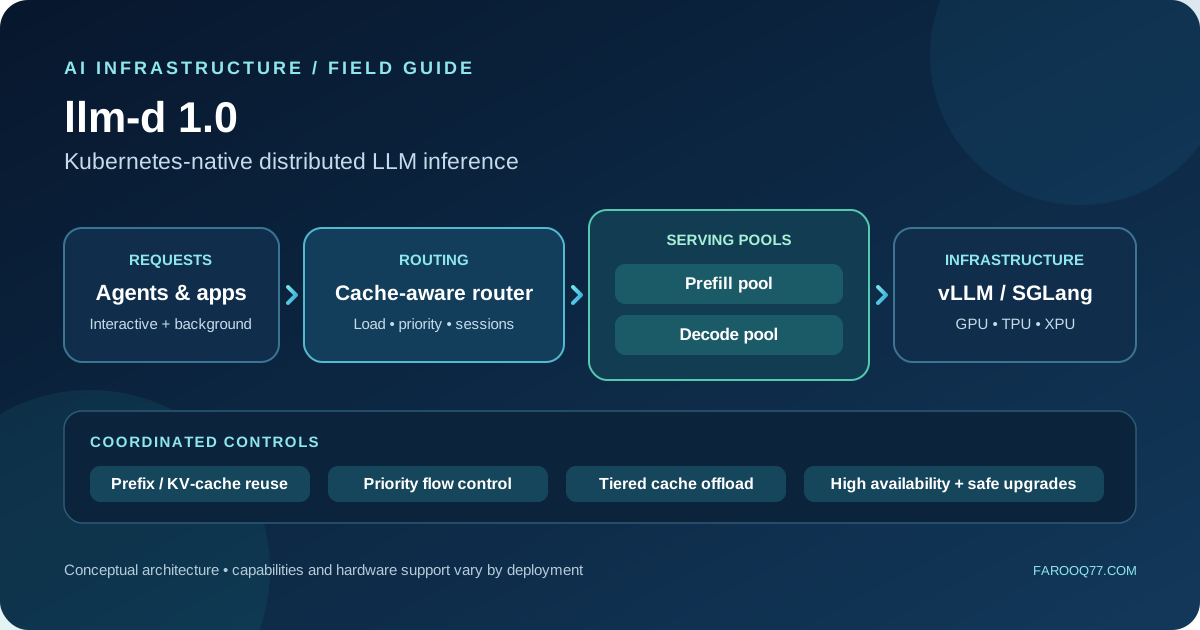
llm-d 1.0 Explained: Kubernetes-Native Distributed LLM Inference
Learn what llm-d 1.0 changes for production LLM serving, including cache-aware routing, KV-cache tiers, prefill/decode disaggregation, traffic control, benchmarks, and rollout decisions.
The difficult part of running an open-weight language model is not always loading its weights. At production scale, teams must keep first-token latency predictable, reuse long prompt context, handle bursts from multi-step agents, share accelerators between tenants, and upgrade serving components without interrupting active work. llm-d 1.0, released on October 20, 2026, is an open-source, Kubernetes-native stack that coordinates distributed inference engines such as vLLM and SGLang. It is not a new foundation model or a hosted API; it is infrastructure for operating model-serving pools. This guide explains the release, the architectural ideas behind it, what published performance figures do and do not prove, and how to decide whether the stack fits a real deployment.
What llm-d 1.0 is—and what it is not
A serving and orchestration layer for teams running their own models.
llm-d sits around inference engines and helps a cluster make coordinated decisions about where requests should run, how cached context can be reused, how competing traffic is prioritized, and how serving components are operated. Its design connects model-serving engines such as vLLM and SGLang with Kubernetes-native scheduling and deployment practices. The project is open source, and its components can be composed instead of adopted as one indivisible product.
That distinction matters. vLLM or SGLang still performs model execution; llm-d adds distributed routing and operational behavior around those engines. Kubernetes provides the surrounding platform primitives, while a cloud provider may offer a managed integration. Google Cloud, for example, describes GKE Inference Gateway as a managed way to run the llm-d router in its GKE environment. That managed service is not the same thing as the upstream open-source project.
The project remains a CNCF Sandbox project. Version 1.0 is a meaningful release milestone, but it does not mean every component is a Kubernetes standard, every accelerator combination has identical support, or production outcomes are guaranteed without workload-specific testing. Teams should verify the engine, accelerator, storage connector, routing policy, and deployment recipe they intend to operate.
If the application uses retrieval-augmented generation, our guide to building production-ready RAG systems covers the application-side retrieval and evidence pipeline that sits above model serving.
| Layer | Primary responsibility | Example |
|---|---|---|
| Application or agent | Defines tasks, tools, context, and user-facing behavior | A coding agent or support assistant |
| Serving control layer | Routes requests, manages cache locality, and coordinates traffic | llm-d router and flow-control components |
| Inference engine | Executes model computation and token generation | vLLM or SGLang |
| Infrastructure | Provides scheduling, networking, accelerators, and storage | Kubernetes cluster with GPU or TPU pools |
Why agent workloads make inference harder
One user action can create many requests that share context but compete for capacity.
A short chat request often looks like one prompt followed by one answer. An agent may instead read files, call tools, inspect results, retry a failed step, and ask the model to reason again. Several agents can do this at once, and each step may reuse a long prefix from the same conversation or task. The resulting workload has repeated context, uneven request sizes, unpredictable bursts, and a mixture of latency-sensitive interactions and background work.
The key-value (KV) cache stores intermediate attention state that lets a model server avoid recomputing portions of a prompt already processed. That state consumes accelerator memory, and it is useful only when the request reaches a server that can reuse it or when the cache can be transferred efficiently. A generic round-robin load balancer may distribute requests evenly while sending them to replicas that must rebuild the same context.
Cache locality alone is not enough. If every request is sent to the replica with the warmest cache, that replica can become overloaded while less-busy replicas sit idle. A production router has to balance reuse against current load and latency. Routing policy should be evaluated with the actual prompt lengths, concurrency, and arrival patterns of the application rather than a toy request loop.
Application-side orchestration and failure handling are explored in our production AI-agent guide; llm-d addresses the serving infrastructure beneath those agent steps, not the agent's task logic.
Tips
- Measure the share of traffic that is interactive, asynchronous, or background before choosing routing and priority policies.
- Record prompt length, output length, concurrency, cache-hit behavior, and queueing delay; averages alone can hide expensive workload slices.
- Treat agent loops as a traffic pattern to design for, not as a reason to remove tenant limits or overload safeguards.
How the serving path works
The router uses request and fleet signals to select where each step should run.
At a high level, a request enters through a serving endpoint and reaches a routing layer. The router can consider whether a candidate replica holds a matching prefix, how busy it is, and which traffic priority applies. It then forwards the request to a model-serving engine. Depending on the deployment, the stack can also use separate pools for prefill and decode, plus additional cache tiers when accelerator memory is not sufficient for the working set.
Prefill processes input tokens and builds the attention state needed for generation. Decode then produces output tokens incrementally and is often constrained by memory bandwidth and active sequence state. The two phases have different resource profiles, so keeping them together is not always the best use of a large fleet. Disaggregated serving lets operators scale and place the phases separately, but introduces networking, coordination, and version-compatibility requirements that must be measured.
KV-cache tiering extends the memory hierarchy rather than making memory unlimited. Frequently reused state may remain in accelerator memory; other state can be moved to host memory or supported storage tiers. Moving it has a cost in transfer latency and bandwidth, so offloading is most useful when the alternative is expensive recomputation or when the working set exceeds the fastest tier.
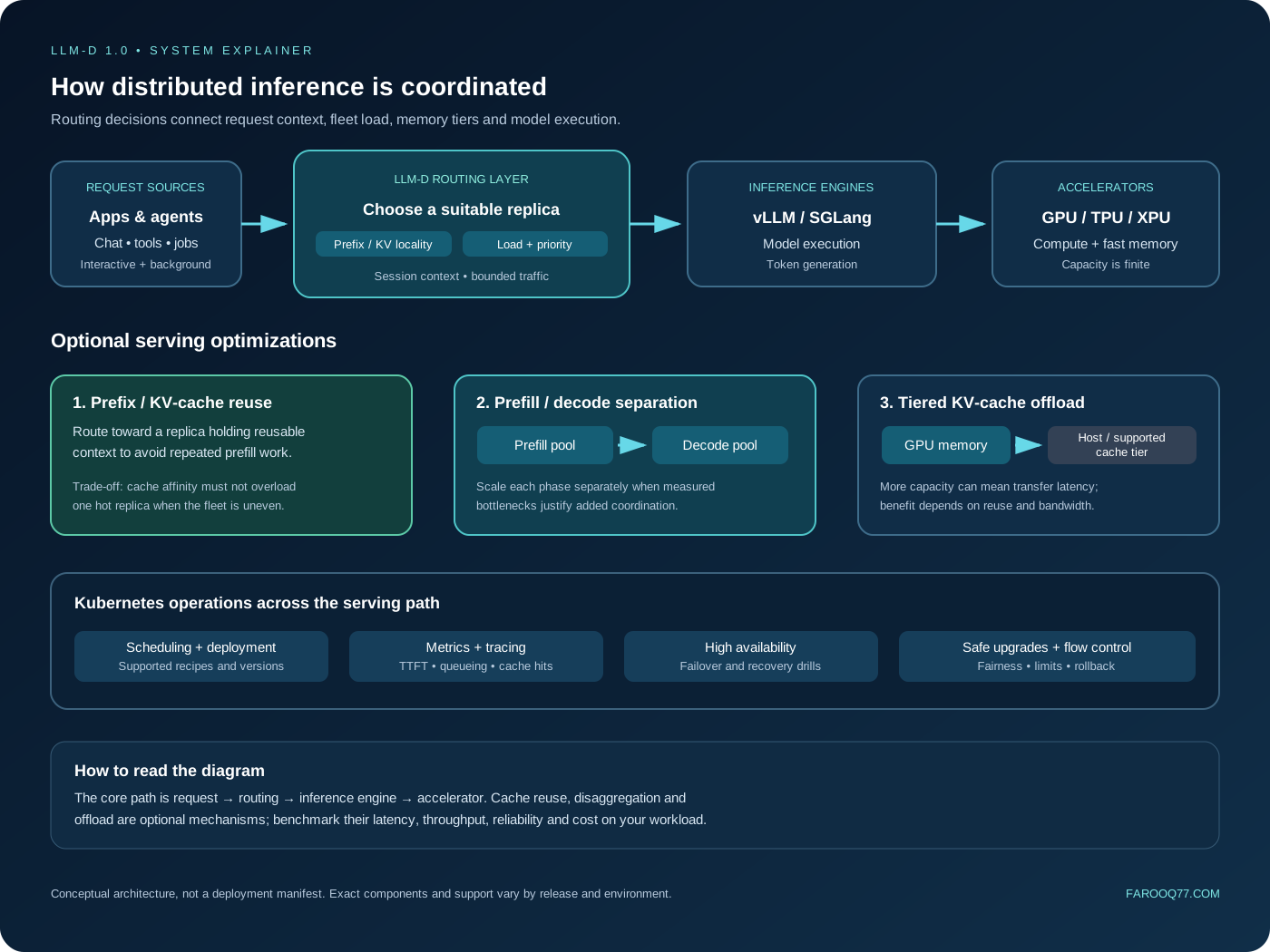
| Mechanism | Potential benefit | What operators must watch |
|---|---|---|
| Prefix- and cache-aware routing | Reuses context already held by a replica | Hot spots when affinity overwhelms load balancing |
| KV-cache offloading | Retains more reusable state beyond accelerator memory | Transfer latency, storage throughput, and eviction policy |
| Prefill/decode disaggregation | Scales compute-heavy and memory-sensitive phases separately | Inter-pool networking, synchronization, and rollout safety |
| Priority flow control | Protects latency-sensitive traffic from bursts | Fairness, queue growth, quota policy, and starvation risk |
| Router high availability | Reduces the risk of routing becoming a single point of failure | Failover behavior, configuration consistency, and upgrade testing |
What changes in version 1.0
The release emphasizes reliable operations, not only individual optimizations.
The October 20 release notes emphasize a stable v1 configuration API and a hardened request path, along with high-availability routing and safer upgrades. For disaggregated serving, the project describes coordinated management of prefill and decode replicas so a rolling update does not casually mix incompatible revisions or drop active context. Those operational concerns become critical once a serving endpoint supports real users.
The release also puts more emphasis on multi-tenant quality of service. Priority- and fairness-aware flow control can help keep background agent loops from consuming all available capacity when interactive traffic arrives. Session-aware routing and turn-priority scheduling are intended to preserve useful context across multi-step interactions. The practical effect depends on how a team configures priorities, admission limits, timeouts, and overload behavior.
The ecosystem includes cloud-specific paths as well as upstream components. Google Cloud describes GKE integration, mixed Google TPU and GPU pools, and managed routing. Those details are relevant to teams already using that environment, but should not be read as a guarantee that every managed feature is available unchanged on every Kubernetes distribution. Use the project's supported deployment recipes and the relevant provider documentation for the target.
- A more stable configuration and request path for teams standardizing on a release.
- High-availability routing and upgrade controls designed for ongoing operations.
- Flow control and priority-aware scheduling for mixed interactive and background workloads.
- Agent-aware routing behavior intended to reuse context across turns.
- Composable serving patterns for cache offload, disaggregation, and different accelerator pools.
What the published performance numbers mean
Use reported results as hypotheses to reproduce, not universal speedup promises.
The Google Cloud release announcement reports workload-specific gains from its own deployments and benchmarks. For example, it describes a coding-agent workload on Ironwood TPU where prefix-aware routing plus host-memory offload reduced median time to first token by more than 85% and increased throughput 2.4 times versus a plain Kubernetes Service. It also describes a multi-region deployment benchmark. These figures are useful clues about workloads that may benefit, but they are not an independent, cross-platform benchmark of every llm-d configuration.
Results depend on the baseline, model, prompt distribution, output lengths, concurrency, accelerator generation, cache state, and definition of success. A deployment that is decode-bound, has little reusable context, or cannot keep the cache warm may see a different outcome. The extra router and storage layers can also add overhead when a workload is small or already well served by a single engine.
Before repeating a headline number in a business case, read the linked benchmark configuration and reproduce the closest workload on the target hardware. Report latency and throughput together, and include cost, failures, and tail behavior. If a result improves the median but worsens p95 latency or increases errors under burst, it may not satisfy the service-level objective that matters to users.
For a repeatable evaluation plan, see our LLM evaluation pipeline guide, which explains frozen cases, slice analysis, regression checks, and release gates.
| Reported result | Context supplied by the source | How to interpret it |
|---|---|---|
| More than 85% lower median TTFT and 2.4x throughput | Google Cloud reports this for an agentic coding workload on Ironwood TPU with prefix-aware routing and host-memory offload versus a plain Kubernetes Service | A provider-reported result for a named setup, not a forecast for arbitrary GPUs or prompts |
| 2.9x throughput across three clusters | Google Cloud describes a 17,000-node multi-region GKE benchmark with 99.9% success and under 1% routing overhead | Validate cluster topology, workload mix, and success criteria before comparing |
| 11.5x lower inference cost in one workload | IBM reports a quantum error-correction workload using open models and llm-d | Cost comparisons depend on model quality, hardware rental, utilization, and the selected baseline |
How to decide whether llm-d fits
Start from a measurable bottleneck instead of adopting the whole stack by default.
llm-d is most compelling when a team operates its own model-serving fleet, has enough concurrency or context reuse for distributed routing to matter, and needs controls that a basic load balancer does not provide. It is also more attractive when the organization already understands Kubernetes operations and can support the extra metrics, policies, and rollout procedures. Teams using a hosted model API may have no reason to introduce this layer because the provider already owns the serving infrastructure.
A small deployment with one model, modest traffic, short prompts, and no strict multi-tenant requirements may be simpler to operate with a single engine and a conventional service. The right baseline is not an outdated architecture chosen to make a new system look fast; it is the simplest supported system that meets the workload's real service objectives.
Write down the reason for evaluating llm-d before running a benchmark. Examples include repeated long prefixes causing excess prefill work, accelerator memory pressure, poor tail latency under bursts, the need to separate prefill from decode, or a requirement to protect premium traffic from background jobs. If the current system does not exhibit one of these problems, the extra control plane may add complexity without enough benefit.
| Signal in the current system | Likely next step |
|---|---|
| Long repeated prefixes and measurable recomputation | Test prefix-aware routing and cache reuse first |
| Cache working set exceeds accelerator memory | Benchmark a supported offload tier against recomputation and latency costs |
| Interactive traffic slows when background jobs burst | Define tenant priorities and test bounded flow control |
| Prefill and decode have different resource bottlenecks | Evaluate disaggregation with network and coordination costs included |
| Traffic is low and one engine already meets SLOs | Keep the simpler design until evidence justifies more components |
A production rollout checklist
Keep the first experiment narrow, observable, and reversible.
Choose one workload and one supported deployment recipe. Capture the current baseline before changing the router, cache tier, or model-server topology. Freeze representative prompts and conversation traces, including long-context requests, short interactive turns, bursty arrivals, and failure cases that currently cause incidents. Record the model revision, engine version, hardware, concurrency, routing configuration, and cache state so another engineer can reproduce the run.
Track time to first token (TTFT), inter-token latency or time per output token, end-to-end latency, completed tokens per second, queueing delay, error and timeout rates, cache-hit behavior, accelerator utilization, and cost per useful request. Break results down by prompt length, output length, tenant, and priority class. Keep cold-cache and warm-cache tests separate; a mixed average can hide a configuration that only works after a favorable warm-up.
Exercise operational behavior before routing important traffic through the new path. Test a router restart, a model-server replacement, cache eviction, storage slowdown, queue saturation, and a rolling update. Confirm authentication and tenant isolation are enforced by trusted services, not inferred from model-generated arguments. Set explicit limits and rollback thresholds, and make sure dashboards can identify which routing or serving decision caused a regression.
- Define the SLO and rollback threshold before inspecting candidate results.
- Use representative traces and repeat runs at multiple concurrency levels.
- Compare the same model and output-quality requirements across baselines.
- Inspect p50 and p95/p99 latency, error rates, and cost—not only peak throughput.
- Test upgrades and failure recovery with active sessions before a broad rollout.
- Keep a known-good deployment recipe and configuration available for rollback.
Limits and common implementation mistakes
Distributed inference creates coordination costs alongside potential gains.
A cache-aware router can overload a warm replica if affinity is treated as an absolute rule. Operators need a load or saturation signal that lets the router choose a less-local endpoint when the warm one is too busy. Offloading can trade recomputation for network and storage latency, so the best cache tier depends on the actual reuse window and the speed of the underlying media.
Disaggregation can improve resource matching, but it is not free parallelism. It adds inter-pool communication and more components to deploy, observe, and upgrade together. A poor rollout policy can put incompatible prefill and decode revisions into the same request path. High availability also needs failure drills: a configured standby is not proof that failover preserves required latency and session behavior.
The stack does not solve model quality, prompt design, retrieval relevance, application authorization, or unsafe tool behavior by itself. Those concerns remain in the application and policy layers. The inference platform should be evaluated as one component of a larger production system, with independent tests for correctness, security, and user outcomes.
Tips
- Do not copy benchmark routing weights or hardware assumptions without measuring the local workload.
- Treat cache state as a resource with ownership, capacity, eviction, and observability requirements.
- Keep authorization and tenant boundaries outside the model and outside best-effort routing decisions.
- Change one major variable at a time so the cause of a latency or cost shift remains identifiable.
A practical adoption path
Move from one demonstrated benefit to a production operating model.
A sensible first step is to deploy a well-lit baseline using a supported engine and hardware path, then measure the request profile without additional optimizations. Add prefix-aware routing when cache reuse is the bottleneck. Introduce flow control when tenants compete for capacity, and consider offloading or disaggregation only after the baseline demonstrates a memory or phase-specific constraint. Each step should have its own success criteria and rollback plan.
Teams building applications around models should keep the serving layer separate from business workflow. llm-d can help a cluster deliver model tokens, but application code still owns request validation, data access, tool permissions, retries, and user-facing failure handling. Our guide to connecting LLMs to APIs and business workflows covers those application integration responsibilities.
The central lesson of llm-d 1.0 is operational: model serving becomes a distributed-systems problem when context, traffic, and tenants grow. Cache locality, load, fairness, upgrades, and observability have to work together. Adopt the parts that address a measured constraint, reproduce results on your own workload, and retain the simplest architecture that meets your service objectives.
FAQ
What is llm-d 1.0?
llm-d 1.0 is an open-source, Kubernetes-native distributed inference stack that coordinates model-serving engines such as vLLM and SGLang. It adds routing, cache-aware serving, traffic control, and operational components around the model engines; it is not a foundation model or hosted model API.
Does llm-d replace vLLM or SGLang?
No. vLLM and SGLang are inference engines that execute model requests. llm-d provides distributed serving and orchestration capabilities around those engines, so the projects are complementary rather than direct substitutes.
Does llm-d 1.0 require Google Cloud?
No, the project is designed as an open-source, Kubernetes-native stack. Google Cloud documents managed GKE integrations and TPU/GPU deployment paths, but teams should check upstream supported recipes and their own provider or on-premises environment before assuming feature parity.
What is KV-cache offloading?
KV-cache offloading moves reusable model attention state from a faster but limited memory tier, such as accelerator memory, to another supported tier such as host memory or storage. It can preserve useful context and avoid recomputation, but transfers add latency and depend on cache reuse, bandwidth, and storage behavior.
Are llm-d performance claims guaranteed?
No. Published numbers are tied to specific workloads, hardware, baselines, and measurement methods, and many release figures are reported by project contributors or cloud providers. Benchmark the intended model, prompts, concurrency, cache state, latency objectives, error rates, and cost on the target deployment.
When should a team avoid adding llm-d?
If a single inference engine already meets the application's latency, throughput, cost, and isolation requirements, the added routing and operational components may not be worth the complexity. Adopt distributed serving when measurements identify a problem such as cache reuse, memory pressure, traffic fairness, or distinct prefill and decode bottlenecks.
Sources
Primary and authoritative sources reviewed for this article.
- Google Cloud Blog: Announcing llm-d 1.0
Official October 20, 2026 release announcement covering the Kubernetes-native stack, routing, KV-cache offload, flow control, disaggregation, and provider-reported benchmark results.
- llm-d maintainers: v1.0, state-of-the-art inference ready for Day 2
Project-maintainer overview of the v1.0 release, stable APIs, multi-tenant serving, upgrade operations, and agent-aware routing.
- IBM Newsroom: llm-d 1.0 advances open, cost-efficient inference
Contributor announcement reporting the quantum error-correction workload and explaining that cost comparisons depend on the named workload and baseline.
- llm-d official project site
Project overview and current well-lit deployment paths for cache-aware routing, tiered cache, prefill/decode disaggregation, and flow control.
Conclusion
llm-d 1.0 gives teams running their own models a more complete set of tools for coordinating distributed inference: cache-aware routing, additional cache tiers, traffic priorities, safer operations, and options for separating serving phases. Its value is not a universal speedup; it is a set of mechanisms for matching the serving system to a real workload. Use project-reported benchmarks as starting evidence, reproduce them with transparent baselines, and make production adoption contingent on latency, throughput, reliability, security, and cost measurements from your own environment.