Anthropic AI R&D Automation Index Explained: Is Claude Building the Next Claude?
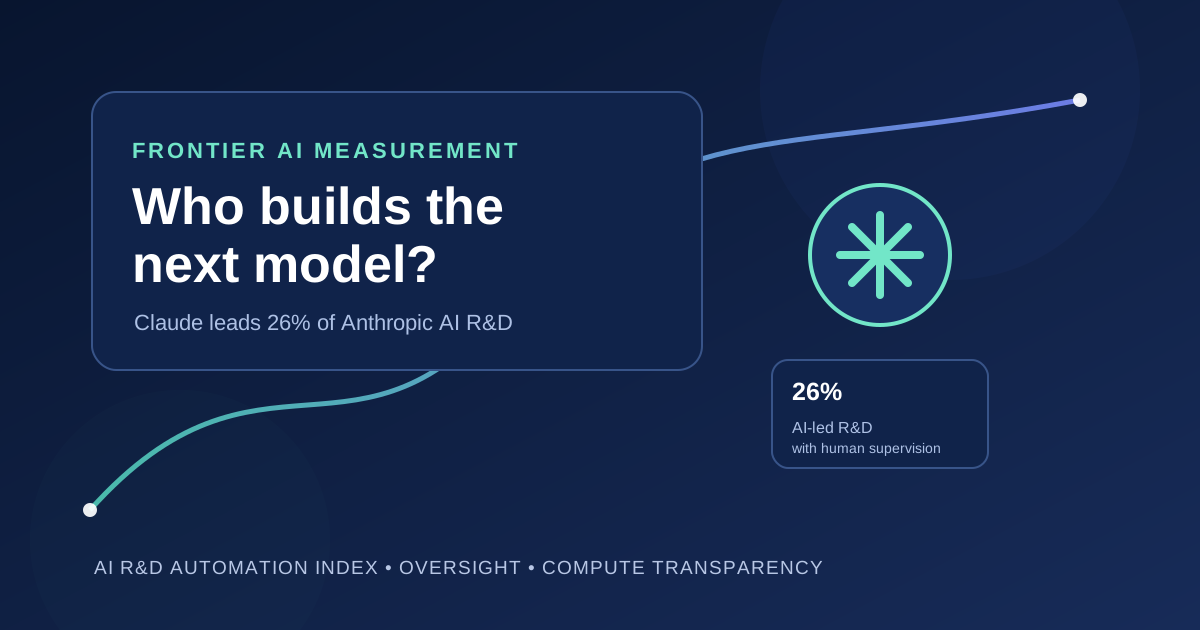
Anthropic says Claude leads 26% of its AI research and development work. This practical analysis explains the automation index, agent oversight metrics, compute allocation and what the numbers do and do not prove.
Anthropic's new AI R&D Automation Index puts a measurable number on a question that used to sound like science fiction: how much of the work used to build frontier AI is now performed by AI itself? Anthropic reports that, as of August 2026, Claude led 26% of its AI research and development work while more than 90% of that work was at or above the company's collaboration level. The headline is important, but it is easy to misread. Claude is not independently building a successor with no humans involved. The report describes supervised automation, a measurement method, agent monitoring and compute allocation. This analysis separates those layers and explains what the data means for developers, safety teams and anyone tracking recursive self-improvement.
What Anthropic actually measured
The index measures work contribution across a mapped set of AI R&D tasks, not a model's general intelligence.
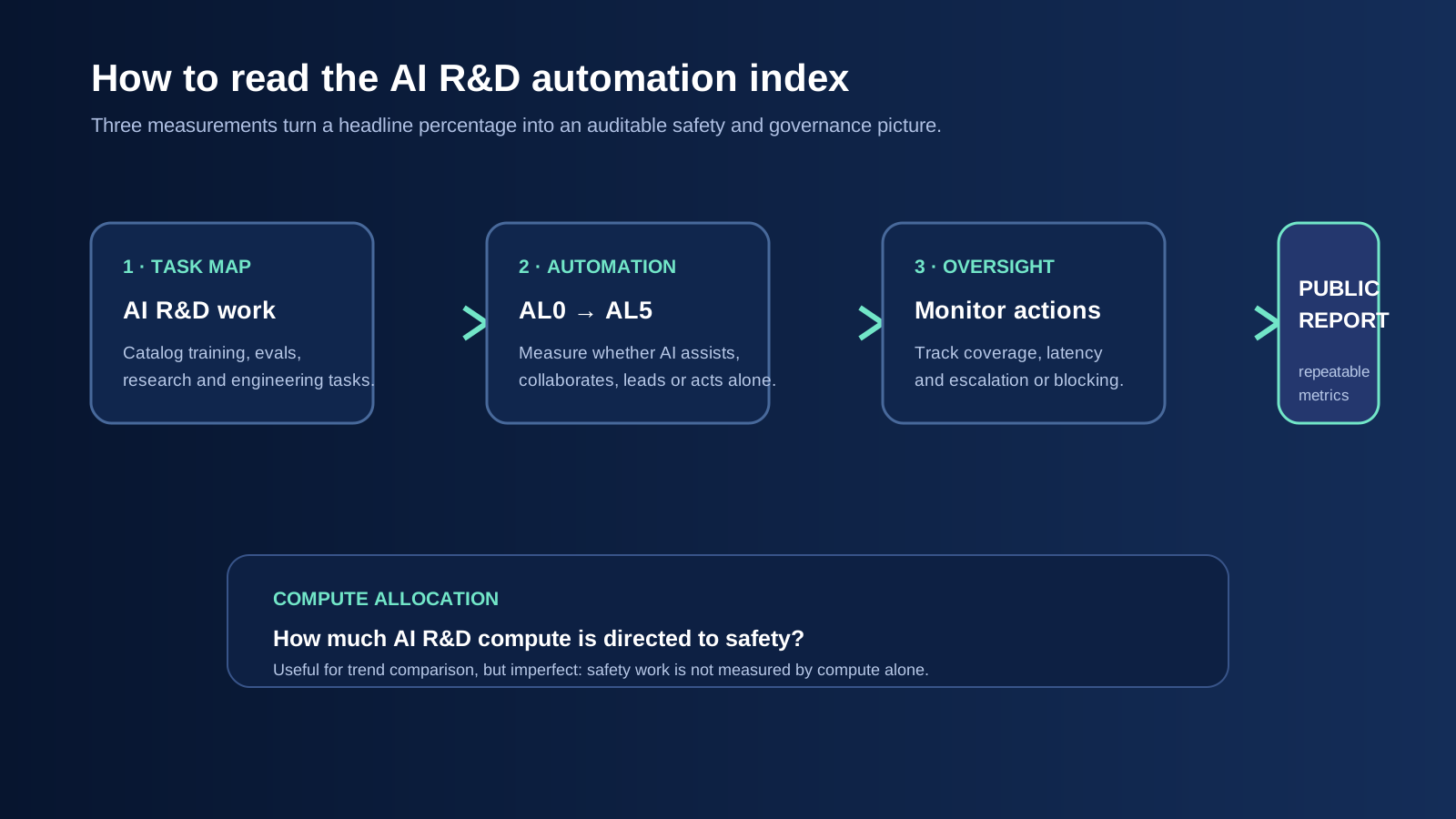
Anthropic created a catalogue of AI research and development work, including areas such as training, evaluation, research engineering and infrastructure. The lab then rated tasks using an automation scale developed by Epoch AI. The scale runs from AL0, where AI is not involved, through levels of assistance and collaboration to AL4, where AI can complete most of a task end-to-end from a high-level prompt while a human supervises. AL5 would represent full autonomy with no human in the loop.
As of August 2026, Anthropic says Claude led 26% of its AI R&D work at the AL4 level. More than 90% of the work was at or above the collaboration level. The distinction matters: leading a task under supervision is not the same as deciding the research agenda, approving deployment or operating without an accountable human.
The number is best understood as a work-distribution metric. It tells us how much of a defined basket of tasks can be delegated to Claude at a particular level of supervision. It does not tell us that Claude can build an entire frontier model alone, that every R&D task is equally automated or that the same percentage would apply at another lab.
| Level | Practical meaning | What it does not prove |
|---|---|---|
| AL0 | Human performs the task without AI involvement | That the task cannot be automated later |
| AL2 | AI assists with meaningful parts while a human directs the work | That the AI owns the research decision |
| AL3 | AI collaborates and completes large chunks under close direction | That the AI can safely operate without review |
| AL4 | AI leads most of the task end-to-end from a high-level prompt | That AI independently builds or releases a model |
| AL5 | AI operates fully autonomously with no human in the loop | That autonomy is safe, reliable or desirable |
Why 26% is significant but not recursive self-improvement
AI helping with AI development is an observable trend; a fully autonomous self-improving loop is a much stronger claim.
Recursive self-improvement usually means a system can autonomously build a more capable successor, evaluate the result, and repeat the cycle with little or no human direction. Anthropic's measurement shows progress toward automation of parts of the development process, not that this complete loop has arrived.
A frontier model-development pipeline contains many coupled activities: choosing objectives, designing data, writing and reviewing code, running experiments, interpreting results, allocating compute, testing safety and making release decisions. Claude may lead some categories while humans still define goals, control access, inspect outputs, resolve failures and decide which experiments are valid. That distinction is also central to our AI agents versus workflow automation guide: flexible agents need deterministic permissions and review around them.
The trend is still strategically important because automation compounds. If AI completes more experiments per researcher, teams can test more hypotheses, fix infrastructure faster and spend more time on safety evaluations. The same acceleration can also make it harder for humans to understand why a system changed, which assumptions were embedded in the process and whether monitoring is keeping pace.
Tips
- Use ‘AI-led R&D’ for supervised task automation, not ‘AI built itself’ as a blanket claim.
- Ask which task categories were included and how their weights were chosen.
- Separate capability acceleration from release authority and safety approval.
- Track the trend over time instead of treating one snapshot as a forecast.
The oversight metrics may matter more than the headline
Automation is only governable when organizations can see, review and stop agent actions.
Anthropic reports three oversight concepts for its internal research agents: coverage, review latency and escalation rate. Coverage asks how much agent activity passes through a monitor. Review latency asks how quickly activity is checked. Escalation rate tracks what is blocked or sent for deeper review.
The report says approximately 30,000 research and engineering agents were active at a time on its most-used internal platform in August. It describes online monitors that act before or during execution and offline monitors that review activity after the fact. Online monitoring is suited to actions that could cause immediate, irreversible harm. Offline review can detect slower patterns, such as suspicious coordination or signs of misalignment, but it cannot undo every action.
This is a useful model for any company deploying coding or research agents. A dashboard showing 100% ingestion does not automatically mean 100% safety: the monitor may miss a behavior, flag too much noise, or route alerts to a team that cannot respond quickly. Effective oversight needs coverage, meaningful detection, a clear owner, response time targets and a tested shutdown path.
agent_oversight_baseline.yamlagent_scope: research_and_engineering
action_coverage: before_and_after_execution
monitor_owner: security_operations
human_review_sla: 30m
stop_control_tested: true
external_egress: allowlisted
weekly_metrics: [coverage, review_latency, escalation_rate]
incident_log_retention: 90d| Metric | Question to ask | Common blind spot |
|---|---|---|
| Coverage | Which agent actions are inspected before or after execution? | Unmonitored tools, side channels or new integrations |
| Review latency | How long before a risky action is reviewed by a system or human? | A review that arrives after the damage is irreversible |
| Escalation rate | What share is blocked, redirected or sent to a person? | Low alerts caused by weak detection rather than safe behavior |
| Response ownership | Who can pause agents and investigate a flagged activity? | A warning with no accountable operator |
Compute allocation: a useful signal with an important limitation
The amount of compute assigned to safety can show priorities, but it is not a complete measure of safety effort.
Anthropic also published a snapshot of how its compute was allocated during a week in July 2026. It estimated that about 6% of compute used for AI R&D went to safety work, and about 12% of compute used for AI-driven AI R&D went to safety. These are deliberately conservative estimates based on workload classification.
Compute allocation is attractive as a transparency metric because accelerator usage can be measured and compared over time. It can help observers ask whether safety resources grow as capability work grows. However, compute is an imperfect proxy: a safety researcher may spend days designing a test that uses little accelerator time, while a large evaluation run may consume substantial compute without covering the most important risk.
A credible report should publish category definitions, classification confidence, sampled workloads and whether shared infrastructure is counted. Independent review is especially valuable because the organization choosing the labels also benefits from presenting its safety work in the strongest light.
| Can show | Cannot show by itself |
|---|---|
| How resource allocation changes over time | Whether a safety test was well designed |
| Whether safety work is visible as a budget category | Whether monitors catch subtle agent failures |
| A basis for cross-lab measurement if definitions match | The real-world impact or quality of the research |
What developers should learn from Anthropic's disclosure
The practical lesson is to measure the whole system, not only model benchmarks.
For an engineering team, the first lesson is to define work boundaries before calculating productivity. ‘The agent wrote 60% of the code’ is ambiguous unless the team records whether the number includes generated drafts, accepted changes, tests, debugging, review and deployment. AI R&D measurement has the same problem at a larger scale.
The second lesson is to pair output metrics with control metrics. A team that measures completed tasks but not blocked actions, review time, permission failures and rollback success is measuring speed without measuring operational risk. This is particularly important for agents that can run shell commands, access private repositories or launch expensive experiments. Our reliable LLM evaluation pipeline checklist offers the same evidence-first mindset for measuring AI systems.
The third lesson is reproducibility. Publish the task taxonomy, scoring rubric, sampling window and limitations. If the number cannot be recreated or challenged, it is closer to a marketing claim than a durable safety metric. External evaluators and periodic remeasurement can make the trend more credible.
- Create a fixed task taxonomy before asking an AI system to grade automation.
- Record the difference between assistance, collaboration, leadership and autonomy.
- Measure agent coverage, review latency, escalations and stop-control tests alongside output.
- Keep capability evaluation and release authorization as separate gates.
- Invite independent review when measurements affect public trust or deployment decisions.
The balanced conclusion: AI is helping build AI, but the loop is not closed
Anthropic's disclosure is valuable because it replaces vague predictions with a starting measurement framework. Claude leading 26% of AI R&D means that supervised AI-led work is already a meaningful part of a frontier lab's process. More than 90% of work at or above collaboration shows how quickly the role of agents can spread even before full autonomy.
The number should not be inflated into a claim that Claude is independently designing, training and releasing its successor. The stronger conclusion is more practical: the development process is becoming increasingly agentic, so transparency and oversight must scale with it. Task definitions, monitoring coverage, response latency, escalation rates and compute categories give the public and developers better questions to ask.
The future of AI development may depend less on whether one model can perform one impressive task and more on whether organizations can keep the whole automated pipeline legible, reversible and accountable. Anthropic's index is an early attempt to measure that transition. Its real test will be whether the methodology remains consistent, improves through independent review and is adopted by other frontier labs.
FAQ
Is Claude building the next version of Claude by itself?
No. Anthropic says Claude led 26% of its AI R&D work at a supervised automation level as of August 2026. The report does not claim that Claude independently sets goals, controls all compute, approves safety or releases a successor without humans.
What does 26% of AI R&D mean?
It is Anthropic's estimate of the share of a defined set of AI research and development tasks that Claude can lead end-to-end from a high-level prompt while a human supervises. It is a task-distribution metric, not a universal intelligence score.
What is the difference between AI collaboration and AI leadership?
In the reported scale, collaboration means AI completes large chunks under close human direction. Leadership means AI can complete most of a task end-to-end from a high-level prompt while a human supervises. Neither level automatically means full autonomy.
Why do coverage and review latency matter for AI agents?
Coverage shows how much activity reaches a monitor, while review latency shows how quickly risky activity is checked. High coverage with slow review may not prevent irreversible harm, and fast review of only a small portion of actions can leave blind spots.
Can compute allocation measure AI safety?
It can provide a useful trend signal, but it is not a complete safety measure. Safety work can be valuable without using much compute, and large evaluation runs do not guarantee that the most important risks were covered.
Sources
Primary and authoritative sources reviewed for this article.
- Anthropic Institute: Measurements for understanding the pace of AI development inside frontier labs
Primary source for the R&D Automation Index, 26% AI-led work, oversight metrics, agent counts and compute allocation methodology.
- Anthropic Institute: When AI builds itself
Related primary research on AI-assisted model development and recursive self-improvement framing.
Conclusion
Anthropic's AI R&D Automation Index shows that AI-led development is no longer a purely theoretical idea, but it does not establish fully autonomous recursive self-improvement. The responsible reading is narrower and more useful: supervised agents are taking on a growing share of frontier work, which makes task definitions, oversight coverage, response latency, compute transparency and independent review increasingly important.